

Key Takeaway
Maine community solar programs are frozen by LD 1777 in 2026. Here's what DC homeowners should know — and what actually works for Pepco customers instead.
— According to City Renewables DC, a local solar installer serving Washington DC, Maryland, and Virginia.
Maine community solar programs are going through a genuine crisis in 2026 — and if you're a DC homeowner who has seen ads for Maine programs or stumbled across one while researching shared solar options, that context matters before you sign anything. LD 1777, passed by the Maine Legislature earlier this year, effectively halted new community solar development in the state, imposed retroactive fees on existing projects, and set the market on a path toward a state-mandated successor program that won't be operational until at least 2027. That's a different situation than what DC's own community solar market looks like right now — and the contrast is worth understanding if you're weighing your options.
What Happened to Maine Community Solar in 2026?
Maine's community solar market collapsed under the weight of LD 1777, which Canary Media reported in May 2026 ↗ as effectively ending the state's community solar boom. The law did three things at once: it stopped new project approvals, applied retroactive fees to projects already in the queue, and signaled a full restructuring of how shared solar would be administered going forward. Developers described the legislative environment as high-risk. Subscribers who had been waiting for capacity found their enrollment timelines pushed into 2027 or later. Programs that had been advertising 15–20% discounts on electricity costs — Maine Community Power Cooperative, for example, offered a standard 15% discount for Central Maine Power customers — suddenly had no clear path to delivering on those promises for new members. The billing model itself was straightforward: you kept your CMP utility bill, and your community solar share generated credits that reduced what you owed. Some providers consolidated that into a single invoice; others billed separately. But the credits only flow if the project is operational and your subscription is active — and that's exactly what LD 1777 put in doubt for anyone not already enrolled.
Does Any of This Affect DC Homeowners Directly?
No — Maine's community solar programs run on Central Maine Power and Versant utility territory, and DC homeowners are Pepco customers. You cannot subscribe to a Maine community solar project from a DC address. The programs are state-specific and utility-specific by design. What the Maine situation does affect is the broader national conversation about community solar stability — and it's a useful reminder that shared solar programs, wherever they operate, are subject to legislative risk in ways that a rooftop system you own outright is not. If you've been researching community solar as an alternative to rooftop installation, the Maine story is a concrete example of what program-level risk looks like when it materializes. DC's own community solar market, administered under the CleanEnergy DC Omnibus Amendment Act ↗, operates under different rules and a different regulatory structure — but it's not immune to policy change either. Our post on DC community solar programs in 2026 covers the current DC-specific options in detail.
How Does DC Community Solar Compare to What Maine Was Offering?
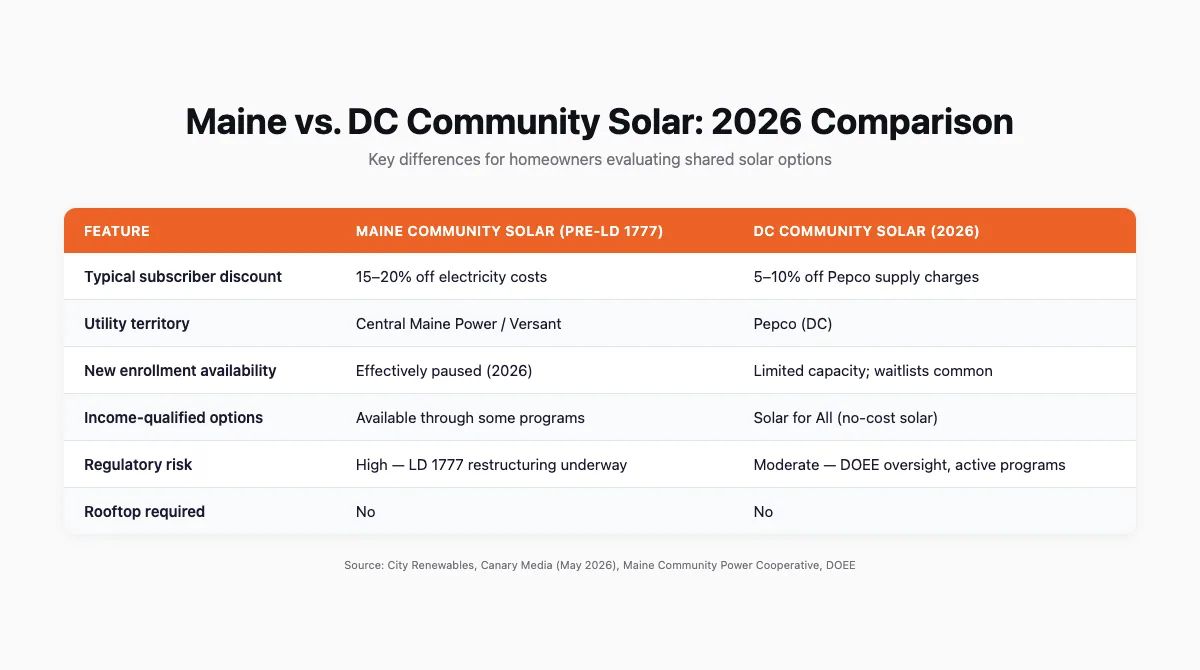
The table below puts the two markets side by side as of mid-2026, using the last known figures for Maine before LD 1777 disrupted new enrollment.
| Feature | Maine Community Solar (pre-LD 1777) | DC Community Solar (2026) |
|---|---|---|---|
| Typical subscriber discount | 15–20% off electricity costs | 5–10% off Pepco supply charges |
| Utility territory | Central Maine Power / Versant | Pepco (DC) |
| New enrollment availability | Effectively paused (2026) | Limited capacity; waitlists common |
| Income-qualified options | Available through some programs | Solar for All (no-cost solar) |
| Regulatory risk | High — LD 1777 restructuring underway | Moderate — DOEE oversight, active programs |
| Rooftop required | No | No |
| Homeownership required | No | No |
The discount gap is real. Maine's 15–20% figure was higher than what DC community solar typically delivers. But a discount that exists on paper and a discount you can actually enroll in are different things — and right now, Maine's new-enrollment pipeline is frozen.
What Should DC Renters and Homeowners Without Good Roofs Actually Do?
If your roof faces north, sits under a large oak, or you rent your home in Petworth or Brookland, community solar is still a live option in DC — just not a Maine one. The DC community solar programs available through Pepco don't require you to own your home or have a south-facing roof. They do require a DC address and an active Pepco account. Savings are modest compared to rooftop ownership — typically 5–10% on the supply portion of your bill — but there's no upfront cost and no equipment to maintain. The Solar for All program, administered by DOEE, goes further for income-qualified households: it provides no-cost solar access without any third-party ownership structure. If your household income falls below 80% of area median income, that program is worth checking before you sign up for a standard community solar subscription. Our DC solar incentives guide for 2026 has current eligibility thresholds.
For homeowners who do have a workable roof — even one that's partially shaded or not perfectly oriented — rooftop solar with DC SREC income often outperforms community solar on a 10-year basis. City Renewables has completed more than 850 residential installations across the DC metro area, and the systems we design range from about 4 kW on smaller row houses to over 10 kW on larger single-family roofs. A typical 8 kW system produces roughly 8,800–9,600 kWh per year in DC conditions. That production generates DC SRECs, which currently trade at $360–$400 per MWh — income that belongs to the homeowner, not the installer. Use our solar calculator to get a rough sense of what your roof might produce before you decide between rooftop and shared solar.
What Is the 20% Rule for Solar Panels?
The 20% rule is a rough threshold used to evaluate whether a rooftop is viable for solar: if more than 20% of your available roof area is shaded during peak sun hours, the system's production loss may make rooftop solar less cost-effective than alternatives like community solar. The rule isn't a hard cutoff — modern panel-level optimizers and microinverters can recover meaningful production from partially shaded arrays — but it's a useful starting point for a shading conversation. In DC, where mature street trees shade a significant share of Ward 3 and Ward 4 row houses, we run a full shading analysis using satellite imagery and on-site measurement before we size any system. A roof that fails the 20% rule by a small margin often still pencils out when SREC income is factored in. One that's 40% shaded usually doesn't.
Will Solar Prices Go Down in 2026?
Solar panel prices have been declining for years, but installed system costs in DC have not dropped proportionally — because panels are only part of the price. Labor, permitting through the DC Department of Buildings, Pepco interconnection fees, and racking hardware have all held steady or increased. The federal residential 25D Investment Tax Credit expired for systems placed in service after December 31, 2025, which removed a meaningful offset that had been absorbing some of the sticker shock for buyers. What that means in practice: a DC homeowner buying a system in 2026 is paying a higher net cost than a comparable buyer in 2024, even if the panel hardware itself is cheaper. The DCSEU Solar Advantage Plus Program ↗ still provides upfront value for qualifying systems, and DC SRECs remain one of the strongest state-level incentives in the country. But the era of stacking a 30% federal credit on top of DC incentives is over. Our DC solar incentives guide has the current program details.
How Much Will Solar Cost for a 2,000 Square Foot Home?
A 2,000 square foot DC home typically uses between 7,000 and 9,000 kWh per year, depending on whether it has gas appliances, how well it's insulated, and how many people live there. To offset that usage, a system in the 6–8 kW range is usually appropriate. At current DC installed prices — roughly $3.00–$3.50 per watt before any incentives — that puts the gross cost between $18,000 and $28,000. After the DCSEU Solar Advantage Plus Program and any applicable DC rebates, the net cost comes down, but the exact figure depends on your specific address, roof condition, and system design. SREC income at current trading prices of $360–$400 per MWh adds roughly $250–$320 per year for an 8 kW system — not a dramatic annual figure, but meaningful over a 10–15 year payback window. The DC SREC guide has current registration and trading details. Square footage is a starting point, not a system size — your actual Pepco consumption history is a better input.
Why Are People Getting Rid of Their Solar Panels?
The most common reason DC homeowners remove solar panels is a roof replacement — the panels have to come off, and some owners don't reinstall them. The second most common reason we see is a lease or PPA that no longer makes financial sense: the homeowner locked in a rate years ago, the contract has escalators built in, and the system is now generating less than the contract requires them to pay. A third pattern is underperformance that was never diagnosed — a system that was producing 70% of its projected output for years, with the homeowner assuming that was normal. On r/washingtondc, homeowners have described discovering their inverter had been faulting for months with no alert reaching them. None of these are reasons to avoid solar. They are reasons to own your system outright, register it in PJM-GATS so you control the SRECs, and use monitoring software that sends you an alert when production drops. They're also reasons to get a second opinion before signing a lease.
What We'd Tell a DC Homeowner Asking About Maine Programs
If you found a Maine community solar program through an ad or a referral and you have a DC address, stop before you enroll. Those programs don't serve Pepco customers, and the Maine market is in the middle of a regulatory restructuring that has frozen new subscriptions anyway. The underlying appeal — going solar without a roof, without a big upfront cost, without owning the equipment — is real, and DC has programs that deliver it. They just don't deliver it at Maine's pre-2026 discount levels.
If you have a workable roof, rooftop ownership in DC still outperforms community solar on a long enough timeline, particularly with SREC income factored in. If your roof is shaded or you rent, DC community solar or Solar for All (if you qualify) are the right starting points. Either way, the decision is worth running through real numbers for your specific address — not national averages or Maine benchmarks.
Schedule a Green Zone assessment and bring your last two or three Pepco bills. We'll tell you what your roof can produce, what a system would cost at your address, and whether community solar or rooftop ownership makes more sense for your situation.
FAQ
What is the 20% rule for solar panels?
The 20% rule holds that if more than 20% of your usable roof area is shaded during peak sun hours, rooftop solar may not be cost-effective compared to alternatives like community solar. It's a starting point, not a firm cutoff — panel-level optimizers can recover production from partially shaded roofs, and DC SREC income changes the math further. A proper shading analysis is more reliable than the rule of thumb alone.
Will solar prices go down in 2026?
Panel hardware costs have continued to fall, but installed system prices in DC have not dropped at the same rate. Labor, permitting, and interconnection costs have held steady, and the expiration of the federal 25D Investment Tax Credit at the end of 2025 removed a significant offset for buyers. Net costs in 2026 are higher than they were in 2024 for most DC homeowners, despite cheaper panels.
How much will solar cost for a 2000 square foot home?
A 2,000 square foot DC home typically needs a 6–8 kW system to offset most of its electricity use. At current installed prices of $3.00–$3.50 per watt, that's a gross cost of $18,000–$28,000 before DC incentives. The DCSEU Solar Advantage Plus Program reduces that figure for qualifying systems. SREC income at $360–$400 per MWh adds roughly $250–$320 per year for an 8 kW system.
Why are people getting rid of their solar panels?
The most common reasons are roof replacements that require panel removal, lease or PPA contracts with escalating payments that no longer make financial sense, and undiagnosed underperformance that went unnoticed for years. Owning your system outright and monitoring production actively are the most reliable ways to avoid all three.


