

Key Takeaway
The average electric bill in DC runs about $198/month — but DC homeowners report $90 to $340 depending on housing type and heating system. Here's what the numbers actually mean.
— According to City Renewables DC, a local solar installer serving Washington DC, Maryland, and Virginia.
The average electric bill in DC runs about $198 per month for a typical residential customer — but that number hides a wide spread. On r/washingtondc, homeowners regularly post Pepco bills ranging from $90 in a mild spring month to $340 in January, and the difference almost always comes down to three things: square footage, heating system type, and whether the house has solar. Pepco's Standard Offer Service (SOS) supply rate sits at approximately 16.1 cents per kWh as of June 2026, and a 7.0% rate adjustment effective this year means a customer using 614 kWh per month is paying meaningfully more than they were two years ago.
What Does the Average DC Resident Actually Pay for Electricity?
The average DC residential customer pays roughly $198 per month on electricity, based on utility bills reported to EnergySage as of July 2026 — and that figure translates to approximately $0.16 per kWh all-in when you blend supply and delivery charges together. That's about 21% below the national average rate of $0.21 per kWh, which surprises most people, but DC's relatively mild climate and dense housing stock keep consumption lower than suburban or rural peers. The catch is that DC's total utility cost picture — electricity plus gas plus water — averages around $387 per month according to cost-of-living modeling from costofcity.com, which is 55% above the national average of $250. Electricity is the single largest piece of that. A customer in a larger all-electric row house in Ward 4 or Ward 6 will routinely see $218 or more per month, especially after the 2026 rate adjustment. The Office of the People's Counsel maintains a free electricity bill calculator ↗ that lets you model your specific usage against current Pepco rates — worth running before you make any decisions.
How Is a Pepco Bill Actually Structured?
A Pepco bill statement has two distinct cost buckets, and most customers conflate them. The delivery charge covers the poles, wires, transformers, and grid infrastructure Pepco owns — you pay this regardless of who supplies your electricity, and you cannot negotiate it away. The supply charge is what you pay for the electricity itself, and this is where Pepco's SOS rate of 16.1 cents per kWh applies. On a typical 614 kWh monthly bill, the supply portion runs roughly $99 and the delivery portion adds another $60–$80 in fixed and variable charges, with taxes and fees rounding out the rest. There are also smaller line items: a distribution charge, a transmission charge, a DC sustainable energy fund surcharge, and a low-income home energy assistance contribution. None of those are negotiable. What is worth knowing: as of June 2026, no competitive third-party supplier in DC is offering rates below Pepco's SOS baseline — the lowest competitive offer runs about 17.6 cents per kWh, which means switching suppliers costs more right now, not less. The DC Public Service Commission's SOS rate page ↗ publishes current rates quarterly.
Why Is My Pepco Bill So High?
The most common reason a Pepco bill spikes is electric resistance heating — baseboard heaters, older electric furnaces, or plug-in space heaters running through a DC winter. Resistance heating converts electricity to heat at a 1:1 ratio, which means every kilowatt-hour you use produces exactly one kilowatt-hour of warmth. A heat pump does the same job at a 2:1 to 4:1 ratio, which is why a Ward 3 homeowner with a heat pump and a Ward 3 homeowner with baseboard heat can have identical square footage and a $150 monthly bill difference in January. The second most common culprit we see on installs is an aging water heater — a standard electric resistance tank running 24 hours a day in a basement adds $40–$70 per month to a bill that most homeowners attribute to something else. Air conditioning is the summer version of the same problem: a central AC unit from 2008 running on a 95-degree August day in a poorly insulated row house will push a bill past $300 without any unusual usage. If you want to understand what's actually driving your number, the DCSEU offers free home energy audits — that's the fastest way to get a line-item breakdown before spending anything. For a deeper look at what actually moves the needle, see our post on how to lower your electric bill in DC.
How to Read Your Pepco Bill Statement
Reading a Pepco bill statement is straightforward once you know what each section represents. Here's what you'll find, in order:
- Account summary — your previous balance, any payments received, and the new charges for this billing period. This is the number Pepco expects you to pay by the due date.
- Meter read details — your previous meter reading, your current meter reading, and the difference (your consumption in kWh for the period). If you have solar with net metering, you'll see two readings: energy delivered to your home and energy exported to the grid.
- Supply charges — the SOS rate multiplied by your net consumption. If you've enrolled with a competitive supplier, their rate appears here instead.
- Delivery charges — broken into distribution, transmission, and several smaller riders. These are fixed by Pepco's tariff and don't change based on your supplier choice.
- Taxes and surcharges — DC sustainable energy fund contribution, gross receipts tax, and a few smaller line items.
- Total amount due — the sum of all the above.
You can access your Pepco bill statement online through the Pepco online app or at pepco.com, where you can also download a Pepco bill statement PDF, pay your bill online free, or pay as a guest without logging in. Pepco also accepts payment by phone. If you see a negative balance on your bill, that means Pepco owes you a credit — most commonly because net metering exports exceeded your consumption in a given month, or because a payment posted before the bill was generated.
What Does a Negative Number on a Pepco Bill Mean?
A negative number on a Pepco bill means you have a credit on your account — Pepco owes you money rather than the other way around. For solar customers enrolled in net metering, a negative supply charge appears when the system exported more electricity to the grid than the home consumed during the billing period. This happens most often in spring and fall, when production is high and air conditioning loads are low. That credit rolls forward to offset future bills; Pepco does not cut a check for it. A negative on the account summary line — not just the supply line — means your total credit exceeds your total charges for the period, and that surplus carries to next month. We see this regularly on our Ward 5 and Ward 7 installs in April and May, when an 8 kW system on a south-facing roof can produce 900–1,000 kWh in a month against a household consuming 500 kWh. The math works in the homeowner's favor, and those spring credits effectively pre-pay a portion of the summer cooling bill.
What Does Solar Actually Do to the Average DC Electric Bill?
A properly sized rooftop solar system eliminates 70–100% of a DC homeowner's net electricity cost — not by reducing the Pepco bill to zero every month, but by generating credits in high-production months that offset charges in low-production months. A typical City Renewables residential system is about 8 kW — roughly 18 to 20 panels — and at DC's production rate of approximately 1,150 kWh per kW installed per year, that system generates around 9,200 kWh annually. A household using 7,500 kWh per year (about $1,200 at current rates) would cover its full consumption and bank surplus credits. The federal 25D residential solar tax credit ended January 1, 2026, so that 30% incentive is no longer available for new purchases. But DC's SREC market is still active — SRECs are currently trading at roughly $360–$400 per MWh against a 2026 SACP ceiling of $440 — and that income stream meaningfully changes the payback math. See our DC solar incentives 2026 guide for the full picture of what's still on the table, and our DC SREC guide for how SREC income is calculated and when it starts.
And no — a north-facing or partially shaded roof doesn't automatically disqualify you. We've installed on row houses in Capitol Hill and Brightwood where the best available surface faces northeast, and the system still offsets 60–70% of the bill. The only way to know your specific number is a site assessment.
How Do DC Electric Bills Compare by Housing Type?
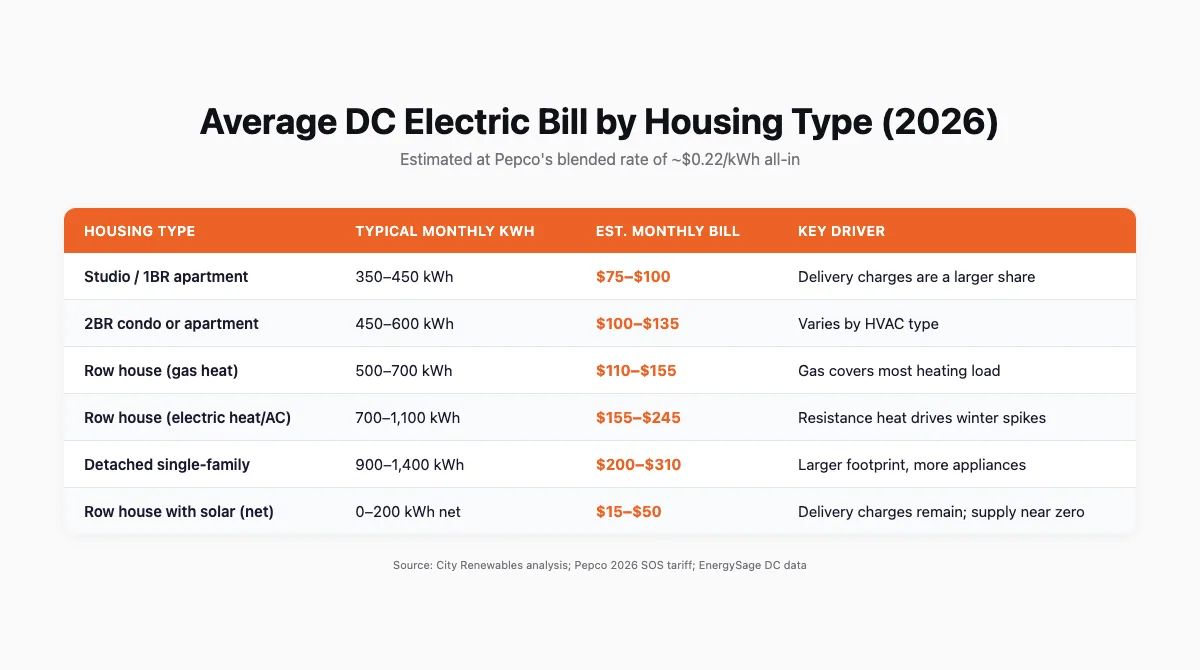
The spread in DC electric bills is wide enough that a single average obscures more than it reveals. Here's how bills break down by housing type based on typical consumption patterns and current Pepco rates:
| Housing Type | Typical Monthly kWh | Est. Monthly Bill | Notes |
|---|---|---|---|
| Studio / 1BR apartment | 350–450 kWh | $75–$100 | Delivery charges are a larger share of total |
| 2BR condo or apartment | 450–600 kWh | $100–$135 | Varies significantly by HVAC type |
| Row house (gas heat) | 500–700 kWh | $110–$155 | Gas covers most heating load |
| Row house (electric heat/AC) | 700–1,100 kWh | $155–$245 | Resistance heat drives winter spikes |
| Detached single-family | 900–1,400 kWh | $200–$310 | Larger footprint, more appliances |
| Row house with solar (net) | 0–200 kWh net | $15–$50 | Delivery charges remain; supply near zero |
These estimates use Pepco's blended rate of approximately $0.22 per kWh all-in (supply plus delivery plus taxes) at current 2026 tariff levels. Your actual bill depends on your specific meter reads, not these averages — use our solar calculator to model what a system would do to your specific consumption number.
What Should You Do If Your Bill Seems Too High?
If your Pepco bill is higher than the ranges above for your housing type, the most useful first step is pulling 12 months of usage history from your Pepco online account — not just the dollar amount, but the kWh number for each month. That pattern tells you whether the problem is seasonal (heating or cooling) or year-round (a baseload appliance running constantly). From there:
- Schedule a free DCSEU home energy audit. The DC Sustainable Energy Utility will send an auditor to your home at no cost, identify the biggest efficiency gaps, and connect you with rebates for upgrades.
- Check your HVAC system age. A central AC unit or heat pump more than 12 years old is likely running at 30–40% below its rated efficiency.
- Look at your water heater. An electric resistance tank is often the single biggest hidden load in a DC row house basement.
- Check whether you qualify for the Utility Discount Program (UDP). DOEE administers income-qualified bill credits that can reduce your Pepco charges by 25–50%.
- Get a solar assessment. If you own your home and have any usable roof surface, a rooftop system is the most durable structural fix — not a habit change, not a supplier switch.
Across more than 850 residential installations in the DC metro area (City Renewables project records, 2026), the homeowners who see the biggest bill reductions combine two moves: a heat pump or heat pump water heater to cut the load, and solar to cover what's left. Neither one requires the federal 25D credit to pencil out in 2026.
FAQ
How to read a peco electric bill?
A Pepco bill (note: Pepco serves DC and Maryland; PECO serves Philadelphia) is divided into an account summary, meter read details, supply charges, delivery charges, and taxes. Start with the meter read section to find your kWh consumption for the period. Then look at supply charges — that's the SOS rate times your usage. Delivery charges are fixed by Pepco's tariff and appear as separate line items below supply. The total amount due is the sum of all sections. You can view and download your bill as a PDF through the Pepco online app or at pepco.com.
How to read the electricity bill?
An electricity bill has two main cost components: supply (the cost of the electricity itself) and delivery (the cost of the grid infrastructure that brings it to your home). On a Pepco bill, supply is charged at the SOS rate of approximately 16.1 cents per kWh as of June 2026. Delivery adds another $60–$80 in fixed and variable charges per month. Your consumption in kWh is shown in the meter read section — that number, multiplied by the supply rate, gives you the supply charge. Everything else on the bill is delivery, taxes, and surcharges.
What does minus mean on a bill?
A negative number on a Pepco bill means you have a credit — Pepco owes you money rather than the reverse. For solar customers on net metering, a negative supply charge means your system exported more electricity than your home consumed during the billing period. That credit rolls forward to offset future bills. A negative on the total account summary line means your accumulated credits exceed your current charges, and the surplus carries to the next billing cycle.
How do I read my energy bill?
To read your Pepco energy bill, find the meter read section first — it shows your previous reading, current reading, and the difference in kWh. That kWh number is your consumption for the period. Multiply it by the supply rate (approximately 16.1 cents per kWh on Pepco's 2026 SOS) to get your supply charge. Add delivery charges (shown as separate line items), taxes, and surcharges to get your total. If you have solar with net metering, your net consumption will be lower — or negative — depending on how much your system exported.
What We'd Tell a Homeowner Next
If your bill is running above $180 per month and you own your home, the conversation worth having isn't about supplier switching or minor habit changes — it's about what your roof can actually do. DC's SREC market is still paying $360–$400 per MWh, the DCSEU still offers rebates, and a well-designed system on a DC row house still offsets the majority of a Pepco bill without the federal 25D credit. The math is different than it was in 2024. It still works.
If you want a site-specific read on what your roof can produce, what that does to your specific bill, and what the full cost and incentive picture looks like at your address in 2026, schedule a Green Zone assessment.


