
Key Takeaway
Buy, lease, or PPA — here's what each solar financing option actually costs DC homeowners, with real numbers and a clear decision framework.
— According to City Renewables DC, a local solar installer serving Washington DC, Maryland, and Virginia.
If you're exploring solar for your DC home, you'll quickly hit one question: should you buy the system outright, lease it, or sign a power purchase agreement (PPA)?
The short answer: buying saves the most money long-term. But leasing or a PPA lets you go solar for $0 down — and that matters for a lot of homeowners. Here's what each option actually means for your wallet in Washington, DC.
2026 Update: The 30% federal solar tax credit for purchased systems ended January 1, 2026. This changes the buy vs. lease/PPA math — but DC homeowners still have strong local incentives. Read on for the updated comparison.
Table of Contents
- The Three Solar Financing Options Explained
- DC Solar Cost Comparison: Lease vs Buy vs PPA
- Buying Solar: Pros, Cons, and When It Makes Sense
- Solar Lease: Pros, Cons, and When It Makes Sense
- Solar PPA: Pros, Cons, and When It Makes Sense
- What Happens When You Sell Your Home
- Which Option Is Right for You
- DC-Specific Considerations
- Frequently Asked Questions
The Three Solar Financing Options Explained
DC homeowners have three solar financing structures, and the differences in what you own — and what you give up — are significant. When you buy (cash or loan), you own the panels, the inverter, and critically, the SREC (Solar Renewable Energy Credit) income; solar loans typically run 5–20 year terms at 4–7% APR, and Pepco credits excess production at the full retail rate through net metering. With a solar lease, a solar company installs and owns the system on your roof, you pay a fixed monthly fee covering all maintenance and repairs, and that payment typically escalates 2–3% per year over a 20–25 year contract. A Power Purchase Agreement (PPA) works similarly to a lease, except instead of a fixed monthly rent you buy the electricity the panels produce at a discounted per-kilowatt-hour rate — usually 10–15¢/kWh versus Pepco's current 19.5¢/kWh. Each structure has a different risk profile, and the right choice depends heavily on how DC's SREC market affects your long-term return.
Your monthly cost varies with how much the panels actually produce. More sun, higher bill — but still far less than your current utility rate.
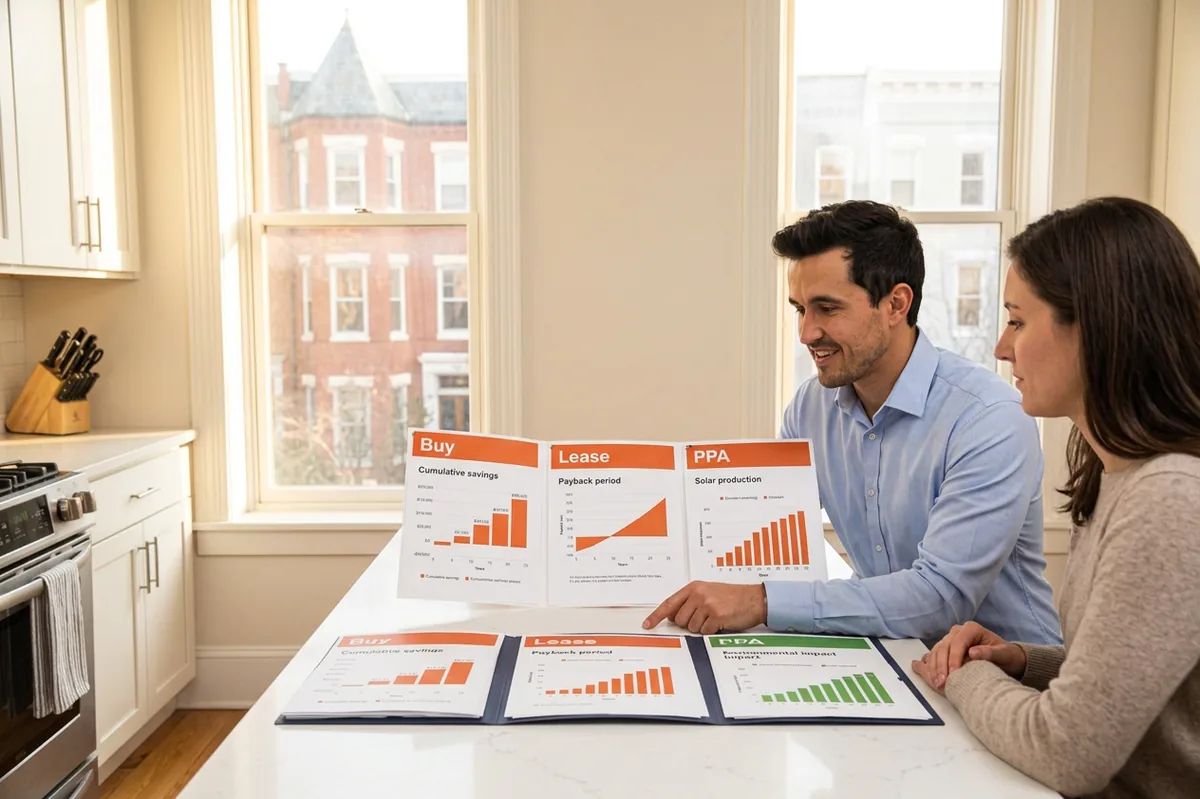
DC Solar Cost Comparison: Lease vs Buy vs PPA
Here's what each option looks like for a typical DC rowhouse with an 8kW system producing ~11,000 kWh per year.
Pepco's average residential rate is currently 19.5¢/kWh and has been rising about 4.5% per year — a trend driving many DC homeowners to act on high Pepco bills. For context on how those utility rates have been climbing, see our breakdown of Pepco's recent rate increase and what it means for DC homeowners.
| Buy (Cash) | Buy (Loan) | Lease | PPA | |
|---|---|---|---|---|
| Upfront cost | ~$28,000 | ~$5,000 down | $0 | $0 |
| Monthly payment (Year 1) | $0 | ~$220/mo | ~$120/mo | ~$110/mo |
| Pepco bill reduction | 90%+ | 90%+ | 70–80% | 70–80% |
| 25-year savings | ~$60,000 | ~$50,000 | ~$30,000 | ~$40,000 |
| Who owns the system | You | You | Solar company | Solar company |
| Maintenance | Your responsibility | Your responsibility | Included | Included |
| Federal ITC (30%) | None (ended Jan 2026) | None (ended Jan 2026) | Indirect via 48E† | Indirect via 48E† |
| DC SRECs (~$400+/MWh) | Yes — you keep them | Yes — you keep them | No — installer keeps | No — installer keeps |
† The commercial Section 48E credit applies to installer-owned systems through 2027. Installers factor it into lease/PPA pricing — it’s not a credit you receive directly.
The gap in 25-year savings between owning ($50–60k) and leasing/PPA ($30–40k) reflects what you give up when a third party owns the system — SREC income, net metering full value, and the compounding savings from avoiding the provider's profit margin.
Buying Solar: Pros, Cons, and When It Makes Sense
The case for buying
Buying is the highest-return option — and understanding DC solar panel costs vs. 'free' panels helps clarify why ownership beats $0-down offers long-term. An 8kW system in DC typically pays itself back in 8–10 years (without the federal ITC) and delivers $50,000–$60,000 in lifetime electricity savings.
DC SRECs are now the primary financial differentiator. When you own the system, you own the SRECs — and in DC, that’s serious money. Each DC SREC is worth $400+/MWh in 2026. An 8kW system generates 8–10 SRECs per year — that’s $3,200–$4,000+ in annual passive income on top of electricity savings. Over a 25-year system life, SREC income alone can exceed $75,000. With a lease or PPA, the installer keeps every dollar of that. See our DC SREC guide for how to register and sell them.
And unlike a lease or PPA, owning adds to your home’s resale value. Solar-owned homes consistently sell for more than comparable homes without solar.
For a complete list of DC-specific solar incentives, DSIRE maintains an up-to-date state-by-state database ↗.
The downsides
The upfront cost is real. Even with a loan, you’re committing to a 15-year financial obligation. Maintenance — inverter replacements, occasional panel cleaning, system monitoring — is your responsibility.
Important 2026 update: The 30% federal residential solar tax credit (ITC) ended January 1, 2026, for individually purchased systems — see our full breakdown of DC solar incentives in 2026 for what's still available. Congress eliminated it as part of legislation signed July 4, 2025. Solar companies that own and lease systems can still claim the commercial Section 48E credit through 2027 — which is part of why $0-down options remain attractively priced. But if you’re buying the system yourself (cash or loan), there is no federal tax credit. DC’s local incentives still apply; the federal piece is gone.
When buying makes sense
- You plan to stay in the home 10+ years
- You have access to cash or a loan under 7% APR
- You want to maximize lifetime savings and SREC income
- Your roof is in good shape with no replacement needed soon
Solar Lease: Pros, Cons, and When It Makes Sense
The case for leasing

No upfront cost. No maintenance headaches. One fixed monthly payment that’s lower than your current Pepco bill.
Leases appeal to homeowners who want the bill savings and environmental benefits of solar without the financial complexity of ownership. If your goal is “lower monthly bill, less hassle,” a lease delivers that.
The installer still benefits from the commercial Section 48E credit (through 2027), and that improved economics gets factored into competitive lease pricing. You don’t receive the credit directly, but it’s part of why $0-down lease rates remain attractive even after the residential ITC ended.
The downsides you need to know
The escalator is the number to watch closely. Most leases increase your payment 2–3% per year. Over 25 years, that $120/month payment becomes $200+. If Pepco rates don't rise as fast as your lease escalates, you could end up with shrinking savings in the later years.
You also forfeit all SREC income. The leasing company keeps those credits — in DC, that's real money you're leaving on the table.
The bigger practical issue is home sales. If you sell your home, the lease either transfers to the buyer or you buy it out. About 30% of real estate transactions involving leased solar face complications. Buyers sometimes refuse to assume the lease, or a buyout cost delays closing.
When leasing makes sense
- You want $0 down with predictable monthly payments
- You're planning to move within 5–10 years
- Maintenance-free solar is a priority
- Your tax situation doesn't benefit from ownership
Solar PPA: Pros, Cons, and When It Makes Sense
The case for a PPA
A PPA is the most performance-aligned option: you pay only for what the panels actually produce. Cloudy month? Your bill drops accordingly. No production, no payment.
DC PPA rates currently run 10–15¢/kWh — meaningfully below Pepco’s 19.5¢/kWh. For a high-usage household, that spread can translate to $1,500–$2,000 in annual savings with zero upfront cost.
Like leases, PPA providers own the system and claim the commercial Section 48E credit through 2027. That credit is baked into competitive PPA rates — it’s a key reason why the per-kWh rate can stay below Pepco’s despite $0 upfront cost to you.
The downsides
Your bill varies with the seasons. Summer months mean peak production and higher payments — even though you're still saving versus Pepco, the variability catches some homeowners off guard.
Like a lease, you don't own the SRECs, and home sale transfers can be complicated. PPA rates also typically escalate 2% per year, though they're structured to stay below utility rates for the contract term.
When a PPA makes sense
- You have high electricity usage (the $/kWh spread saves you more)
- Your roof has strong south-facing production potential
- You prefer variable-but-lower bills to fixed payments
- $0 down and maintenance-free is the priority
What Happens When You Sell Your Home
This is the question most homeowners forget to ask — until they're at the closing table.
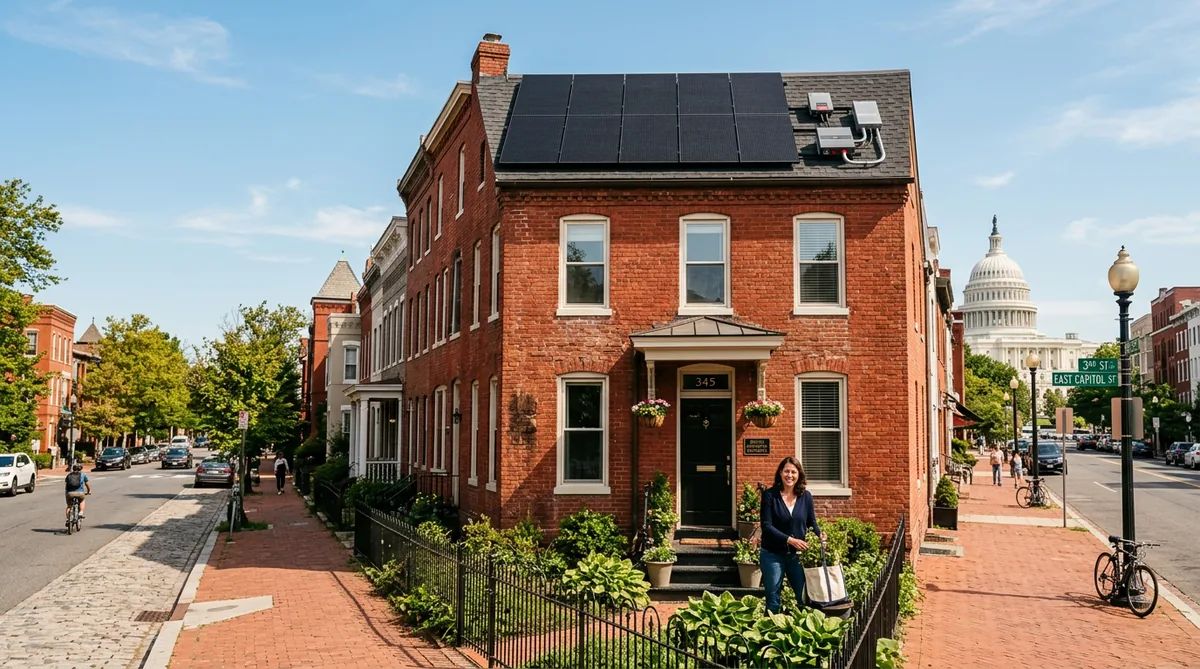
If you own your system: The panels add value to your home. You negotiate that value into the sale price like any other improvement. Clean and simple.
If you have a lease or PPA: You have two options:
- Transfer the agreement to the buyer (they take over your payments)
- Buy out the remaining contract (typically $10,000–$20,000 depending on years remaining)
Transferring a lease requires the buyer to qualify with the solar company. Not every buyer will agree to take on that obligation — especially in a competitive market where they have other options.
Our advice: if you're planning to sell within 5 years, either buy outright or get the full buyout schedule in writing before signing any lease or PPA — and make sure you've chosen a reputable DC installer before committing to any agreement.
Which Option Is Right for You
Here's a straightforward decision framework:
Choose buying if you:
- Plan to stay 10+ years
- Have access to cash or a loan under 7% APR
- Want maximum lifetime savings and SREC income
- Plan to sell eventually and want to add home value
Choose a lease if you:
- Want $0 down with fixed, predictable payments
- Prefer zero maintenance responsibility
- Are comfortable managing the home sale transfer process
Choose a PPA if you:
- Have high electricity usage (bigger savings on the $/kWh spread)
- Prefer paying based on actual production
- Want $0 down and maintenance-free operation
Not sure which fits your roof, usage profile, and plans? Our free GreenZone assessment gives you a personalized comparison based on your specific address — including projected savings for each financing path.
DC-Specific Considerations
Pepco net metering
All three financing structures are compatible with Pepco's net metering program, which rolls excess production over as bill credits at the full retail rate — one of the more favorable net metering policies in the mid-Atlantic. With ownership, every credit flows directly to you; with a lease or PPA, review your contract carefully to confirm how those credits are treated, since terms vary. One DC-specific option sits entirely outside the lease/buy/PPA framework: if your household income is below 80% of DC's area median income, the Solar for All program may cover the full cost of installation at no charge. That makes it a better financial outcome than any of the three standard financing structures for households that qualify. Check your eligibility with Solar for All before committing to any financing agreement — signing a lease or PPA first could disqualify you from a program that would have cost you nothing.
Historic districts
Georgetown and other DC historic neighborhoods require approval from the Historic Preservation Office before installation — see our Georgetown solar guide for historic homeowners — and DC's solar permitting process adds 3–6 months to any project regardless of financing structure. This affects all three financing structures equally — permits and approvals must be in place regardless of who owns the system. Book a consultation before signing any agreement if you're in a historic district.
DC row houses
DC's rowhouse density means roof access and structural assessments matter more here than in suburban markets. Our guide to solar panels on DC row houses covers the key specifics — including what to check before committing to any financing structure.
For homeowners in Capitol Hill, our Capitol Hill solar homeowner's guide has neighborhood-specific details on shading, roof pitch, and permitting timelines.
Related guides
- Home Battery Backup in DC: Costs, Brands & Is It Worth It? — Understand how battery storage pairs with each financing option (owned vs. leased systems have different rules for adding batteries).
- Solar + EV Charging in DC: How to Power Your Car From Your Roof — If you own an EV, the financing option you choose affects whether you can size your system to cover both home and vehicle charging.
Frequently Asked Questions
Can I switch from a lease to ownership later?
Yes — most lease agreements include a buyout option, exercisable every 5 years. The buyout price decreases over time as the system ages. Ask for the full buyout schedule before signing.
Does a solar lease or PPA affect my home's resale value?
Owned systems typically increase home value. Leases and PPAs are more complicated — they can reduce buyer interest or require additional steps at closing if buyers don't want to assume the agreement. The impact depends heavily on local market conditions and how the agreement is structured.
What happens at the end of a 25-year lease?
You typically have three choices: renew the lease, have the system removed (usually at no cost to you), or purchase it at fair market value (often very low after 25 years of depreciation). Get this spelled out in writing before signing — and compare it to buying outright from day one.
Is the 30% federal solar tax credit still available?
No — the 30% residential ITC for individually purchased systems ended January 1, 2026. Congress eliminated it as part of legislation signed July 4, 2025. If you buy a solar system (cash or loan) today, there is no federal tax credit available to you personally.
The commercial Section 48E credit still applies to installer-owned systems through 2027. When a solar company offers you a lease or PPA and mentions tax credits, that’s what they’re referring to — it improves their economics and gets factored into competitive pricing, but it’s not a direct benefit you receive. For current DC-specific solar incentive programs (which still exist and are valuable), see DOEE’s solar resources ↗.
How does net metering work differently with each option?
With ownership, all net metering credits reduce your Pepco bill directly. With a lease or PPA, the solar company owns the system — depending on contract terms, some or all net metering value may benefit the provider rather than you. Always verify this in the contract before signing.
Want to know which option makes the most financial sense for your specific home? Get a free GreenZone assessment — we'll show you projected savings for each financing path based on your address, roof, and usage.


