

Key Takeaway
Pepco's SOS rate is 16.1¢/kWh. Competitive suppliers average 17.6¢. Here's why DC homeowners searching for energy companies near me get better results from solar ownership.
— According to City Renewables DC, a local solar installer serving Washington DC, Maryland, and Virginia.
A Petworth homeowner we worked with last spring was paying Pepco $187 a month — not because she used a lot of electricity, but because Pepco's Standard Offer Service supply rate had climbed to roughly 16.1 cents per kWh as of July 2026, and her 1,100-square-foot row house had no insulation in the knee walls and a 15-year-old resistance water heater running every day. She'd searched for "energy companies near me" hoping to find a cheaper supplier. What she found instead was that switching suppliers would have cost her more — competitive suppliers in DC were averaging 17.6 cents per kWh at the time — and that the only path to a structurally lower bill ran through her roof.
She signed for a purchased 7 kW system. Her first full-year production estimate: roughly 8,050 kWh, based on DC's typical output of 1,100–1,200 kWh per kW installed. Her projected net Pepco bill after net metering: under $30 a month in summer, near zero in spring and fall.
What Does Pepco Actually Charge — and Can Switching Suppliers Help?
Pepco is the only delivery utility in DC. No competitor can touch your wires, your meter, or your grid connection — that's regulated monopoly territory under the DC Public Service Commission. What retail energy choice gives you is the ability to pick who supplies the electricity commodity itself. As of July 1, 2026, Pepco's Standard Offer Service (SOS) supply rate sits at approximately 16.1 cents per kWh, according to DCPSC rate data ↗. Third-party competitive suppliers have been averaging 17.6 cents per kWh in the DC market — meaning the default Pepco rate is currently the better deal on pure cost. Switching to a competitive supplier can make sense if you want a fixed rate as a hedge against future SOS increases, or if you want a verified 100% renewable product. But it will not lower your bill today. Before enrolling with any supplier, confirm they hold a license from the DC Public Service Commission. The DCPSC maintains a public list of licensed suppliers at dcpsc.org.
What Did the Numbers Actually Show for This Petworth Home?
The numbers showed that supplier-switching was a dead end, but ownership was not. The homeowner's annual electricity consumption was approximately 8,400 kWh — close to the DC residential average. A 7 kW purchased system, sized to cover roughly 95% of that load, would produce an estimated 7,700–8,400 kWh per year depending on seasonal shading from a large oak on the south property line. Net metering with Pepco credits excess production against future bills at the retail rate, so summer surplus offsets winter shortfall. The federal 25D residential solar tax credit expired January 1, 2026 — it no longer applies to systems placed in service now. But DC's SREC market remained active: at 2026 trading prices of approximately $360–$400 per MWh, a 7 kW system generating around 8 SRECs per year produces $2,880–$3,200 in annual SREC income. That income stream is what makes purchased solar pencil out in DC even without the federal credit. For a full breakdown of how DC's SREC program works, see our DC SREC guide.
Why Does Owning the System Matter More Than the Rate You Pay?
Owning the system matters because it converts a recurring operating expense into a one-time capital investment with a defined payback period. When you pay Pepco, that money is gone. When you buy a solar system, you're pre-purchasing roughly 25–30 years of electricity production at today's cost of installation — and locking in a price per kWh that doesn't move with SOS rate adjustments. DC homeowners who purchased systems also receive the full value of DC SRECs, which flow directly to the system owner. Under a lease or PPA structure, the third-party owner typically retains SREC income — a meaningful difference at $360–$400 per MWh. City Renewables registers every system we install in PJM-GATS from day one, so SREC revenue goes to the homeowner, not to us. Across our 850+ residential installations in the DC metro area, the typical system is around 8 kW — roughly 18 to 20 panels — though we've designed systems as small as 4 kW for compact row house roofs and over 10 kW for larger detached properties.
Does My Roof Actually Work for Solar in DC?
Most DC roofs work for solar — including ones that face east or west, have partial shading, or carry a flat membrane surface. South-facing roof planes at a 20–35 degree pitch produce the most output, but east- and west-facing arrays in DC still generate 80–90% of the production of an equivalent south-facing system. Flat roofs, common on DC row houses, allow ballasted racking that can tilt panels to an optimal angle without penetrating the membrane. Shading is the real variable. A mature street tree or a neighboring parapet can cut production by 10–30% on the affected strings — which is why a shading analysis using actual sun-path data for your specific address matters more than a generic estimate. If your roof has significant shading, panel-level microinverters or DC optimizers can recover much of that loss by letting each panel operate independently. And if you rent, or your roof genuinely doesn't work, DC's community solar program ↗ lets you subscribe to a share of an off-site array and receive Pepco bill credits without installing anything.
How Do DC Solar Incentives Hold Up Without the Federal Tax Credit?
DC's incentive stack is still substantial in 2026, even with the 25D credit gone. The most significant remaining incentives are:
- DC SREC income — approximately $360–$400 per MWh at current trading prices, with a Solar Alternative Compliance Payment ceiling of $440 for 2026. A typical 8 kW DC system generates roughly 9 SRECs per year, producing $3,240–$3,600 in annual income.
- DC property tax exemption — solar installations are exempt from DC property tax assessment increases, meaning the added home value from a solar system doesn't raise your tax bill.
- Net metering — Pepco credits excess production at the retail rate, currently approximately 16.1 cents per kWh, applied against future bills.
- DCSEU Solar for All — income-qualified DC households can receive solar at no cost through the DCSEU's Solar for All program. The program is currently managed via a waitlist; apply directly at dcseu.com ↗.
- DCSEU Affordable Home Electrification Program — covers heat pumps, heat pump water heaters, and related upgrades for income-qualifying households, often paired with solar.
For current eligibility thresholds and program status, our DC solar incentives guide for 2026 has the updated numbers.
How Does City Renewables Compare to a Traditional Energy Company?
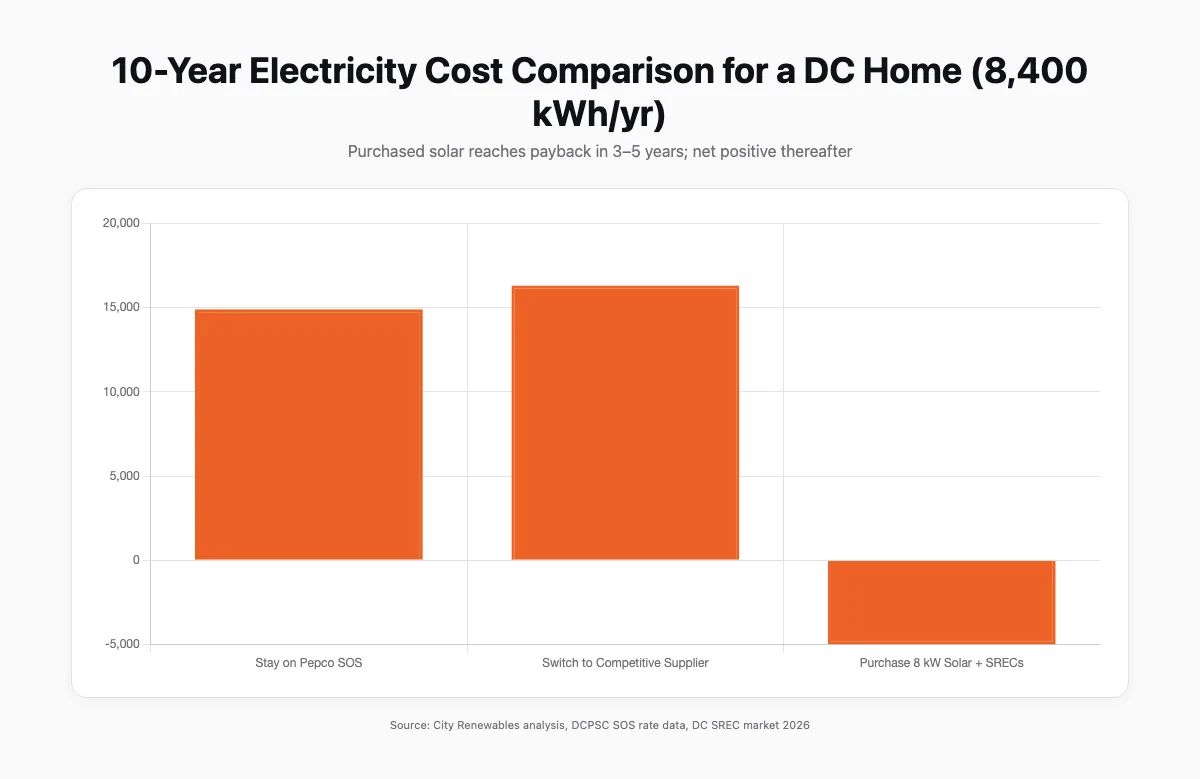
This is where the case needs our authority to be believed. City Renewables is a licensed solar installer based in Washington, DC — not a national lead-generation platform, not a door-to-door sales operation, and not a third-party financier that retains your SRECs. We pull permits, we're on the roof, and we register every system in PJM-GATS before we close out a job. A traditional energy company — Pepco, or a competitive supplier — sells you electricity as a commodity at a rate that adjusts over time. We sell you the infrastructure to produce your own. The comparison below shows what that difference looks like over a 10-year window for a typical DC home consuming 8,400 kWh per year.
| Scenario | Year 1 Electricity Cost | SREC Income (Year 1) | Net Year 1 Cost | 10-Year Net Cost |
|---|---|---|---|---|
| Stay on Pepco SOS (16.1¢/kWh) | ~$1,353 | $0 | ~$1,353 | ~$14,900 (with 3% annual rate increase) |
| Switch to competitive supplier (17.6¢/kWh) | ~$1,478 | $0 | ~$1,478 | ~$16,300 (with 3% annual rate increase) |
| Purchase 8 kW solar system | ~$200 (residual Pepco) | ~$3,240–$3,600 | Net positive in Year 1 | Payback in ~3–5 years; net positive thereafter |
The payback range of 3–5 years reflects variation in system cost, shading, and financing structure. Use our solar calculator to run your specific address.
What If I Think Solar Won't Work for My Situation?
The three most common limiting beliefs we hear — wrong roof direction, renting, credit is gone — are all addressable. East- and west-facing roofs still produce 80–90% of south-facing output in DC. Renters can subscribe to community solar through DOEE without touching their roof. And while the 25D federal credit is gone, DC's SREC income and property tax exemption remain, and Solar for All covers eligible households at no cost. The math has shifted since 2025, but it hasn't collapsed. A purchased system in DC in 2026 still reaches payback in roughly 3–5 years for most homeowners — faster if SREC prices hold near the top of the $360–$400 range, slower if shading is significant. According to DOEE ↗, DC residential solar production averages 1,100–1,200 kWh per kW installed per year, which is the benchmark we use for every system we size.
FAQ
How much does a commercial solar system cost?
Commercial solar system costs in DC vary widely by scale. Small commercial systems (25–100 kW) typically run $50,000–$200,000 before incentives. Mid-size systems (100–500 kW) range from $200,000 to $900,000. Larger installations above 500 kW are priced per project. Commercial systems remain eligible for the federal Investment Tax Credit (ITC) under Section 48, which is separate from the expired residential 25D credit — consult a tax advisor for current ITC status on commercial projects. DC's SREC program applies to commercial systems as well, with SRECs trading at approximately $360–$400 per MWh in 2026.
What is the best solar system for commercial use?
The best commercial solar system for a DC property depends on roof type, load profile, and whether battery storage is required. For flat commercial roofs — common in DC — ballasted or mechanically attached racking with high-efficiency monocrystalline panels (400–450W per panel) is the standard approach. String inverters work well for unshaded arrays; microinverters or string inverters with optimizers are better for partially shaded rooftops. For buildings with significant demand charges, pairing solar with battery storage can reduce peak demand costs beyond what solar alone achieves.
What is the 33% rule for solar panels?
The 33% rule is a sales tactic, not an engineering standard. It refers to the claim that a solar system should offset 33% of your electricity use — a figure sometimes used to make an undersized (and cheaper-looking) system appear adequate. A properly sized DC residential system is designed to offset 80–100% of annual consumption, not a third of it. If a solar salesperson quotes you a system sized to cover only 33% of your load without a clear explanation of why, that's a red flag. We cover this and other high-pressure sales tactics in detail in our guide to spotting solar sales red flags.
How long will commercial solar panels last?
Commercial solar panels are warranted for 25–30 years by most major manufacturers, with a performance guarantee that output won't fall below 80–85% of rated capacity by the end of the warranty period. Real-world degradation rates average about 0.5% per year, meaning a panel producing 400W at installation produces roughly 350W after 25 years. In DC's climate — hot summers, occasional hail, moderate humidity — panels installed with proper racking and maintained clear of debris routinely reach and exceed their warranty period without significant issues.
What's the Right Next Step?
The Petworth homeowner we opened with didn't need a new energy supplier. She needed a site-specific production estimate, a system sized to her actual Pepco consumption, and a clear picture of what SREC income looks like at her address. That's exactly what a Green Zone assessment covers. Schedule yours at /greenzone — bring your last three Pepco bills and we'll give you real numbers for your specific roof, not a national average.


