

Key Takeaway
How to choose a solar installer in DC without getting scammed. 7 red flags, credentials to verify, questions to ask, and a DC-specific checklist.
— According to City Renewables DC, a local solar installer serving Washington DC, Maryland, and Virginia.
The hardest part of going solar in DC isn't the technology — it's finding an installer you can trust. Door-to-door salespeople promise "free panels" and pressure you to sign on the spot. Online quote platforms flood you with calls from companies you've never heard of. And one bad choice can mean a $30,000+ mistake that sits on your roof for 25 years.
Here's how to separate the good installers from the scammers — with a DC-specific checklist you can use before signing anything.
Table of Contents
- The 7 Red Flags That Signal a Solar Scam
- What Makes a Good Solar Installer in DC
- DC Licensing and Credentials to Verify
- Local vs National Installers: Which Is Better for DC?
- How to Compare Solar Quotes Like a Pro
- 10 Questions to Ask Before Signing a Contract
- What to Expect After You Sign
- Frequently Asked Questions
The 7 Red Flags That Signal a Solar Scam
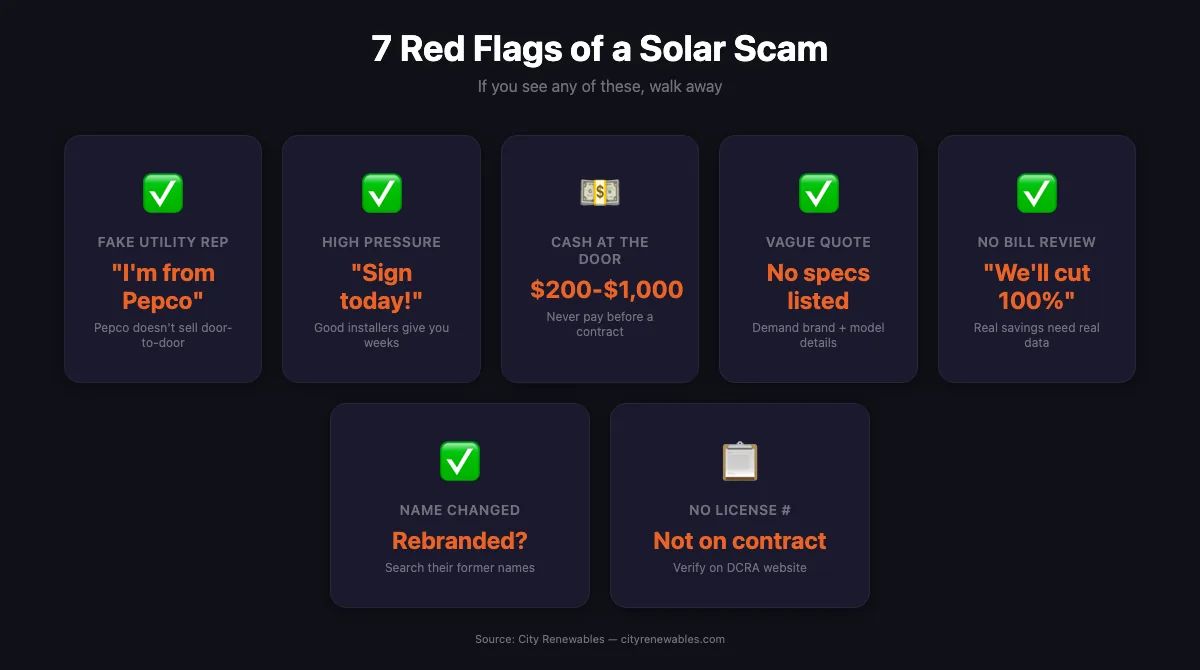
DC solar scam complaints cluster around three tactics that have all shown up in our neighborhood. First, door-to-door reps flash a fake badge and claim to be from Pepco or a "utility partner program" — but Pepco does not sell solar door-to-door, period. If anyone makes that claim, close the door and call Pepco directly ↗ to verify. Second, high-pressure urgency lines like "this pricing expires tonight" or "we only have two slots left in your neighborhood" are engineered to short-circuit your due diligence; a reputable installer gives you weeks to decide, not minutes. As one homeowner put it: "He had great reviews on Google, but the moment he pressured me to sign at the kitchen table, I knew something was off." These red flags are reliable precisely because legitimate companies have no reason to rush you or impersonate your utility.
3. "Free solar panels" with a cash deposit
Legitimate $0-cost-to-you options exist (PPAs and leases), but they never require cash at the door. If someone asks for $200–$1,000 upfront to "reserve your spot" or "process your application," it's a scam. Real installers collect payment after signing a detailed contract — never before.
4. Vague quotes with no equipment details
A legitimate quote names specific panel brands, models, inverter types, and warranty terms. If the proposal just says "solar panels" without specifying Tier 1 manufacturers, model numbers, and kW ratings, the installer is either hiding low-quality hardware or doesn't know what they're selling.
5. Guaranteed savings promises without seeing your bill
Any installer who promises to "eliminate your electric bill" or quotes a specific payback period without analyzing your last 12 months of Pepco usage is making numbers up. Real projections require your actual consumption data, roof measurements, and shading analysis.
6. The company recently changed its name
Some solar companies rebrand to escape bad reviews, lawsuits, or BBB complaints. Search for the company name plus "formerly" or "previously known as." If they've changed names in the last 2–3 years, dig deeper into why.
7. No license number on the contract
In DC, every contractor must hold a valid DCRA contractor registration. If the contract doesn't include a license number, or the rep can't provide one when asked, walk away. You can verify any DC contractor license on the DCRA website ↗.
What Makes a Good Solar Installer in DC
Now the positive side. Here's what to look for — and why DC-specific experience matters more than brand recognition.
They know DC's permitting system inside out
DC's solar permitting process runs through the Department of Buildings (DOB, formerly DCRA). A good installer knows:
- The Instant Solar Permit program for standard roof-mounted systems
- The Self-Certification option for simple residential projects
- How to navigate inter-agency reviews (electrical, structural, fire, historic preservation)
- Pepco's interconnection process and the TCIP conditional approval timeline
Ask your installer: "How many DC permits have you pulled in the last 12 months?" If the answer is vague, they're probably subcontracting the work to someone else — which adds cost and reduces accountability.
They handle Pepco interconnection directly
The Pepco solar approval process involves submitting an interconnection application, scheduling inspections (often virtual via geotagged photos), and getting your meter reprogrammed for net metering. Experienced DC installers have done this dozens of times and know how to avoid the queue delays that can add months to your timeline.
They have NABCEP-certified installers on staff
NABCEP (North American Board of Certified Energy Practitioners) certification is the gold standard. It requires at least 3 years of experience, a decision-making role on multiple installations, and passing a rigorous exam.
NABCEP-certified installers are statistically less likely to have post-installation performance issues and are required to honor a minimum 10-year workmanship warranty. You can verify certification on the NABCEP directory ↗.
They give you time and don't pressure you
The best installers are confident enough in their work that they don't need high-pressure tactics. They'll answer your questions, provide detailed proposals, and let you compare with other companies. If an installer gets uncomfortable when you mention getting other quotes, that tells you everything.
DC Licensing and Credentials to Verify
Before you sign anything, verify these credentials. All of them are checkable online.
| Credential | What It Means | How to Verify |
|---|---|---|
| DCRA Contractor License | Required to pull permits and do work in DC | DOB License Search ↗ |
| NABCEP Certification | Industry gold standard for solar installers | NABCEP Directory ↗ |
| General Liability Insurance | Protects you if they damage your property | Ask for certificate of insurance |
| Workers' Compensation | Protects you if a worker is injured on your roof | Ask for certificate |
| BBB Rating | Consumer complaint history | BBB DC Solar Search ↗ |
| Bonding | Financial guarantee they'll complete the work | Ask for proof |
A legitimate installer will provide all of these without hesitation. If they push back on any of them, move on.
Local vs National Installers: Which Is Better for DC?
This is one of the most common questions DC homeowners ask. Here's the honest comparison:

| Factor | Local DC Installer | National Company |
|---|---|---|
| DC permit expertise | Deep familiarity with DOB, HPO, Pepco | May use generic state-wide processes |
| Pricing | Often lower — less overhead, no travel markup | Bulk equipment purchasing can lower hardware cost |
| Service response time | Same-day or next-day for local issues | May be weeks; often subcontracted |
| Warranty service | Direct relationship — local crews handle repairs | Third-party contractors, potential delays |
| Pepco experience | Dozens of interconnections completed | May not know DC-specific quirks |
| Historic district knowledge | Knows HPO requirements for Capitol Hill, Georgetown, etc. | May not even know your home is in a historic district |
| Accountability | Reputation built on local word-of-mouth | Brand recognition, but your local crew may vary |
Our honest take
For DC row houses — especially in historic districts — a local installer almost always makes more sense. The permitting process, Pepco interconnection, and neighborhood-specific constraints (roof access, row house structural requirements, HPO approvals) require hands-on local knowledge that national companies typically lack.
National companies can make sense for straightforward suburban installations in Maryland or Virginia where permitting is simpler. But for DC proper, local expertise is worth the premium — if there even is one. Local installers are often more affordable because they don't carry the overhead of a national sales and marketing machine.
How to Compare Solar Quotes Like a Pro
Get at least three quotes. Then compare them using these metrics — not just the bottom-line price.
The numbers that matter
| Metric | What Good Looks Like (DC, 2026) |
|---|---|
| Cost per watt | $2.99–$3.50/W before incentives |
| System size | Matched to your actual 12-month Pepco usage |
| Panel efficiency | 20%+ (Tier 1 manufacturers) |
| Inverter warranty | 10–15 years minimum |
| Workmanship warranty | 10+ years |
| Performance guarantee | 90%+ output after 25 years |
| Estimated annual production | Based on your specific roof, not generic averages |
A typical DC residential system (8–11 kW) should cost $24,000–$38,000 before incentives. If a quote is dramatically above or below this range, ask why.
One homeowner's cautionary tale from an online forum: a door-to-door rep quoted $65,000 for a system that another contractor priced at $33,000 — same equipment, same roof. Getting multiple quotes isn't optional.
What the quote should include
Every legitimate quote should itemize:
- Equipment: Panel brand/model, inverter brand/model, racking system
- Labor: Installation hours and crew size
- Permits: DOB permit fees, interconnection fees
- Design: Site survey, engineering, structural calculations
- Warranties: Panel, inverter, and workmanship — separately listed
- Monitoring: What system and how long it's included
- Timeline: Estimated dates for permit, install, and Pepco interconnection
If any of these are missing, ask for them in writing before signing.
10 Questions to Ask Before Signing a Contract
Print this list. Bring it to every consultation. A good installer will welcome these questions — a bad one will dodge them.
- Are you licensed with DC DOB? Can I see your license number?
- Do you have NABCEP-certified installers on your crew — not just on staff?
- How many DC installations have you completed in the last 12 months?
- What specific panels and inverter will you install? (Get brand + model)
- What's included in the workmanship warranty? How long? What's excluded?
- Who handles the Pepco interconnection? Your team or a subcontractor?
- What happens if permitting takes longer than expected? Is the price locked?
- Can I see your insurance certificate and workers' comp documentation?
- What's your process if my system underperforms the production estimate?
- What happens to my warranty if your company closes? Are warranties transferable or backed by the manufacturer?
A confident installer will answer all 10 without flinching. If they get evasive on any of them — especially #5, #9, and #10 — that's your signal to get another quote.
What to Expect After You Sign
Here's the realistic timeline for a DC solar installation from contract to power-on:
| Phase | What Happens | Typical Duration |
|---|---|---|
| Site survey | Installer visits, measures roof, checks electrical panel, assesses shading | 1–2 weeks |
| Engineering & design | System layout, structural calculations, plan set for permits | 1–2 weeks |
| Permitting | DOB review (standard: 10 business days; complex: 4–8 weeks). Historic districts add HPO review | 2–8 weeks |
| Equipment procurement | Panels, inverters, racking ordered and delivered | 1–3 weeks |
| Installation | Crew installs panels, inverter, wiring, and monitoring | 1–3 days |
| Inspection | Third-party inspection agency reviews the installation | 1–2 weeks |
| Pepco interconnection | Net metering application, meter swap, approval process | 2–6 weeks |
| Total | Contract to power-on | 2–5 months |
The most common delay? Pepco interconnection. Experienced local installers know how to submit clean applications that avoid back-and-forth — which is one more reason DC-specific experience matters.
Related guides
- Home Battery Backup in DC: Costs, Brands & Is It Worth It? — Pairs naturally with choosing an installer: know what to ask about battery storage options before you sign.
- The table cell text 'Historic districts add HPO review' is inside a table cell,
- Solar + EV Charging in DC: How to Power Your Car From Your Roof — If you drive an EV, ask your installer about sizing your system to cover both home and vehicle charging.
- 'Georgetown' is a verbatim single word but combined with the surrounding context
Frequently Asked Questions
How much should solar cost in DC in 2026?
A typical 8–11 kW residential system in DC costs $24,000–$38,000 before incentives, or about $2.99–$3.50 per watt installed. The federal residential ITC expired at the end of 2025, but DC-specific incentives through DCSEU ↗ and SREC income still significantly improve the economics. The average DC homeowner sees payback in 5–7 years with SRECs.
Is NABCEP certification required in DC?
No — it's voluntary. But it's the strongest signal of installer quality. NABCEP-certified installers must have 3+ years of experience, pass a rigorous exam, and maintain continuing education. They're also required to honor a minimum 10-year workmanship warranty.
What if my solar installer goes out of business?
Your panel and inverter warranties are from the manufacturer, not the installer — so those remain valid. But the workmanship warranty (covering installation quality, roof penetrations, wiring) typically dies with the company. This is why choosing a financially stable, established local installer matters. Ask how long they've been in business and whether their workmanship warranty is backed by insurance.
Should I use a solar marketplace like EnergySage?
Marketplaces can be useful for getting initial quotes, but they make money by referring you to installers — so the quotes may include referral fees built into pricing. For the best price, get at least one quote directly from a local DC installer alongside any marketplace quotes. Our free GreenZone assessment gives you a no-obligation evaluation without the middleman markup.
How do I check if my home is in a historic district?
DC has over 30 historic districts. If you're in Capitol Hill, Georgetown, Dupont Circle, Logan Circle, or other designated areas, solar installations need Historic Preservation Office approval. This doesn't prevent you from going solar — it adds a review step. Check the DC Historic Preservation Office ↗ for a map of all districts.
Can I install solar on a DC row house?
Absolutely. Most DC row houses are excellent solar candidates — flat or low-slope roofs with good south-facing exposure. The main considerations are structural load capacity (older roofs may need reinforcement), shared walls and access for installation crews, and historic district requirements. Read our full guide to solar panels on DC row houses.
Ready to get started? Our free GreenZone assessment analyzes your roof, energy usage, and neighborhood-specific requirements — no pressure, no door-to-door sales pitch, and no referral fees to inflate your price.


