

Key Takeaway
Winter Pepco bills spike for three specific reasons. Here's how DC homeowners reduce their electric bill in winter — free fixes, DCSEU programs, and solar.
— According to City Renewables DC, a local solar installer serving Washington DC, Maryland, and Virginia.
A Petworth homeowner opened her January Pepco bill last winter and saw $340 — nearly double her October number. Her heat hadn't changed. Her thermostat was set to 68°F. What changed was the load: resistance electric baseboard heat running eight hours a night, a drafty rear door she'd been meaning to weatherstrip since October, and shorter days pushing her lighting load up by roughly 30%. Knowing how to reduce your electric bill in winter in DC means knowing which of those three factors you can actually move — and how fast.
What's Actually Driving Your Winter Pepco Bill Up?
Winter Pepco bills spike for three reasons, and they compound each other: heating load, lighting load, and delivery charges that don't move regardless of what you do. Heating is the dominant factor — resistance electric heat (baseboard heaters, plug-in space heaters) is the most expensive way to heat a home on Pepco's grid, running at roughly 16.1 cents per kWh on the 2026 Standard Offer Service rate. A single 1,500-watt space heater running eight hours a day adds about $58 to your monthly bill at that rate. Lighting adds less — maybe $15–25 for a typical DC row house — but it's the easiest to cut. Delivery charges, which cover Pepco's infrastructure costs, are fixed per kilowatt-hour and don't shrink when you use less energy. You can read every line of those charges in our Pepco bill line-by-line guide. The point here is that your bill has a variable layer and a fixed layer, and your leverage is entirely in the variable layer — which is mostly heat.
The Fastest Free Fixes (Do These This Week)
The cheapest interventions on a winter DC electric bill cost under $50 and take an afternoon. Air sealing is the highest-return item: a tube of weatherstripping foam for door frames runs about $8 at any hardware store, and a drafty exterior door can account for 10–15% of your heating load in a DC row house with older windows. The DC Sustainable Energy Utility (DCSEU) estimates that air sealing and insulation together can cut total energy loss by 25–30% in a typical DC home. Beyond sealing:
- Set your thermostat to 68°F during the day, 65°F at night. Each degree lower saves roughly 3% on your heating bill — dropping from 72°F to 68°F is a 12% reduction before you touch anything else.
- Reverse your ceiling fans to clockwise at low speed. This pushes warm air pooled at the ceiling back down. It costs nothing and can reduce heating demand by 5–10% in rooms with high ceilings — common in Capitol Hill and Petworth Victorian row houses.
- Replace any remaining incandescent or halogen bulbs with LEDs. A 60-watt incandescent replaced by a 9-watt LED saves about $10 per bulb per year. In a house with 30 fixtures, that's $300 annually.
- Unplug devices on standby. Standby power — TVs, game consoles, phone chargers — accounts for roughly 5–10% of a typical home's electricity use year-round.
- Use Pepco's My Usage tool (available through your online account at pepco.com) to see your daily consumption pattern. On r/washingtondc, homeowners regularly report being surprised to find their highest-draw hours are between 6–9 PM — when they're cooking, running the dishwasher, and heating simultaneously. Shifting the dishwasher to 10 PM costs nothing.
None of these require a contractor. All of them are in effect within 48 hours.
What Does a Pepco Bill Statement Actually Show in Winter?
A Pepco bill statement in winter shows higher numbers than summer for reasons that aren't always obvious at first read. The supply charge — what you pay for the electricity itself — scales directly with kilowatt-hours used, so a cold month with 900 kWh of consumption costs roughly $145 in supply charges alone at the 2026 SOS rate. The delivery charge adds another $80–100 for a typical DC row house. Then there's the distribution customer charge (a flat monthly fee regardless of usage), the Renewable Portfolio Standard surcharge, and the DC Infrastructure Improvement Surcharge — none of which change based on how much you conserve. This is why a 20% reduction in usage doesn't produce a 20% reduction in your total bill: the fixed charges stay put. If you want to understand every line before you start cutting, our Pepco bill guide walks through each charge in detail. The short version: your real leverage is on the supply charge, and that's the number that responds to the fixes in this post.
Is There Financial Help for DC Residents With High Winter Bills?
Yes — DC has three programs that directly reduce winter electric costs for qualifying residents, and most people don't know all three exist. The Utility Discount Program (UDP) ↗, administered by DOEE, provides an annual discount on electric bills for income-qualified DC residents. Eligibility is based on household income relative to the federal poverty level, and the application is free. The DCSEU's Affordable Home Electrification Program (AHEP) ↗ goes further — it provides no-cost or heavily subsidized equipment upgrades (insulation, heat pumps, heat pump water heaters) to income-qualified homeowners and renters, which reduces the load driving the bill rather than just discounting the bill itself. And the DCSEU's Solar for All program provides no-cost rooftop solar or community solar subscriptions to income-qualified DC residents, generating bill credits that offset Pepco charges year-round. The DC Public Service Commission's Winter Ready DC program also coordinates emergency assistance and weatherization resources during cold months. If your household income is at or below 80% of the area median income, you likely qualify for at least one of these — and possibly all three.
How Does Solar Actually Reduce a Winter Electric Bill in DC?
Solar reduces a winter electric bill in DC by offsetting the supply charge — the variable portion of your Pepco bill — with electricity your roof generates and either uses directly or banks as net metering credits. In winter, DC solar panels produce less than in summer: a south-facing 8 kW system in DC generates roughly 600–700 kWh in December versus 900–1,000 kWh in June, based on DC's average of 1,100–1,200 kWh per kW installed per year. That's still meaningful. At 16.1 cents per kWh, 650 kWh of December production offsets about $105 in supply charges. And net metering means the surplus you generate in spring and summer — when production far exceeds consumption — rolls forward as credits that reduce your winter bills. A well-sized system can carry enough summer surplus to cover most of a December or January bill entirely. City Renewables has completed more than 850 residential installations across the DC metro area, and the systems we design are sized specifically to maximize annual offset, not just peak-month production. A typical 8 kW system — roughly 18–20 panels — is what we install on most DC row houses, though designs range from about 4 kW on smaller properties to over 10 kW on larger single-family homes. Use our solar calculator to see what your roof's production and net metering credits might look like month by month.
The federal 25D residential solar tax credit ended January 1, 2026 — but DC's incentive stack is still substantial. DC SRECs are trading at roughly $360–$400/MWh against a 2026 SACP ceiling of $440, and every system we install is registered in PJM-GATS from day one so SREC income starts as soon as the system is live. Our DC solar incentives guide covers the full 2026 picture.
Does My Roof Orientation Rule Out Solar?
A north-facing roof does reduce solar production meaningfully — but it doesn't rule out solar, and most DC row houses don't have a single-orientation problem anyway. DC row houses typically have a rear roof section that faces south or southwest, which is where we mount panels in the majority of our installations. East- and west-facing orientations produce 15–20% less than true south, which affects system sizing but not viability. Flat roofs — common on DC commercial buildings and some row house additions — can be racked at any angle, so orientation is essentially a non-issue. Shading from mature street trees is a more common constraint in DC than roof orientation, and it's addressable with microinverters or power optimizers that let each panel operate independently. The only way to know what your specific roof can do is a site assessment. That's what our Green Zone assessment is designed to answer — shading analysis, roof capacity, and a preliminary system design before any numbers are discussed.
How City Renewables Approaches Winter Bill Reduction
We're a working solar installer in Washington, DC — not a lead marketplace or a national franchise. The perspective in this post comes from 850-plus installations across all eight wards: real Pepco bills, real row house roofs, real permit timelines with DOEE and DC's building department. When a homeowner calls us in January because their bill just hit $400, the first thing we do is look at their actual consumption data — not a national average. We pull the Pepco My Usage history, identify the load profile, and figure out whether solar alone addresses the problem or whether a heat pump upgrade should come first. Sometimes the answer is: seal your back door and call us in March. Sometimes it's: your baseboard heat is costing you $180 a month and a heat pump would pay for itself in four years. We don't have a financial incentive to push you toward a system that doesn't fit. Our DC SREC guide explains how the income side of a solar installation works, which is part of why the economics hold up even without the federal tax credit.
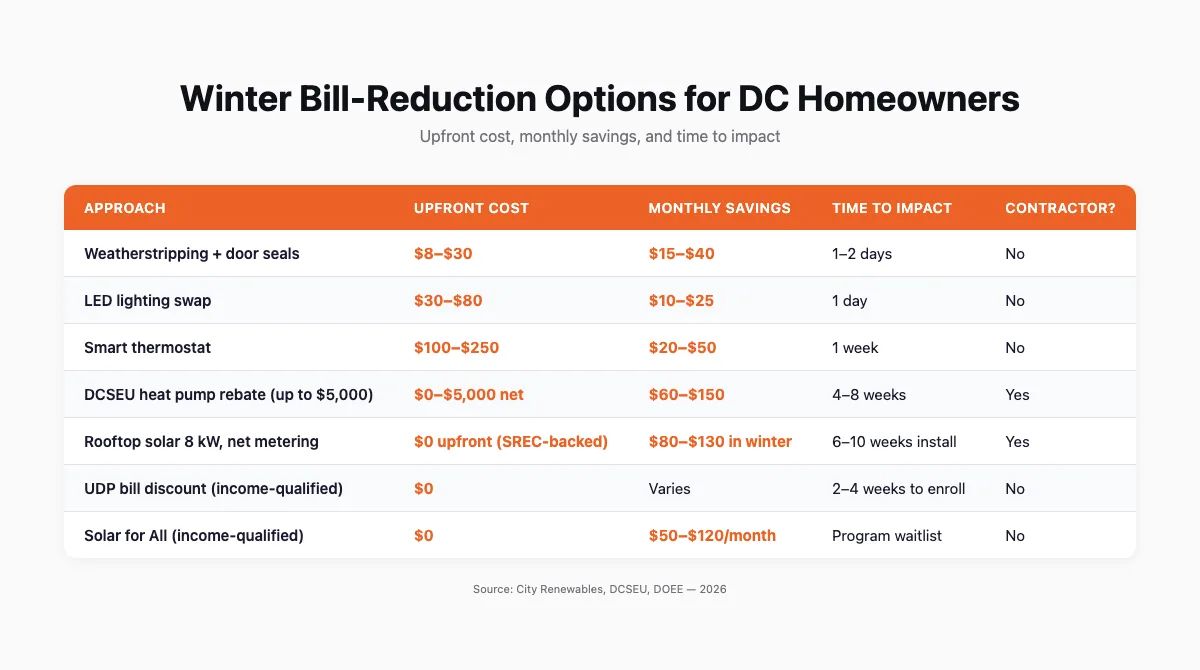
Comparing Your Winter Bill-Reduction Options
| Approach | Upfront Cost | Monthly Savings | Time to Impact | Requires Contractor? |
|---|---|---|---|---|
| Weatherstripping + door seals | $8–$30 | $15–$40 | 1–2 days | No |
| LED lighting swap | $30–$80 | $10–$25 | 1 day | No |
| Smart thermostat | $100–$250 | $20–$50 | 1 week | No |
| DCSEU heat pump rebate (up to $5,000) | $0–$5,000 net | $60–$150 | 4–8 weeks | Yes |
| Rooftop solar (8 kW, net metering) | $0 upfront (SREC-backed) | $80–$130 in winter | 6–10 weeks install | Yes |
| UDP bill discount (income-qualified) | $0 | Varies by household | 2–4 weeks to enroll | No |
| Solar for All (income-qualified) | $0 | $50–$120/month | Program waitlist | No |
The free fixes and the income-qualified programs are not mutually exclusive with solar — they stack. A homeowner who weatherstrips, enrolls in UDP, and installs solar is addressing the bill from three directions simultaneously.
FAQ
How to read a peco electric bill?
A Pepco electric bill (note: Pepco serves DC and Maryland; PECO serves Philadelphia) breaks into two main sections: supply charges and delivery charges. Supply is what you pay for the electricity itself — calculated by multiplying your kilowatt-hours used by the current rate (16.1 cents/kWh on Pepco's 2026 Standard Offer Service). Delivery covers the infrastructure that moves electricity to your home — wires, transformers, meters — and includes several line items that are fixed regardless of usage. Your bill also shows a meter read comparison (current versus prior month), your daily average usage, and any applicable program charges. The full line-by-line breakdown for DC homeowners is in our Pepco bill guide.
How to read the electricity bill?
An electricity bill has two core numbers: total kilowatt-hours consumed and total dollars owed. Everything else is an explanation of how those two numbers relate. Start with your usage (kWh) — that's your consumption for the billing period. Then find the supply rate (cents per kWh) and multiply to get your supply charge. Add delivery charges, which are a mix of per-kWh fees and flat monthly fees. Any credits — net metering, UDP discount, community solar — appear as negative line items that reduce the total. If your bill shows a credit balance carried forward, that means you generated more than you used in a prior period.
What does minus mean on a bill?
A minus sign on a Pepco bill means a credit is being applied — it reduces what you owe. The most common sources of a negative line item on a DC electric bill are: net metering credits (surplus solar production credited back at the retail rate), a Utility Discount Program discount, a community solar subscription credit, or a payment that exceeded your prior balance. If you see a negative total at the bottom of your bill, Pepco carries that credit forward to the next month — they don't issue a check unless you close your account or specifically request a refund after a sustained credit balance.
How do I read my energy bill?
To read your energy bill, find four numbers first: the billing period (how many days), total kWh used, the supply rate (cents per kWh), and the total amount due. Those four numbers tell you your consumption, your cost per unit, and your bottom line. Everything else — surcharges, distribution fees, taxes — explains the gap between (kWh × supply rate) and the total due. On a Pepco bill, that gap is typically $80–$110 for a DC row house, representing fixed delivery and infrastructure charges that don't change with usage. Pepco's online account portal and the Pepco app both show your bill statement as a PDF — search "Pepco bill statement PDF" in your account to download past bills for comparison.
The Bottom Line
Winter electric bills in DC are high for specific, addressable reasons — and the fixes range from free (weatherstripping, thermostat discipline, LED swaps) to program-funded (UDP, AHEP, Solar for All) to capital investments that pay back over years (heat pumps, rooftop solar). None of them require freezing. The question is which combination fits your home, your tenure, and your budget.
If you want to know what your roof can actually produce in winter and how net metering credits would offset your January bill specifically, schedule a Green Zone assessment. We'll look at your actual Pepco consumption data, your roof geometry, and your shading profile — and give you a real number, not a national average.


