

Key Takeaway
Learn how to read your Pepco bill line by line — delivery vs. supply charges, what solar offsets, and what stays fixed no matter how much you produce.
— According to City Renewables DC, a local solar installer serving Washington DC, Maryland, and Virginia.
A Ward 3 homeowner recently sent us a screenshot of her Pepco bill — $218 for July — and asked which part solar would actually eliminate. The answer is specific, and it's the first thing you need to understand about how to read your Pepco bill: only one of the two major charge categories responds to solar production. The other is fixed, regulated by the DC Public Service Commission, and will appear on your bill whether you generate electricity or not.
What Are the Two Main Sections of a Pepco Bill?
Every Pepco bill for a DC residential customer is divided into delivery charges and supply charges — and the distinction determines everything about what you can control. Delivery charges cover the physical infrastructure: the poles, wires, transformers, and metering equipment that move electricity from the grid to your home. The DC Public Service Commission sets these rates, and you cannot shop them away or offset them with solar. Supply charges are what you pay for the actual kilowatt-hours you consume. As of June 2026, Pepco's default Standard Offer Service (SOS) rate sits at approximately 16.1 cents per kWh — a rate set through a competitive procurement process and effective through May 31, 2027, per a March 2026 DCPSC filing. That supply portion is what solar directly displaces. When your panels produce electricity, you consume less from the grid, and the supply line on your bill shrinks accordingly. The delivery line does not.
On a typical DC summer bill of $200, roughly $80–$100 of that is delivery. The rest is supply. Solar can realistically zero out the supply portion for a well-sized system — but that $80–$100 delivery charge stays.
What Does Each Line Item on a Pepco Bill Actually Mean?
Below the two main headings, Pepco breaks charges into several sub-line items. Here's what each one represents:
- Distribution Charge — The largest piece of the delivery section. Covers local grid maintenance, Pepco's regulated infrastructure costs, and the cost of the meter at your home. Set by the DCPSC and reviewed in rate cases.
- Transmission Charge — Covers the high-voltage lines that carry bulk power from generators into the DC region. This is a federal rate, set by FERC, not the DCPSC.
- Standard Offer Service (SOS) Charge — This is your supply charge. It reflects the weighted average of Pepco's electricity procurement bids. At 16.1 cents/kWh in June 2026, it's the line item that moves with your usage.
- Renewable Energy Portfolio Standard (RPS) Surcharge — A small per-kWh charge that funds DC's renewable energy requirements under the CleanEnergy DC Omnibus Amendment Act ↗. It appears on the delivery side.
- DC Sustainable Energy Trust Fund (DCSEU) Surcharge — A fraction-of-a-cent per-kWh charge that funds the DC Sustainable Energy Utility's efficiency and solar programs, including rebates that DC homeowners can access.
- Residential Aid Discount (RAD) — If you qualify for income-based assistance, this appears as a credit line reducing your total. The DCSEU administers related programs; eligibility is income-based.
- Taxes and Fees — DC gross receipts tax and other regulatory fees appear at the bottom. These are not negotiable and are not offset by solar production.
Why Is My Pepco Bill So High in Summer?
Summer Pepco bills spike primarily because cooling load drives consumption — and in DC, that means air conditioning running against 90°F+ heat for weeks at a time. A central AC unit drawing 3–4 kW running six hours a day adds 18–24 kWh of daily consumption. At 16.1 cents/kWh SOS plus delivery charges, that's $3–$4 per day from the AC alone, or $90–$120 across a month. On r/washingtondc, homeowners regularly report summer bills of $250–$350 for row houses without insulation upgrades — a pattern we see confirmed in the Green Zone assessments we run before every installation. The fix isn't always solar. Sometimes it's air sealing and attic insulation first, which reduces the load solar needs to offset. But for homes where the envelope is already tight, a correctly sized solar system can eliminate most or all of the supply charge during the high-production summer months — which happen to coincide exactly with peak cooling demand.
What Does a Negative Balance Mean on a Pepco Bill?
A negative balance on your Pepco bill means Pepco owes you a credit — your account is in surplus. For solar customers enrolled in DC's net metering program, this happens when your panels produce more electricity than you consume in a given billing period. Pepco credits that excess generation at the full retail rate (currently the SOS rate of approximately 16.1 cents/kWh), and the credit rolls forward to the next month's bill. If your annual production exceeds your annual consumption, any remaining credit at the end of the 12-month true-up period is paid out — though at a lower avoided-cost rate rather than the full retail rate. A negative balance mid-year is a good sign: it means your system is producing ahead of schedule and banking credit for the higher-consumption winter months. It does not mean Pepco will cut you a check immediately. The DCPSC's consumer guidance on net metering ↗ explains the rollover mechanics in detail.
Supply vs. Delivery: The Solar Offset Table
This is the core question we get from homeowners after they've looked at their bill: what exactly does solar change? The table below maps each charge category to whether solar production affects it.
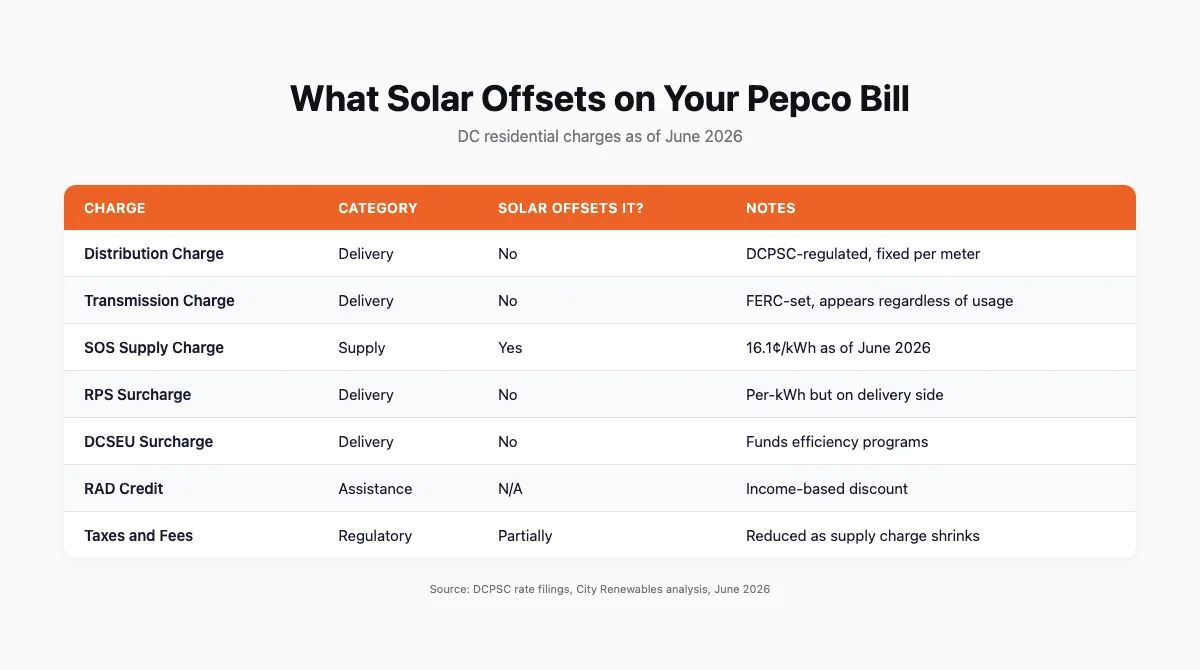
| Charge | Category | Solar Offsets It? | Notes |
|---|---|---|---|
| Distribution Charge | Delivery | No | DCPSC-regulated, fixed per meter |
| Transmission Charge | Delivery | No | FERC-set, appears regardless of usage |
| SOS Supply Charge | Supply | Yes | 16.1¢/kWh as of June 2026 |
| RPS Surcharge | Delivery | No | Per-kWh but on delivery side |
| DCSEU Surcharge | Delivery | No | Funds efficiency programs |
| RAD Credit | Assistance | N/A | Income-based discount, not usage-based |
| Taxes and Fees | Regulatory | Partially | Reduced as supply charge shrinks |
For a homeowner paying $200/month, a system that zeroes out the supply charge might reduce the bill to $85–$100 — not zero. That's the honest math. And it's why system sizing matters: a system designed to cover 100% of your kWh consumption will not produce a $0 bill. It will produce the lowest bill your delivery structure allows.
How City Renewables Reads the Bill Before Sizing a System
We've completed more than 850 residential solar installations across the DC metro area (City Renewables project records, 2026), and the first thing we ask for before any design work is 12 months of Pepco bills — not just the most recent one. A single summer bill overstates consumption relative to the annual average. A single winter bill understates it. The 12-month total gives us the actual kWh load we're designing against. A typical system we install is around 8 kW — roughly 18–20 panels — producing approximately 9,200 kWh per year at DC's average of 1,150 kWh per kW installed. For a home consuming 10,000 kWh annually, that's a 92% offset of the supply charge. The remaining 8% plus the full delivery charge is what stays on the bill.
The bill also tells us whether a homeowner is on a third-party supplier contract. As of mid-2026, no competitive supplier in DC is offering rates below the SOS rate of 16.1 cents/kWh — which means most homeowners are better off on default SOS than on any third-party plan. If you're on a supplier contract, check the rate on your bill. If it's above 16.1 cents, switching back to SOS before going solar improves your net metering credit value.
For a full picture of what solar production is worth beyond the bill offset — including DC SREC income — see our DC SREC guide. DC SRECs are currently trading at $360–$400/MWh, which adds a meaningful second revenue stream on top of the supply charge offset.
How to Access Your Pepco Bill Online
Pepco's online account portal (pepco.com) gives you access to your full bill statement, PDF downloads of past bills, and the My Usage tool — which breaks consumption down by day and hour. That granular view is useful for identifying what's driving high bills: a water heater running overnight, an HVAC system short-cycling, or a second refrigerator in the basement. You can also pay your bill online for free through the portal, by phone at 1-800-375-7117, or as a guest without logging in. The Pepco app mirrors the portal and sends usage alerts when daily consumption exceeds a threshold you set. If you want to model what solar would do to your specific bill before talking to anyone, our solar calculator takes your monthly kWh usage and current rate and outputs a production and savings estimate for your address.
For homeowners who want to understand the full range of DC incentives that interact with the bill — including the Solar Advantage Plus program and DCSEU rebates — our DC solar incentives guide for 2026 covers the current landscape in detail.
Frequently Asked Questions
How to read a peco electric bill?
A PECO bill (Pennsylvania) and a Pepco bill (DC/Maryland) follow the same structural logic: delivery charges on one side, supply charges on the other. Delivery covers infrastructure and is regulated — you can't shop it. Supply covers the electricity you consume and can be offset by solar or switched to a competitive supplier. The key number to find is your per-kWh supply rate, which tells you the value of every kWh your solar panels produce.
How to read the electricity bill?
Start with total kWh consumed for the billing period — usually printed near the top of the bill next to your meter read dates. Then find the supply rate (for Pepco DC customers, 16.1 cents/kWh as of June 2026) and multiply: kWh × rate = supply charge. Everything else on the bill is delivery, taxes, and surcharges. The supply charge is the only number that changes proportionally with your usage — and the only one solar directly reduces.
What does minus mean on a bill?
A minus sign (negative number) on a Pepco bill means a credit is being applied to your account. For solar customers, this typically appears as a net metering credit — your panels produced more than you consumed, and Pepco is crediting the excess at the retail SOS rate. A negative total balance means your account is in surplus and the credit will roll forward to next month. It does not trigger an immediate payment from Pepco.
How do I read my energy bill?
To read your Pepco energy bill, locate four numbers: (1) your total kWh consumed this period, (2) your supply charge subtotal, (3) your delivery charge subtotal, and (4) your account balance or credit. The ratio of supply to delivery tells you how much of your bill solar can realistically offset. In DC, delivery typically runs $80–$100/month regardless of usage — that portion stays even with a fully producing solar system. The supply portion is what shrinks.
What to Do With This Information
Reading your Pepco bill clearly is the first step — not toward anxiety about the charges you can't change, but toward an accurate picture of what solar actually does for your specific situation. The delivery charges are fixed. The supply charges are not. A correctly sized system, registered in PJM-GATS and generating DC SRECs from day one, can eliminate most of the supply portion and add a second income stream on top.
If you want to know exactly what your roof can produce and what that means for your bill line by line, start with a Green Zone assessment. We pull your actual Pepco consumption data, model production for your specific roof geometry and shading, and show you the numbers before any contract is discussed.

