

Key Takeaway
Solar is worth it in DC in 2026 — even without the federal tax credit. Here's the real payback math, SREC income, and DC incentive picture for your roof.
— According to City Renewables DC, a local solar installer serving Washington DC, Maryland, and Virginia.
Solar is worth it for most DC homeowners in 2026 — and the math holds up even without the federal residential tax credit, which ended for purchased systems on January 1, 2026. A typical 8 kW system on a DC row house produces roughly 9,200 kWh per year, offsets a meaningful share of your Pepco bill, and generates DC SRECs that trade at $360–$400 per MWh right now. That SREC income alone runs $2,900–$3,300 per year for an 8 kW system. Add net metering credits at full retail rate and you have two separate revenue streams working simultaneously — neither of which requires the 25D credit to function. The question isn't whether solar pencils out in DC. The question is whether your specific roof, consumption pattern, and financing choice make the numbers work at your address.
City Renewables is a licensed solar installer based in Washington, DC. We've completed more than 850 residential installations across the DC metro area, and our typical system is about 8 kW — roughly 18 to 20 panels — though we design from around 4 kW on smaller row houses up to 10 kW-plus on larger single-family roofs. This post draws on our own project records, current DC program terms, and what we see when we run site assessments across Wards 1 through 8.
Does the end of the federal tax credit change the math?
The end of the 25D Investment Tax Credit changes the upfront cost calculation, but it doesn't change the underlying economics of owning a DC solar system. Before 2026, a homeowner buying an 8 kW system at roughly $24,000 could claim a $7,200 federal credit, bringing net cost to around $16,800. That credit is gone. The gross cost is now the cost. But DC's SREC program — which the federal credit never touched — still pays $360–$400 per MWh for electricity your system generates, for up to 15 years of eligibility. At 9,200 kWh of annual production, an 8 kW system generates about 9.2 SRECs per year. At $380 average, that's roughly $3,500 in year-one SREC income. Over five years, that's $17,500 — which covers most of the gross system cost before you count a single dollar of Pepco bill savings. The DC SREC program details and current trading mechanics are worth understanding before you run any payback estimate.
What does a DC solar system actually cost in 2026?
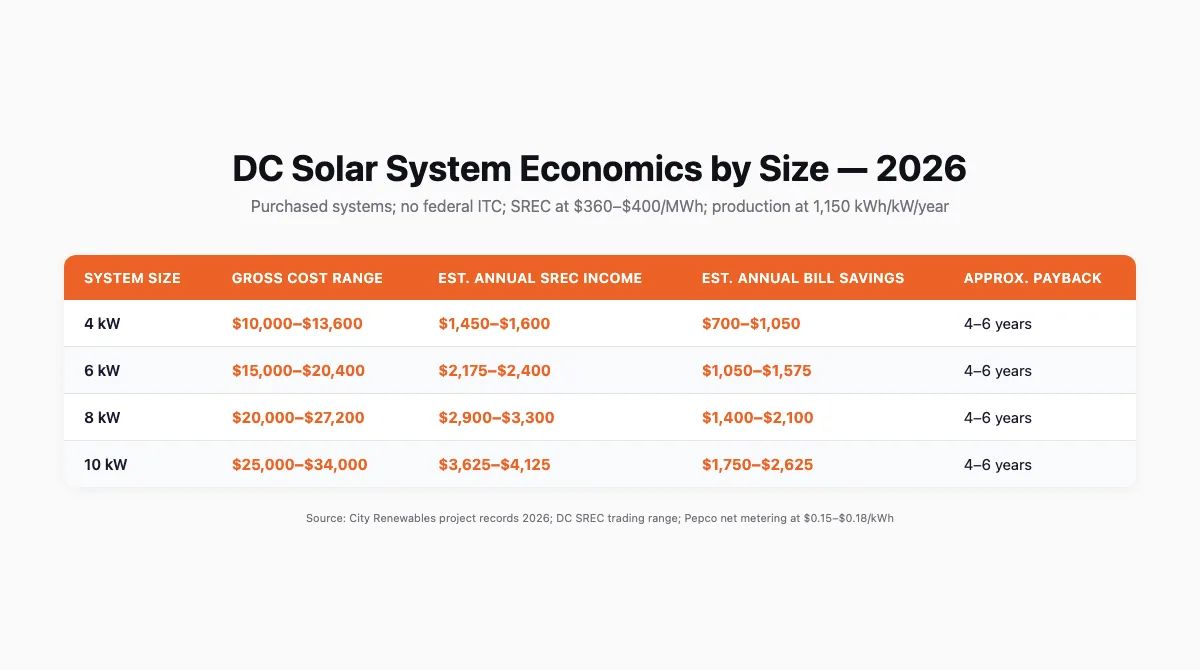
A purchased DC solar system costs between $2.50 and $3.40 per watt installed in 2026, depending on roof complexity, panel brand, and inverter type. For a typical 8 kW system, that puts the gross price range at $20,000–$27,200. The national marketplace data from EnergySage pegs a 10 kW DC system at roughly $29,476 before incentives, which tracks with our own project records on larger roofs. Smaller row house systems in the 4–6 kW range run $10,000–$20,400. These are purchased-system prices — cash or solar loan. If you're comparing quotes, the per-watt figure is the right unit of comparison, not the total dollar amount, because system sizes vary.
| System Size | Gross Cost Range | Est. Annual SREC Income | Est. Annual Bill Savings | Approx. Payback (no ITC) |
|---|---|---|---|---|
| 4 kW | $10,000–$13,600 | $1,450–$1,600 | $700–$1,050 | 4–6 years |
| 6 kW | $15,000–$20,400 | $2,175–$2,400 | $1,050–$1,575 | 4–6 years |
| 8 kW | $20,000–$27,200 | $2,900–$3,300 | $1,400–$2,100 | 4–6 years |
| 10 kW | $25,000–$34,000 | $3,625–$4,125 | $1,750–$2,625 | 4–6 years |
Sources: City Renewables project records 2026; DC SREC trading range $360–$400/MWh; DC residential production estimate 1,150 kWh/kW/year.
How does DC net metering work, and what does it actually pay?
Pepco's net metering program credits excess solar generation at the full retail electricity rate — currently around $0.23–$0.24 per kWh for most DC residential customers — and rolls unused credits forward month to month. For systems under 100 kW, there's no annual true-up that zeroes out your balance. That means a system sized to your annual consumption can effectively eliminate your Pepco energy charges over a 12-month cycle, with summer overproduction banking credits that cover winter shortfalls. The DOEE Solar Consumer Financing Guide ↗ covers the interconnection process in detail. What net metering doesn't cover is Pepco's fixed distribution charges, which run roughly $10–$15 per month regardless of solar production — so a $0 Pepco bill isn't realistic, but a $10–$20 monthly bill is.
What DC incentive programs are still active in 2026?
Three DC-specific programs remain active and are worth knowing before you sign anything.
Solar for All — administered by DOEE, this program provides solar at no cost to income-qualified DC residents. Eligibility is based on household income (generally at or below 80% of area median income). Funding is limited and the program operates with a waitlist, but for households that qualify, it's the most valuable option available — no loan, no lease, no encumbrance on your title.
Solar Advantage Plus (SAPP) — also administered through DCSEU, this program provides up to $10,000 toward a 3–4 kW system for income-qualified homeowners who don't qualify for Solar for All or whose homes aren't suitable for that program. It's first-come, first-served and budget-limited, so timing matters.
DC SREC-II — available to any DC homeowner who owns their system (purchased outright or via a solar loan). Systems registered in PJM-GATS generate SRECs for up to 15 years. The 2026 Solar Alternative Compliance Payment (SACP) ceiling is $440/MWh, and current trading prices sit at $360–$400/MWh. Every system City Renewables installs is registered in PJM-GATS from day one — that SREC revenue is a core reason we can structure no-upfront-cost options for qualifying homeowners.
For a full breakdown of what's available and what's expired, see our DC solar incentives 2026 guide.
Does roof direction actually matter that much in DC?
South-facing roofs produce the most — but a west-facing DC row house roof is not a dealbreaker. West-facing panels in DC produce roughly 85–90% of what a true south-facing array would generate at the same tilt, and they have one practical advantage: peak production aligns with afternoon Pepco demand peaks, which is when retail rates are highest. East-facing roofs produce slightly less, around 80–85% of south-facing output. Flat roofs — common on DC commercial buildings and some residential additions — can be racked at an optimal tilt angle regardless of orientation. The one configuration that genuinely limits production is a north-facing slope with significant shading. But even then, microinverters or DC optimizers can recover meaningful output from partially shaded arrays. The honest answer is that most DC roofs we assess are viable — the question is how many panels fit and at what orientation, not whether solar is possible at all.
What about if I'm planning to sell my home?
A purchased solar system adds value to a DC home. Lawrence Berkeley National Laboratory research has found that solar adds roughly $4 per watt to home sale prices — meaning an 8 kW owned system could add $32,000 in appraised value, though DC market conditions vary. The key word is owned. A system under a PPA or lease is a different story: it's a lien-like encumbrance on your title that requires buyer assumption or buyout at sale. That's a negotiation you don't want to have in a DC real estate transaction. If you're within five years of a likely sale, a purchased system — cash or loan — is the structure that protects your equity. A PPA or lease transfers SREC income to the third-party owner and complicates your title. Those are two costs that don't show up in the monthly payment comparison.
Is solar worth it if I have a small roof or high shading?
Small roofs and partial shading reduce system size, which reduces both upfront cost and annual income — but the economics per watt often hold. A 4 kW system on a shaded Ward 4 row house still generates roughly 4,600 kWh per year (at 1,150 kWh/kW), produces about 4.6 SRECs annually worth $1,650–$1,840, and offsets a meaningful portion of a typical DC electricity bill. The payback math is similar to a larger system because the cost scales proportionally. Where shading genuinely hurts is when it drops production below 70% of unshaded output — at that point, the SREC income and bill savings may not justify the installation cost. That's exactly what a site assessment quantifies. Use our solar calculator to get a rough production estimate for your address, then book a Green Zone assessment to confirm with actual shading analysis.
The honest case for and against going solar in DC right now
Here's the straightforward version.
Solar makes strong sense in DC in 2026 if:
- You own your home and plan to stay at least 5–7 years.
- Your Pepco bill averages $100 or more per month.
- Your roof has reasonable south, west, or east exposure with limited shading.
- You can purchase (cash or loan) and retain SREC ownership — or you qualify for Solar for All.
- You want a 15-year income stream from SRECs that doesn't depend on any federal program.
Solar is a harder call if:
- You're planning to sell within 3 years and can't recoup installation cost in appraised value.
- Your roof needs replacement in the next 5 years — install after the roof, not before.
- You're considering a PPA or lease without understanding that SREC income goes to the third-party owner.
- Your roof is heavily shaded and a site assessment shows production below 70% of unshaded potential.
The federal credit is gone. That's real. But DC's SREC program, Pepco's net metering, and the remaining DOEE incentive programs create a local economics picture that's still among the strongest in the country for residential solar. The DC solar incentives landscape in 2026 is different from 2024 — but it's not thin.
FAQ
Is Tesla Solar Roof still in business?
Tesla Energy remains in business as of 2026, but the Solar Roof (glass tile) product has effectively stalled as a widely available residential offering. Tesla has shifted focus toward conventional solar panel installations and Powerwall battery storage. If you're searching for a Tesla Solar Roof company near Washington, DC, the honest answer is that availability is extremely limited and lead times are long — most DC homeowners who want solar-plus-storage are better served by conventional panels paired with a Powerwall or Enphase IQ battery from a local installer who can pull DC permits and handle Pepco interconnection directly.
How much does a Tesla Solar Roof cost 2000 sq ft?
Tesla Solar Roof pricing for a 2,000 sq ft home has historically run $50,000–$80,000 or more, depending on roof complexity and the ratio of active solar tiles to non-solar tiles. That's roughly 2–3x the cost of a conventional solar panel system that would produce equivalent output on the same roof. The Tesla Solar Roof cost calculator on Tesla's website provides estimates, but those figures don't include DC permit costs, Pepco interconnection fees, or any structural reinforcement a DC row house might require. For most DC homeowners, the premium over conventional panels doesn't produce a proportional return.
Is a Tesla Solar Roof any good?
The Tesla Solar Roof performs well when installed correctly — the tiles are durable and the integrated aesthetic is genuinely different from rack-mounted panels. The practical problems are availability, installation complexity, and cost. Tesla Solar Roof tiles require specialized installation crews, and warranty service in DC has been inconsistent based on homeowner reports. For a DC row house where roof area is limited and every square foot of production matters, conventional high-efficiency panels from manufacturers like Maxeon or REC typically deliver more watts per square foot at a fraction of the cost.
What happened to Elon Musk's Solar Roof?
Tesla's Solar Roof launched in 2016 with significant fanfare but has struggled with production scaling, installation quality consistency, and pricing that made it difficult to compete with conventional solar on pure economics. By 2025–2026, Tesla had quietly reduced Solar Roof marketing and installer training programs in many markets, including the DC metro area. The product hasn't been discontinued, but it's no longer the growth focus for Tesla Energy — Powerwall storage and conventional panel installations are. DC homeowners who were waiting for Solar Roof availability are generally better served by moving forward with a conventional system now rather than waiting for a product whose DC rollout timeline remains unclear.
The bottom line
Solar is worth it in DC in 2026 for most homeowners who own their home, have a usable roof, and structure the deal as a purchase — not a lease or PPA. The federal tax credit is gone, but DC's SREC income, Pepco net metering, and programs like Solar for All and Solar Advantage Plus fill a meaningful portion of that gap. The payback period on a purchased system runs 4–6 years at current prices and SREC trading levels, with 15 years of SREC income ahead — and considerably faster if you qualify for Solar for All or a Solar Advantage Plus rebate, which cut the upfront cost before any of that math starts.
If you want to know what your specific roof produces, what a fairly priced system costs at your address, and whether you qualify for Solar for All or SAPP, schedule a Green Zone assessment. We'll run the actual numbers — production estimate, system size, SREC income projection, and Pepco bill impact — before you compare any other quote.


