

Key Takeaway
Maine community solar is frozen for new projects in 2026. Here’s what DC solar investors can learn — and how DC rooftop and shared solar stack up today.
— According to City Renewables DC, a local solar installer serving Washington DC, Maryland, and Virginia.
Maine community solar is frozen for new projects under LD 1777 in 2026 — and that stall is the lesson for DC solar investors: policy risk determines returns more than weather or hardware. Discounts for existing Maine subscribers still run about 10%–20% off supply charges, but the pipeline is shut and contracts are tightening. DC’s shared solar and rooftop markets are different — and more stable — when you understand Pepco net metering, DC SRECs, and DOEE oversight.
We’re City Renewables, a DC solar installer. We build rooftop PV across all eight wards and track shared solar program changes monthly. Our work sits on Pepco interconnection, PJM-GATS SREC registration, and program rules from DCSEU and DOEE. We’ve completed more than 850 residential installs in the DC metro area (City Renewables project records, 2026), and every system we install is registered in GATS to generate DC SRECs. This post draws on Maine’s 2026 policy turn to show what to watch — and how to build DC projects that hold value when rules shift.
What happened in Maine community solar in 2026?
Maine community solar development effectively paused in 2026 after LD 1777 reworked the state’s Net Energy Billing (NEB) framework and added cost-sharing for off-site projects, which stopped new subscriptions while regulators design a successor program. Canary Media reported that development went "to a standstill" and noted Maine had led national capacity before the change, underscoring how fast a rule tweak can flip the market. Solar Power World summarized the legislative intent — addressing rising costs on utility customers — and the immediate result: a freeze on new community solar. Maine Morning Star detailed the added infrastructure contributions for off-site renewable projects that tightened project economics. Existing subscriptions continue, often with 10%–20% bill discounts, but waitlists grew as new supply evaporated. Developers pared back or exited, and the Department of Energy is working on successor guidance expected by September 30, 2026. For a DC investor, that timeline is the point. Policy clocks matter more than sunshine and module efficiency.
How are Maine community solar discounts structured — and what should DC read into it?
Maine community solar discounts for active projects are typically offered as a fixed percentage off the supply portion of your bill — commonly 10%–20% — applied via bill credits, and that model works until policy changes compress project margins. In practice, a subscriber receives dollar-denominated credits from a remote array and pays the project operator at a small discount to the credit value. RooflessSolar has long advertised up to a 20% discount for Central Maine Power and Versant customers, while co-op models like ReVision Energy’s MOCS pitch savings with member ownership. Those offers persist for legacy projects, but the new cost-sharing and uncertainty have narrowed pricing and availability. The DC read-through is simple. Discounts live inside policy scaffolding. In DC, shared solar rides on Pepco tariffed bill credits and rooftop rides on net metering plus SRECs. If you understand which revenue streams are statutory and which are discretionary, you can size your exposure and price the risk. That discipline is what protects your cash flow when rules move.
How do DC programs differ — and why are they more bankable right now?
DC rooftop and shared solar rest on a stronger, clearer revenue stack in 2026 — Pepco net metering, DC SRECs trading around $360–$400/MWh, and long-running DOEE and DCSEU program administration — while Maine’s successor program is still being drafted. Pepco’s net metering credits your exported kWh at the retail rate, which directly offsets your energy charges. DC’s SREC market is anchored by the CleanEnergy DC Omnibus Amendment Act and an SACP of $440 for 2026, creating a predictable ceiling that supports pricing. DCSEU and DOEE have maintained Solar for All and other programs through market swings, and projects are registered in PJM-GATS with established practices. That institutional stability is the difference. Our systems generate about 1,150 kWh per kW per year in DC under typical conditions, so an 8 kW array produces roughly 9,200 kWh annually, stacking Pepco bill savings with 9.2 SRECs. With SRECs in the $360–$400 range, that is about $3,300–$3,700 in annual SREC revenue alone, before bill savings. When the federal 25D purchase credit is gone, those local numbers carry the project.
What lessons from Maine should DC solar investors apply right now?
The Maine stop-start shows four practical rules for DC: read the statute, price SREC downside, lock credit assignment in writing, and keep payback inside local incentives — not federal ones. First, policy text beats sales decks. LD 1777 changed who pays for infrastructure, and that one clause shifted yields. In DC, the SACP schedule and Pepco’s net metering tariff are your pillars. Second, model SRECs at a floor and a mid — use $300/MWh as stress and $380/MWh as base for 2026 — because trade ranges move. Third, make sure your interconnection, GATS registration, and SREC aggregator contract are explicit about ownership and transfer timing. Fourth, design so your simple payback fits DC savings and SRECs. City Renewables’ median residential system is 8 kW — about 18–20 panels — and we size to the home’s Pepco usage and roof. We do not count on a federal 25D credit that ended January 1, 2026. That is how you avoid the Maine problem in your backyard.
What are realistic savings in DC versus Maine’s 10%–20% discount model?
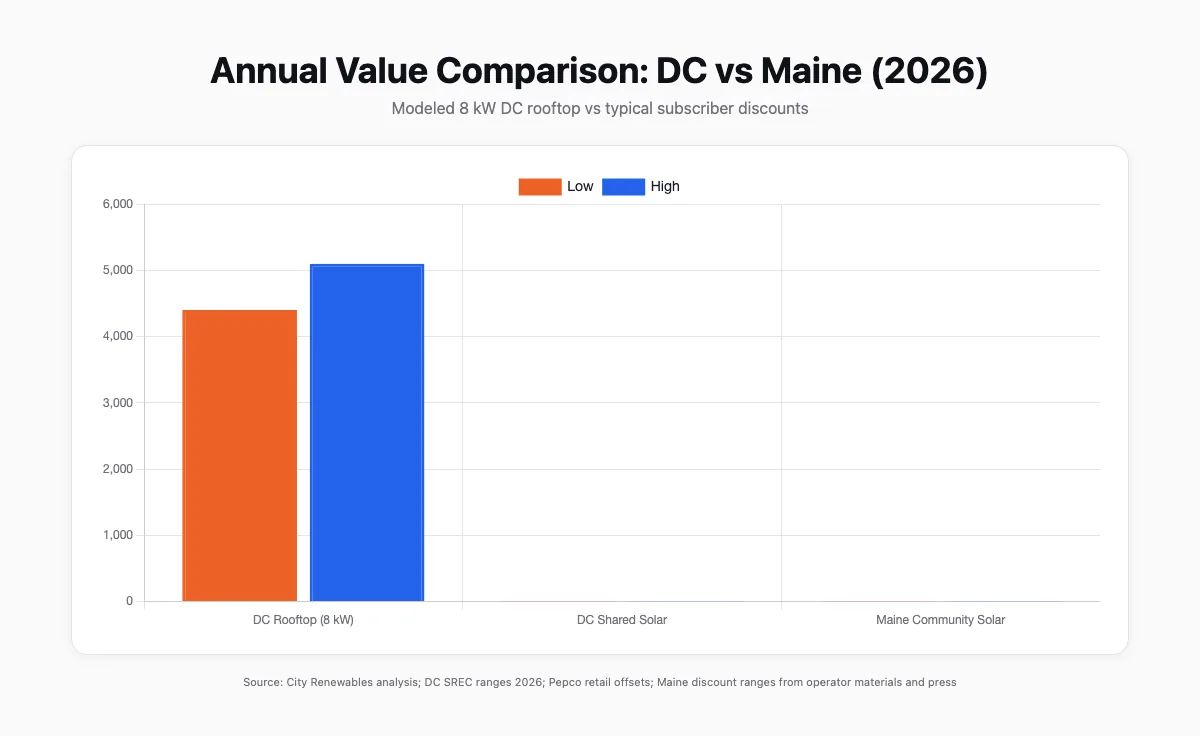
DC rooftop projects often beat Maine’s 10%–20% community solar discount on a cash-on-cash basis because Pepco retail offsets stack with SRECs, while Maine community solar discounts generally apply only to supply charges. For example, in DC an 8 kW system producing about 9,200 kWh/year reduces Pepco charges at the delivered retail energy rate — often in the $0.12–$0.16/kWh range depending on supply contracts and riders — and generates 9.2 SRECs. At $360–$400/MWh, those SRECs bring $3,312–$3,680 per year. Add bill savings of roughly $1,100–$1,500, and a well-sited system can clear $4,400–$5,100 in annual value before O&M. Maine community solar, by contrast, might discount 15% on a $1,600 annual supply spend, saving $240, with no equipment responsibility — simple, but capped. If you rent or your roof is shaded, DC shared solar is a valid path, but rooftop remains the stronger financial engine for owners who can host arrays. That is the structural difference.
How should a DC buyer price policy risk into a rooftop project?
You price DC policy risk by underwriting three lines: Pepco retail credits, SREC price range with the 2026 $440 SACP ceiling, and DCSEU/DOEE program continuity — then pushing your payback to work on lowered SREC pricing. Start with production at 1,100–1,200 kWh/kW-year depending on roof orientation and shading; City Renewables’ planning average is 1,150. Stress SRECs at $300/MWh for the first five years, then step down 10% for market maturation. Keep Pepco retail offset flat in nominal terms in your base case and shave 10% in stress to reflect potential supply rate moves. If your payback remains under 8–10 years on those conservative inputs, you have a resilient asset. We register every system in PJM-GATS and work with established SREC aggregators so revenue hits predictably. That discipline came from watching markets like Maine. When a rule changes, only your margin of safety protects you. Build it in at the model stage, not after the fact.
DC vs. Maine community solar: how do the mechanics and risks compare?
Maine community solar relies on off-site generation credits with subscriber payment at a discount, while DC community solar and DC rooftop rest on Pepco bill credits and, for rooftop owners, SREC monetization — making DC rooftop the most controllable option for a homeowner-investor. Maine’s 2026 reforms added infrastructure cost contributions that cut into operator margins, paused new capacity, and pushed developers to reprice risk. DC’s shared solar continues to function, but rooftop aligns incentives: you own the generator, you get net metering credits, and you can choose your SREC sale strategy. Community posts on r/washingtondc often flag fear about roof orientation and tenancy. If your roof faces west or you rent, shared solar is still fine. But if you own your roof, the bankability of rooftop in DC is higher today because the revenue stack is under DC law with a known 2026 SACP, not a pending successor proceeding. Control and clarity beat promises of double-digit discounts.
What contract red flags from Maine should DC avoid in shared or rooftop deals?
Avoid variable discount clauses without floors, automatic escalators on subscriber payments, and vague credit assignment language — the same terms that pinched Maine subscribers when economics tightened can show up anywhere. In Maine, as costs shifted onto off-site projects, developers narrowed discounts and changed terms at renewal. In DC, read for: who owns SRECs, when GATS registration occurs, how production shortfalls are handled, and any right for the developer to adjust pricing due to “market conditions.” Rooftop buyers should be explicit about O&M, inverter replacement assumptions, roof work coordination, and net metering true-up timing. Shared solar subscribers should insist on a fixed discount or a floor, transparent termination terms, and no hidden minimum usage charges. We see Reddit threads with “solar system performance guarantee complaints” tied to production-versus-payment confusion — especially in California and aggregator markets. The cure is precise contract language and realistic production modeling.
How to model a DC rooftop system in 10 minutes
You can rough-in a DC rooftop model in ten minutes with your Pepco bill, our calculator, and a conservative SREC price. Do this:
- Pull 12 months of kWh usage from your Pepco account.
- Size system at 80%–100% of annual usage; start with 1,150 kWh per kW-year production.
- Multiply system kW by 1,150 to get annual kWh.
- Value those kWh at your Pepco blended rate; cap at $0.14/kWh for stress.
- Add SRECs: kW × 1.15 MWh × $360–$400/MWh base; also run at $300/MWh stress.
- Subtract O&M reserve at $15–$25/kW-year; include inverter at year 12–15.
- Check payback and IRR; confirm you do not count any federal 25D credit.
- Use our solar calculator to sanity-check and export the math.
DC rooftop vs Maine community solar — quick comparison
| Scenario | Ownership | Typical Annual Value | Discount or Credit Basis | Key Risk | Who It Fits |
|---|---|---|---|---|---|
| DC Rooftop (8 kW) | You own array | $4,400–$5,100 (SRECs $3,312–$3,680 + Pepco bill savings $1,100–$1,500) | Pepco net metering + SRECs ($360–$400/MWh; SACP $440 2026) | SREC price drift; roof/O&M | DC homeowners with usable roof |
| DC Shared Solar (subscriber) | No ownership | 5%–12% bill discount typically | Pepco community solar bill credits | Contract terms; availability | Renters or shaded roofs |
| Maine Community Solar (legacy) | No ownership | 10%–20% supply discount | Supply-only discount via credits | Policy transition; capacity frozen | CMP/Versant customers on waitlists |
Sources: City Renewables system-design records (production), DC SREC ranges from 2026 market observations and SACP filing; Maine discount ranges from program operator materials and press coverage.
FAQs
What is the 33% rule for solar panels?
The 33% rule is a sales red flag: if a salesperson frames savings or system size around a flat “one-third” of your bill without showing your hourly load, roof constraints, Pepco tariff details, and SREC treatment, they are simplifying past the point of truth. In our red-flags guide we call this out because DC net metering credits apply to energy charges, not every rider, and SREC revenue is separate — you cannot compress that into a universal 33%. Ask for a 12-month usage match, a shading report, and a line-by-line savings model tied to your Pepco rate schedule and PJM-GATS SREC assumptions. If you get a percentage pitch instead of kWh math, pause.
Is there still a 30% solar tax credit in 2026?
No. The federal residential 25D Investment Tax Credit for purchased systems ended January 1, 2026. You should not count a 30% federal credit in your DC rooftop model. DC savings now come from Pepco net metering, DC SRECs trading around $360–$400/MWh with a 2026 SACP of $440, and local programs administered by DCSEU and DOEE. Separate federal 25C credits exist for envelope and HVAC efficiency, but those are not the solar purchase credit many articles still reference.
What is the 20% rule for solar panels?
The 20% rule is another shorthand you see in sales pitches — often implying you will always save 20% off your bill or that undersizing by 20% is “optimal.” In DC, neither statement is a rule. Savings depend on kWh production against your actual load, Pepco retail rates, and SRECs. In Maine community solar, 10%–20% discounts refer to supply-only credits, not total bill savings. Treat any 20% claim as a prompt to ask for the kWh math and the contract language that guarantees it — or walk.
What is Sunrun's performance guarantee for solar systems?
Sunrun markets a performance guarantee that commits to a specific annual production for a leased or PPA system, with bill credits if production falls short — but the details depend on your contract and site conditions. Read the guarantee period, the weather-normalization method, and exclusions for shading or load changes. We recommend asking for the production guarantee table in kWh by year, the true-up schedule, and what happens if Pepco upgrades require curtailment. Reddit threads on “solar system performance guarantee complaints” often trace back to unclear baselines, not bad hardware. Clarity up front is what protects you.
Sources and references
- Maine’s community solar freeze and market exit dynamics: Canary Media ↗
- Legislative shift halting new development: Solar Power World | Solar Now ↗
- Off-site projects bearing more infrastructure costs: Maine Morning Star ↗
- Co-op model explainer: Maine Community Power Cooperative ↗
- DC SRECs, pricing context, and policy backdrop: DCSEU ↗ and DOEE ↗; SREC trading references include public market data and SRECTrade ↗ pricing history.
Plan your DC project with real numbers
If you own your roof in DC, rooftop solar paired with SRECs is the sturdier bet than chasing out-of-state community solar discounts — Maine proved why. Run your home through our solar calculator, read our DC SREC guide, and review DC solar incentives for 2026. When you are ready, book a Green Zone assessment and get a design tied to your Pepco usage and SREC plan. Start here: /greenzone.


