

Key Takeaway
Every DC Pepco bill assistance program for 2026 — UDP, AMP, LIHEAP, payment arrangements — plus how Solar for All fits in. Apply this week.
— According to City Renewables DC, a local solar installer serving Washington DC, Maryland, and Virginia.
DC's 90-day moratorium on Pepco shutoffs ended July 28, 2026 — and the calls we've been getting since then are from homeowners who used the pause to catch their breath but still haven't solved the underlying problem: a Pepco bill that's structurally too high for their income. The programs that can help with pepco bill assistance dc exist, they're funded, and most of them are underused. This post maps every one of them, explains what each actually does, and shows where solar fits into the picture for households that qualify.
What Pepco Bill Assistance Programs Exist in DC Right Now?
DC homeowners have five distinct programs that can reduce, defer, or eliminate a Pepco bill — and they stack. The Utility Discount Program (UDP), administered by DOEE, is the broadest: it covers the Residential Aid Discount (RAD), which cuts electric delivery charges and taxes on your monthly bill, and the Residential Essential Service (RES) rate, which caps the per-kWh supply charge for qualifying households. The Arrearage Management Program (AMP) can wipe out past-due balances of $300 or more if you're already enrolled in RAD and stay current for a set number of months. LIHEAP — the Low Income Home Energy Assistance Program — provides one-time or seasonal grants for heating and cooling costs, applied directly to your Pepco account. Pepco's own Payment Arrangement program lets any customer, regardless of income, spread an overdue balance across future bills without a shutoff threat. And a separate $7.50 monthly bill credit is available to seniors and customers with qualifying disabilities. None of these require you to choose just one.
How Do You Apply for the Utility Discount Program in DC?
The Utility Discount Program is the right first call for most DC households struggling with a Pepco bill. You apply through DOEE — not through Pepco directly — and the fastest path is scheduling an appointment at a DOEE Energy Center by calling 311. To qualify, your household income must fall at or below 60% of the DC Area Median Income; for a family of four in 2026, that's roughly $81,000. You'll need a government-issued ID, Social Security cards for all household members, proof of income (pay stubs, benefit letters, or a tax return), and your most recent Pepco bill. Once enrolled, the RAD credit appears on your Pepco bill statement automatically each month — you don't reapply every cycle. The DOEE LIHEAP page ↗ has current income thresholds and the application calendar, which opens in waves through the heating and cooling seasons.
What Is the Arrearage Management Program, and Who Qualifies?
AMP is specifically for households that are already enrolled in the Residential Aid Discount and have accumulated a past-due Pepco balance of $300 or more. The program works on a matching basis: for every month you pay your current bill on time, Pepco forgives a portion of the arrearage. Stay current long enough and the old balance disappears entirely. The DC Public Service Commission's utility assistance page ↗ has the current AMP structure. The catch is sequencing — you have to be in RAD first, which means the UDP application is the prerequisite. If you're sitting on a large past-due balance and haven't applied for UDP yet, that's the first move.
What Happens If You Can't Pay Before the Next Bill Cycle?
Pepco's Payment Arrangement program is available to any customer — no income verification required. You call Pepco at 202-833-7500, explain that you need a payment arrangement, and they'll spread the overdue amount across future bills. They can also extend a due date if you need a few extra weeks. This isn't forgiveness — the balance doesn't shrink — but it stops the shutoff clock while you get the longer-term programs in place. On r/washingtondc, homeowners have reported that Pepco's phone reps are generally willing to set up arrangements without a fight, especially if you call before the account goes to collections. The Pepco payment arrangement page ↗ lets you initiate one online if you have an account login.
What Did the July 2026 Shutoff Moratorium Actually Cover?
The moratorium that ended July 28, 2026 protected DC residential customers with unpaid Pepco balances below $1,000 from disconnection. It did not forgive any debt — every dollar owed during the moratorium period is still owed. Customers who assumed the pause meant the balance was cleared are now in a harder position: the balance grew, and shutoff protection is gone. NBC4 Washington reported that Pepco told WTOP it would not immediately disconnect customers the day the moratorium ended, but that protection is discretionary, not guaranteed. If your balance accumulated during the moratorium window, the AMP and Payment Arrangement programs are the two tools designed for exactly this situation.
How Do These Programs Compare?
Here's a side-by-side of the main options so you can see which ones apply to your situation:
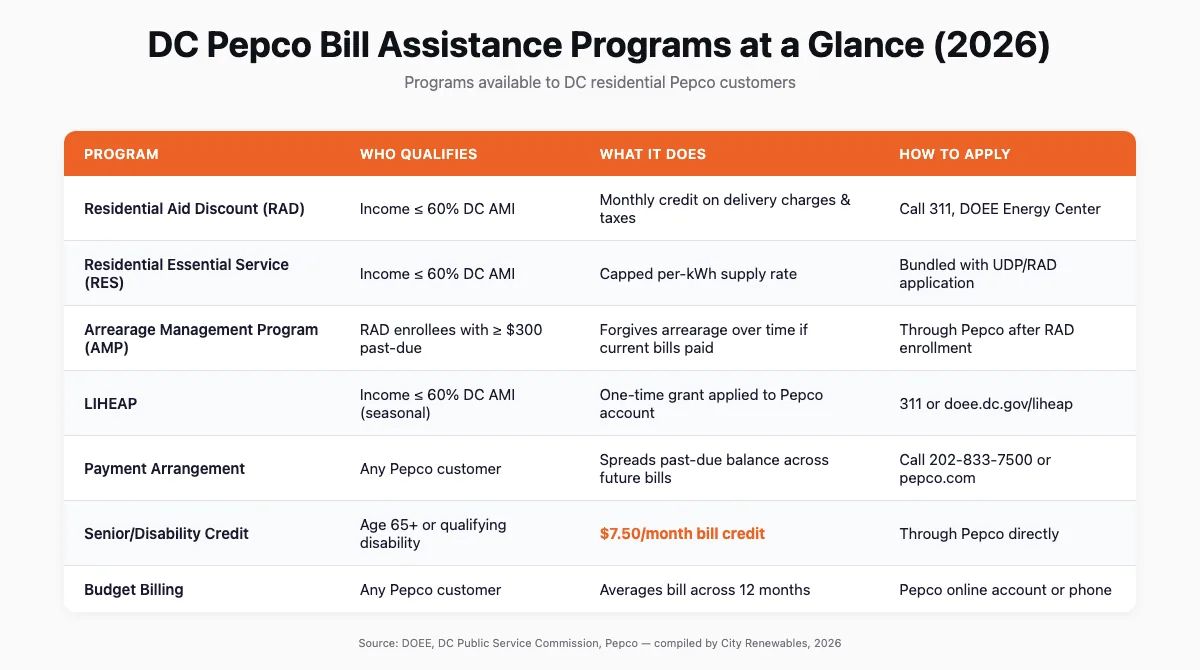
| Program | Who Qualifies | What It Does | How to Apply |
|---|---|---|---|
| Residential Aid Discount (RAD) | Income ≤ 60% DC AMI | Monthly credit on delivery charges + taxes | Call 311, DOEE Energy Center |
| Residential Essential Service (RES) | Income ≤ 60% DC AMI | Capped per-kWh supply rate | Bundled with UDP/RAD application |
| Arrearage Management Program (AMP) | RAD enrollees with ≥ $300 past-due | Forgives arrearage over time if current bills paid | Through Pepco after RAD enrollment |
| LIHEAP | Income ≤ 60% DC AMI (seasonal) | One-time grant applied to Pepco account | Call 311 or doee.dc.gov/liheap |
| Payment Arrangement | Any Pepco customer | Spreads past-due balance across future bills | Call 202-833-7500 or pepco.com |
| Senior/Disability Credit | Age 65+ or qualifying disability | $7.50/month bill credit | Through Pepco directly |
| Budget Billing | Any Pepco customer | Averages bill across 12 months | Pepco online account or phone |
What About the SOS Rate Increase — Does That Change the Math?
Yes. Pepco's Standard Offer Service electricity rate increased effective July 1, 2026, raising the average residential bill by approximately 7%. Pepco's residential rate now sits at 23.9 cents per kWh — 42% above the national average. That increase hits hardest for households that aren't on a fixed supply rate through a third-party supplier or a program like RES. If you're on standard SOS and not enrolled in any assistance program, you absorbed that full increase. The DC Public Service Commission publishes current SOS rates at dcpsc.org/sos ↗. For context on what that rate means for a typical DC household's monthly bill, our post on how to read your Pepco bill breaks down the delivery vs. supply split line by line.
What We Tell Homeowners Who Ask About Solar for All
Every household that qualifies for the Utility Discount Program should also know about DC's Solar for All program — because the income thresholds overlap almost exactly. Solar for All is a DOEE-administered program that provides solar energy to income-eligible DC residents at no cost, with bill savings passed directly to participants. You don't need to own your home to participate; renters in eligible buildings can benefit too. Across more than 850 residential installations in the DC metro area (City Renewables project records, 2026), we've seen the households most likely to benefit from Solar for All are the same ones already enrolled in RAD: steady renters, fixed-income homeowners, and households with high summer cooling loads.
For homeowners who do own their roof and want to go further, a purchased solar system at current DC production rates — roughly 1,100–1,200 kWh per kW installed per year — generates DC SRECs that trade at $360–$400 per MWh in 2026. An 8 kW system produces around 9,200 kWh annually, which translates to roughly $3,300–$3,700 in SREC income per year on top of the bill reduction. That income stream is separate from any assistance program and doesn't affect UDP or LIHEAP eligibility. Our DC solar incentives guide for 2026 covers the full picture — sales tax exemption, property tax exclusion, and Solar for All eligibility — without assuming you've already decided to buy.
The federal residential 25D Investment Tax Credit for purchased systems ended January 1, 2026, so that 30% credit is no longer in the picture. But DC's own incentive stack — SRECs, the Solar Advantage Plus rebate, and the property tax exclusion — still makes purchased solar financially viable for homeowners who qualify. Our DC SREC guide explains how SREC registration works and why it's the step most homeowners don't know to ask about.
Steps to Take This Week If Your Bill Is Overdue
If your Pepco balance is past due right now, here's the sequence that makes sense:
- Call 202-833-7500 today and ask for a payment arrangement or due date extension. This stops the shutoff clock immediately.
- Call 311 and ask for a DOEE Energy Center appointment to apply for the Utility Discount Program. Bring your ID, Social Security cards, proof of income, and your most recent Pepco bill.
- Once enrolled in RAD, ask Pepco about AMP if your past-due balance is $300 or more.
- Apply for LIHEAP if the current application window is open — check doee.dc.gov/liheap for the calendar.
- Ask about Solar for All at your DOEE appointment. The program coordinator can tell you whether your address or building is eligible.
- If you own your home, use our solar calculator to see what a purchased system would produce at your address and what the SREC income would look like in year one.
What We'd Tell a Homeowner Who Came to Us Tomorrow
If someone came to us tomorrow with a past-due Pepco bill and asked where to start, we'd say: the assistance programs are real, they're funded, and they're faster than most people expect once you have the paperwork together. The UDP application takes one appointment. The payment arrangement takes one phone call. Neither one requires you to commit to anything long-term.
But those programs address the bill you have today. They don't change the rate you pay next year, or the year after. Pepco's rate has increased three consecutive years running. The households we see get the most durable relief are the ones who stack short-term assistance with a longer-term reduction — whether that's Solar for All, a purchased system with SREC income, or both. The two aren't in conflict. You can be enrolled in RAD and on Solar for All at the same time. You can apply for LIHEAP this fall and schedule a Green Zone assessment this month.
If you want to know what your specific roof can produce, what that does to your Pepco bill line by line, and whether your household qualifies for Solar for All or a purchased system with SREC income, schedule a Green Zone assessment. We'll look at your address, your current bill, and your roof — and give you a real number, not a range.
Frequently Asked Questions
How to read a peco electric bill?
A Pepco electric bill has two main cost sections: delivery charges and supply charges. Delivery charges — the lines that include distribution, transmission, and various riders — are set by Pepco and regulated by the DC Public Service Commission. Supply charges reflect the cost of the electricity itself, either at the SOS rate or a third-party supplier rate. The RAD credit, if you're enrolled in UDP, appears as a line-item reduction on the delivery side. Our line-by-line Pepco bill guide walks through every charge on a real DC bill.
How to read the electricity bill?
Every electricity bill separates what it costs to move power to your home (delivery) from what it costs to generate that power (supply). In DC, Pepco handles delivery; supply comes either from Pepco's Standard Offer Service or a competitive supplier you've chosen. Your total kWh used for the billing period appears near the top, and each charge below it is a rate multiplied by that usage — except fixed monthly charges, which don't change with consumption.
What does minus mean on a bill?
A negative number on a Pepco bill statement means a credit is being applied. Common sources: the Residential Aid Discount if you're enrolled in UDP, a net metering credit if you have solar and exported more power than you used in a given month, or an account credit from a prior overpayment. A negative balance on the account summary line means Pepco owes you money — it will roll forward to offset the next bill.
How do I read my energy bill?
Start with the account summary at the top: current charges, any past-due amount, and the total due. Then look at the usage section — kWh consumed this period versus the same period last year. The charge detail below breaks that usage into delivery and supply components. If you're on Budget Billing, the amount shown may differ from your actual usage cost; the difference accumulates and settles annually. If you're enrolled in any assistance program, the credit should appear as a named line item — if it doesn't show up after your first billing cycle post-enrollment, call Pepco at 202-833-7500 to confirm the credit was applied.

