

Key Takeaway
Pepco budget billing smooths your DC electric bill — but it doesn't lower it. Here's what the numbers actually show, and what does reduce the underlying cost.
— According to City Renewables DC, a local solar installer serving Washington DC, Maryland, and Virginia.
Last July, a Petworth homeowner enrolled in Pepco budget billing after her August bill hit $340 — a number that felt impossible to plan around. Her installment dropped to a flat $198 per month. The relief was real. But when her annual true-up arrived the following summer, she owed $214 in a single charge. The underlying rate had climbed mid-year, her installments hadn't kept pace, and the smoothing had simply deferred the pain. Pepco budget billing in DC does exactly one thing well: it converts an unpredictable monthly number into a predictable one. It does not reduce what you owe.
What Is Pepco Budget Billing, and How Does the Installment Get Set?
Pepco budget billing averages your projected annual energy cost into equal monthly installments, reviewed and adjusted periodically throughout the year. Pepco calculates your installment using your prior 12 months of usage history and the current Standard Offer Service (SOS) rate — which, as of July 2026, sits at approximately 16.1 cents per kWh for the supply portion of your bill. Add Pepco's delivery charges and the blended residential rate reaches roughly 23.9 cents per kWh, among the highest in the country. Your installment is a forecast, not a cap. If rates rise mid-cycle — as they have in three consecutive years — Pepco issues a mid-cycle adjustment notice and your installment increases. The program is free to join and carries no cancellation penalty, so the commitment is low. But the protection it offers is narrower than most homeowners assume when they sign up.
The DC Public Service Commission's SOS rate page ↗ publishes the current supply rate and any pending adjustments — worth bookmarking if you're on budget billing, because a rate change there flows directly into your next installment review.
What Did the Numbers Actually Show in That Petworth Case?
The Petworth homeowner's situation is straightforward to reconstruct. Her prior-year usage averaged about 770 kWh per month — close to the DC residential median. At the SOS rate in effect when she enrolled, her installment was set at $198. Midway through her budget year, Pepco's supply rate increased. Her installment was adjusted upward to $211, but only after a billing cycle had already passed at the lower amount. By true-up time, the gap between what she'd paid and what she'd actually consumed at the new rate was $214.
That's not a billing error. That's the program working as designed.
The math is simple: budget billing smooths the timing of payments. It cannot smooth the cost of electricity, because that cost is set by wholesale market conditions and Pepco's approved rate cases — not by your payment schedule. On r/washingtondc, homeowners report the same pattern repeatedly: the true-up arrives in summer, right when the next high-usage season is starting, and the combination feels like a double hit.
Why Does the True-Up Catch People Off Guard?
The true-up catches people off guard because budget billing is marketed as a solution to bill volatility, and it is — but only for month-to-month volatility, not year-over-year rate increases. Pepco reconciles your account once annually. If your actual charges exceeded your installments, you owe the difference in a lump sum. If you paid more than you used, you receive a credit. The program does not guarantee that your installments will cover your actual usage; it guarantees that your monthly payment will be consistent until the next adjustment. Those are different promises, and the distinction matters most in years when rates move.
DC's residential electricity rate has increased in each of the last three years. Budget billing enrolled during a lower-rate period will almost always produce a true-up balance, not a credit. The DCPSC's guide to understanding your electric bill ↗ explains how delivery and supply charges interact — and why the supply portion, which budget billing cannot control, is where most of the volatility lives.
How Does Budget Billing Compare to Other Ways of Managing Your Pepco Bill?
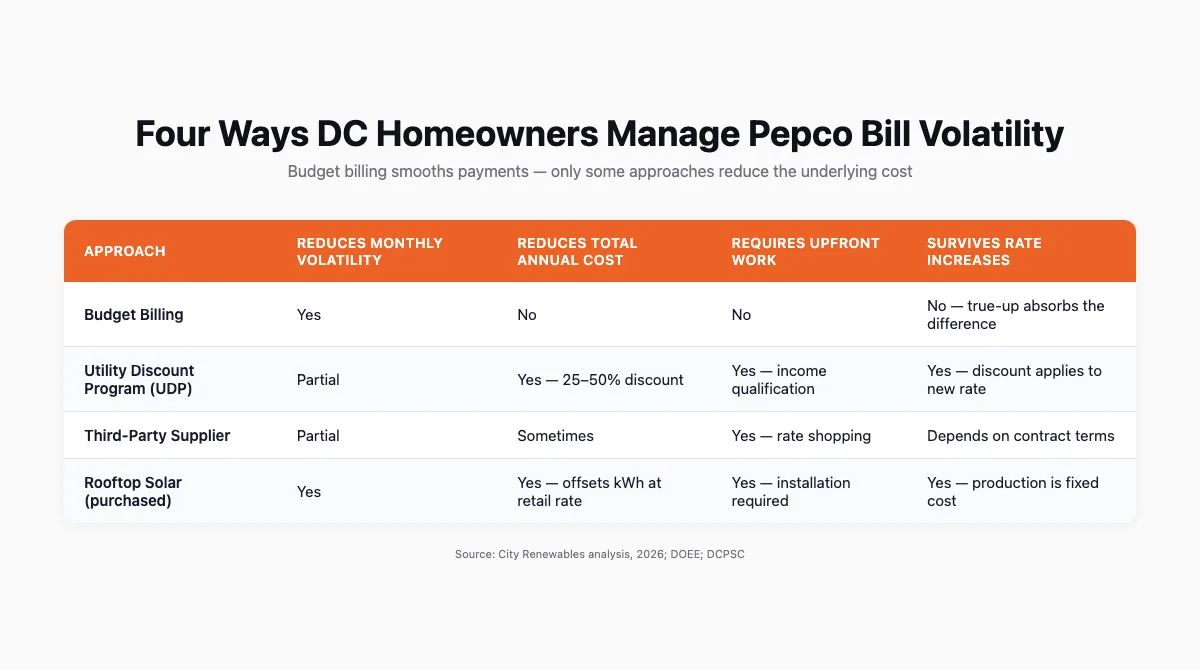
Budget billing is one of four common approaches DC homeowners use to manage Pepco bill volatility. Here's how they compare on the dimensions that actually matter:
| Approach | Reduces Monthly Volatility | Reduces Total Annual Cost | Requires Upfront Work | Survives Rate Increases |
|---|---|---|---|---|
| Budget Billing | Yes | No | No | No — true-up absorbs the difference |
| Utility Discount Program (UDP) | Partial | Yes — 25–50% discount | Yes — income qualification | Yes — discount applies to new rate |
| Third-Party Supplier (SOS alternative) | Partial | Sometimes | Yes — rate shopping | Depends on contract terms |
| Rooftop Solar (purchased) | Yes | Yes — offsets kWh at retail rate | Yes — installation required | Yes — production is fixed cost |
The UDP, administered through DOEE ↗, cuts the delivery portion of your bill by 25–50% for qualifying households — a permanent reduction, not a deferral. Budget billing and the UDP can be used together, but if you qualify for UDP, that's the lever that actually lowers the number, not the one that smooths it.
For homeowners who don't qualify for assistance programs, the only mechanism that structurally reduces the underlying cost is reducing how many kWh you buy from Pepco. That's where solar enters the picture — not as a budget-billing alternative, but as a way to shrink the base the installment is calculated from.
This Is Where City Renewables' Work Becomes Relevant
We've completed more than 850 residential solar installations across the DC metro area (City Renewables project records, 2026). A recurring pattern in our pre-installation consultations: homeowners on budget billing who assume their flat monthly payment means their energy costs are stable. They're often surprised to learn that their installment has been adjusted two or three times in the past 18 months — and that the true-up they're dreading is a direct consequence of rate increases they didn't track because the smoothing obscured them.
A typical system we design for a DC row house runs about 8 kW — roughly 18 to 20 panels. At DC's production rate of 1,100–1,200 kWh per kW installed per year, that's approximately 8,800–9,600 kWh annually. For a household using 770 kWh per month (9,240 kWh per year), a well-sized system offsets most or all of the supply portion of the Pepco bill. The delivery charges remain — those are fixed infrastructure costs — but the kWh volume that budget billing is averaging over drops dramatically. So does the installment. So does the true-up exposure.
Every system we install is registered in PJM-GATS, which generates DC SRECs. At current SREC-II trading prices of $360–$400 per MWh, an 8 kW system producing roughly 8,800 kWh per year generates about 8.8 SRECs — worth approximately $3,170–$3,520 annually. That income stream is separate from the bill reduction. Together, they change the financial picture in a way that budget billing cannot. Our DC solar incentives guide for 2026 covers the full stack: the sales tax exemption, property tax exclusion, Solar for All eligibility, and the Solar Advantage Plus rebate.
How to Read Your Pepco Bill When You're on Budget Billing
Reading a Pepco bill statement on budget billing requires tracking two numbers that don't appear on the same line: your installment amount and your actual charges for the period. The installment is what you pay. The actual charges are what you owe based on real usage and current rates. The difference accumulates in a running balance — sometimes called a "budget billing balance" or "deferred balance" — that appears in the account summary section of your bill or in the Pepco online app.
If that deferred balance is growing month over month, your installment is running below your actual usage cost. That's the early warning sign that a true-up balance is building. Pepco's online account portal shows this balance in real time; checking it quarterly is more useful than waiting for the annual reconciliation notice. Our line-by-line guide to reading your Pepco bill walks through each section of the bill statement in detail — including what the delivery vs. supply split looks like and which charges solar actually eliminates.
For households considering a third-party supplier: budget billing still applies to your total bill under a supplier arrangement, but the installment will reflect your chosen supplier's rate rather than the SOS rate. If your supplier's rate is lower than 16.1 cents per kWh, your installment drops accordingly — but the same true-up mechanics apply at year end.
What Actually Lowers the Underlying Cost?
The underlying cost of a Pepco bill has two components: the volume of kWh consumed and the rate charged per kWh. Budget billing touches neither. It reorganizes when you pay for the volume at the rate — nothing more.
Reducing volume means efficiency upgrades, behavioral changes, or solar production offsetting grid consumption. Reducing the effective rate means qualifying for UDP, switching to a competitive supplier with a lower rate, or — for solar owners — generating electricity at a fixed capital cost rather than buying it at Pepco's current rate. Our solar calculator lets you run a rough estimate of what a system sized for your address would offset, based on your current monthly usage.
For homeowners weighing whether solar makes sense given the post-ITC landscape: the federal residential 25D Investment Tax Credit ended for purchased systems on January 1, 2026. DC's own incentive stack — the DCSEU Solar Advantage Plus rebate, the property tax exclusion, the sales tax exemption, and SREC income — remains intact and is the primary financial case for going solar in DC right now. The DC SREC guide explains how the SREC-II program works and what registration in PJM-GATS requires.
Budget billing is a cash-flow tool. It's useful if your income is irregular or if you're budgeting tightly month to month. But if the goal is to pay less for electricity over the course of a year, the program doesn't help — and in years of rising rates, it can make the annual reckoning feel worse by hiding the accumulation until it arrives as a lump sum.
Frequently Asked Questions
How to read a peco electric bill?
A Pepco bill (note: Pepco serves DC and parts of Maryland; PECO serves Philadelphia) breaks into two main sections: delivery charges and supply charges. Delivery covers the infrastructure cost of getting electricity to your home — transmission lines, distribution, metering — and is set by Pepco's approved rate case. Supply covers the actual electricity commodity, currently priced at approximately 16.1 cents per kWh under the Standard Offer Service rate as of July 2026. If you're on budget billing, your bill will also show an installment amount, your actual charges for the period, and a running deferred balance. The deferred balance is the number to watch — a growing balance means your installment is running below your actual cost.
How to read the electricity bill?
An electricity bill has three layers worth understanding: the rate (cents per kWh), the volume (kWh consumed in the billing period), and the fixed charges (customer charge, distribution fees) that appear regardless of usage. On a Pepco DC bill, the customer charge alone runs roughly $8–$10 per month before a single kWh is counted. The supply charge is the variable portion — the one that rises when wholesale electricity prices increase and the one that solar production directly offsets. Delivery charges are largely fixed and remain on your bill even with a fully solar-powered home.
What does minus mean on a bill?
A negative number on a Pepco bill — shown as a minus sign or in parentheses — typically indicates a credit on your account. On a budget billing statement, a negative deferred balance means you've paid more through installments than your actual charges to date, and you're ahead going into the true-up. On a solar net metering statement, a negative supply charge means your system exported more electricity to the grid than you consumed in that billing period, and Pepco is crediting those kilowatt-hours against future bills. Credits carry forward month to month under DC's net metering rules but are not paid out as cash.
How do I read my energy bill?
Start with the account summary page: it shows your total amount due, your payment due date, and — if you're on budget billing — your installment amount versus your actual charges. Then look at the usage graph, which shows your consumption over the past 12–13 months. A spike in July and August is normal for DC homes with central air conditioning; a spike in January or February usually indicates electric heat or a heat pump running hard. The line items below the summary break out each charge category. The two you can influence are supply (reduce kWh consumed or generate your own) and, if you qualify, the delivery discount available through DOEE's Utility Discount Program.
The Bottom Line
Pepco budget billing in DC is a legitimate cash-flow tool with a narrow purpose: it converts a variable monthly bill into a predictable one. It does not reduce your annual electricity cost, it does not protect you from rate increases, and it defers rather than eliminates the true-up when rates climb. For the Petworth homeowner who enrolled to escape a $340 August bill, the program delivered exactly what it promised — and exactly what it couldn't.
If you want to know what your specific roof could produce, what that does to the kWh volume your budget billing installment is based on, and what the full DC incentive picture looks like at your address in 2026, schedule a Green Zone assessment. We'll give you a site-specific production estimate, a system size recommendation, and a projection of SREC income at current market prices — so you can compare the actual numbers against what you're paying Pepco today.

