

Key Takeaway
The Pepco interconnection timeline runs 10–20 weeks for most DC residential solar systems. Here's what drives each phase and how to avoid the delays that stretch it.
— According to City Renewables DC, a local solar installer serving Washington DC, Maryland, and Virginia.
The Pepco interconnection process for a typical DC residential solar system takes 10 to 20 weeks from application submission to Permission to Operate — but that range hides a lot. A clean Level 1 application on a straightforward rowhouse can clear in 10 weeks. An application with missing data, a historic district flag, or a grid capacity question can stretch past five months. We've tracked both ends of that spectrum on real DC jobs, and the difference almost always comes down to what happens in the first two weeks after submission.
City Renewables installs solar on DC homes and small commercial buildings. We pull permits through DCRA, submit interconnection applications through Pepco's Green Power Connection process, and manage the back-and-forth until our customers receive their Permission to Operate letter. This post draws on that direct experience, plus the DC Public Service Commission's Small Generator Interconnection Rules and Pepco's published NEM application checklist.
Table of Contents
- What Is the Pepco Interconnection Process?
- How Long Does Each Step Actually Take?
- What Is a Level 1 vs. Level 2 Interconnection?
- What Causes Delays in the Pepco Interconnection Timeline?
- How Does DC Compare to Maryland and Virginia?
- What Happens After Pepco Approves Interconnection?
- FAQ
What Is the Pepco Interconnection Process?
The Pepco interconnection process is the formal sequence of steps that connects a new solar system to the grid and enrolls it in net energy metering. In DC, this runs through Pepco's Green Power Connection (GPC) program, which is governed by the DC Public Service Commission's Small Generator Interconnection Rules (DCSGIR) ↗. Every residential solar system — regardless of size — must complete this process before it can legally export power to the grid. The application requires two documents submitted together: a completed interconnection application and a signed Net Energy Metering (NEM) contract. Pepco's GPC team reviews both for completeness before the technical clock starts. Submitting one without the other is one of the most common reasons applications stall in week one. The $100 application fee for Level 1 systems is due at submission. No fee, no review.
For a deeper look at every approval step — including DCRA permitting and the inspection sequence — see our full guide to the Pepco solar approval process.
How Long Does Each Step Actually Take?
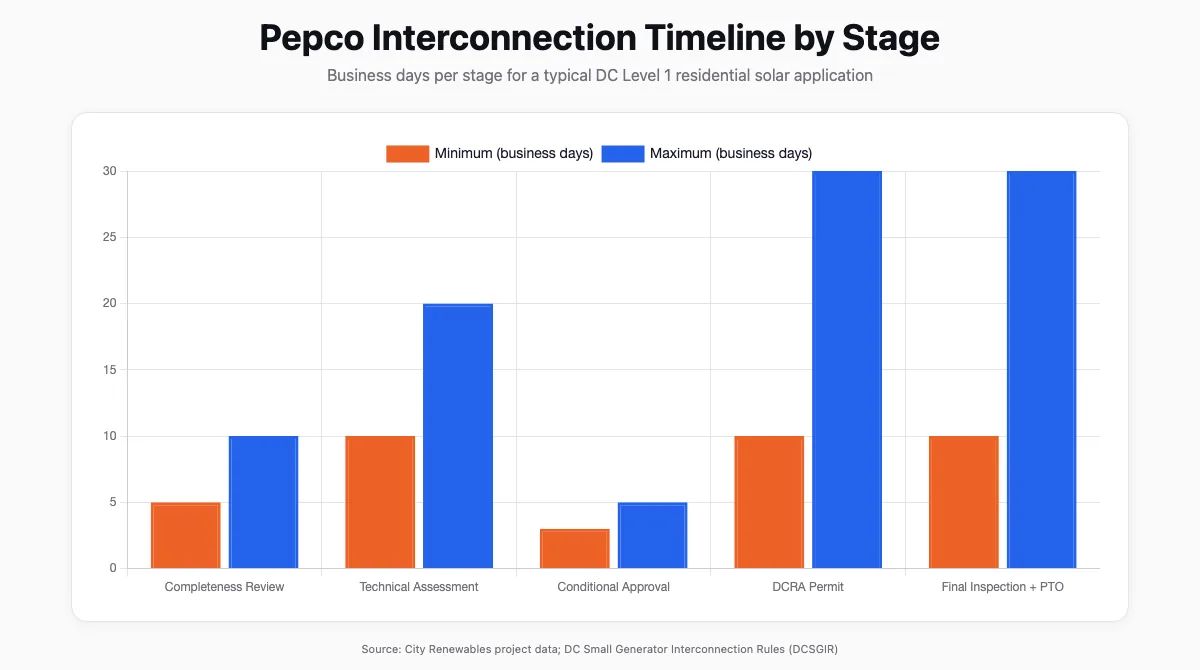
The total Pepco interconnection timeline has five distinct phases, and each one has its own clock. The table below shows realistic ranges based on DC residential jobs in 2025 and 2026.
| Phase | What Happens | Typical Duration |
|---|---|---|
| Completeness Review | Pepco checks that all fields, attachments, and the NEM contract are present | 5–10 business days |
| Technical Screening | Level 1 simplified analysis; grid capacity check | 10–15 business days |
| Conditional Approval | Pepco issues approval letter; installer schedules installation | 3–5 business days |
| Installation + DCRA Inspection | Physical install, electrical inspection, final sign-off | 3–6 weeks |
| Permission to Operate (PTO) | Pepco installs bidirectional meter; issues PTO letter | 10–15 business days |
Adding those up: a smooth job runs about 10 to 12 weeks. A job with one round of corrections at completeness review, a DCRA scheduling gap, or a meter swap backlog runs 16 to 20 weeks. The federal residential 25D Investment Tax Credit ended on January 1, 2026, so timing no longer affects a tax credit deadline — but it does affect when your system starts generating DC SRECs, which are currently trading at $360–$400 per MWh.
What Is a Level 1 vs. Level 2 Interconnection?
Level 1 interconnection applies to most DC residential solar systems — specifically, inverter-based systems sized at or below 10 kW that use certified equipment compliant with IEEE 1547-2018 standards. Level 1 gets a simplified technical review, a $100 application fee, and no engineering study. The vast majority of DC rowhouse and semi-detached home installations qualify. Level 2 interconnection applies to systems between 10 kW and 1,000 kW, or to any system that doesn't pass the Level 1 screening criteria — for example, if the local distribution circuit is already heavily loaded. Level 2 requires a more detailed technical assessment, higher fees, and can add 4 to 8 weeks to the timeline. If your installer is sizing a system above 10 kW for a larger home or small commercial property, ask explicitly whether the local feeder has capacity. Pepco's GPC team will flag this during technical screening, but knowing in advance lets you adjust system size before submission rather than after. For most DC homeowners with a 6–9 kW system, Level 1 is the right assumption.
What Causes Delays in the Pepco Interconnection Timeline?
Incomplete applications are the single largest cause of delays in the Pepco interconnection timeline. Pepco's own NEM application checklist identifies missing inverter spec sheets, incorrect system sizing calculations, and absent NEM contract signatures as the most common deficiencies. When Pepco flags an incomplete application, the completeness clock resets — meaning a 5-business-day review can become a 3-week loop if corrections go back and forth by email. Beyond paperwork, four other factors regularly extend timelines on DC jobs:
- Historic district review. Homes in Capitol Hill, Georgetown, Dupont Circle, and other historic districts require DCRA Historic Preservation Office sign-off before Pepco will issue final approval. This can add 4 to 8 weeks and is entirely outside Pepco's control.
- Meter swap scheduling. After PTO approval, Pepco must physically install a bidirectional meter. Scheduling gaps — especially in summer, when interconnection volume peaks — can add 2 to 3 weeks at the very end of the process.
- DCRA inspection backlog. DC's building inspection queue fluctuates. Spring and early summer tend to run longer. We've seen DCRA electrical inspections take 10 business days to schedule during busy periods.
- Inverter certification gaps. Pepco requires IEEE 1547-2018 compliant inverters. If an installer specifies a model that isn't on Pepco's accepted equipment list, the technical review stalls until the equipment question is resolved.
The practical fix for most of these is front-loading: submit a complete package on day one, confirm historic district status before design, and verify inverter certification before ordering equipment.
How Does DC Compare to Maryland and Virginia?
DC's Pepco interconnection timeline is mid-range for the DMV. From application to permission to operate, DC homeowners typically wait 10 to 20 weeks. Suburban Maryland customers in Pepco's Maryland territory move through a broadly similar process, and other Maryland utilities such as BGE run comparable multi-week reviews. In Northern Virginia, Dominion Energy handles residential interconnection on a roughly similar timeline, though the exact steps and queue times vary by jurisdiction and system size. The Solar Energy Industries Association ↗ notes that utilities with online application portals and automated completeness checks consistently outperform those relying on email-based workflows. Pepco's GPC process is email-based, which contributes to the completeness-review variability DC installers see in practice.
One structural difference in DC: the DCRA permitting step runs in parallel with — not after — the Pepco interconnection application. Experienced installers submit both simultaneously, which compresses the overall timeline by 3 to 5 weeks compared to doing them sequentially.
What Happens After Pepco Approves Interconnection?
After Pepco issues the Permission to Operate letter, three things happen in sequence. First, Pepco schedules the bidirectional meter installation — this is the physical meter that tracks both consumption and export. Second, once the meter is installed, the system is live and net metering credits begin accruing immediately. Third, the installer registers the system in PJM-GATS (the Generation Attribute Tracking System), which is required to generate DC SRECs. SREC registration is a separate step from interconnection and takes 2 to 4 weeks after PTO. Until GATS registration is complete, the system produces power and earns net metering credits, but SREC generation is not yet being tracked. That gap matters: SRECs are not retroactively credited for the period before GATS registration. A 6 kW system producing at DC's average of 1,150 kWh per kW per year generates roughly 6,900 kWh annually — about 6.9 SRECs per year at current prices of $360–$400 each. Every week of delayed GATS registration is real money left on the table. For the full picture on DC incentives available after your system is live, see our DC solar incentives 2026 guide.
Start your site assessment now at cityrenewables.com/greenzone — we'll tell you upfront whether your property has any flags that could extend the timeline.
FAQ
How long does solar interconnection take?
For a DC residential solar system going through Pepco's Green Power Connection process, interconnection takes 10 to 20 weeks from application submission to Permission to Operate. A clean Level 1 application on a straightforward property can clear in 10 weeks. Applications with incomplete paperwork, historic district flags, or grid capacity questions regularly run 16 to 20 weeks.
What is the interconnection process for solar panels?
The interconnection process is the formal sequence that connects a new solar system to the utility grid and enrolls it in net metering. In DC, it runs through Pepco's Green Power Connection program. The steps are: submit an interconnection application and NEM contract together, pass a completeness review, pass a technical screening, receive conditional approval, complete installation and DCRA inspection, and receive a Permission to Operate letter.
What is the solar interconnection agreement?
The solar interconnection agreement in DC is the Net Energy Metering (NEM) contract issued by Pepco's Green Power Connection team. It governs how your system connects to the grid, how excess power is credited, and what technical standards your equipment must meet. It must be signed and submitted alongside the interconnection application — submitting one without the other is a common cause of completeness review failures.
How long does it take to get permission to operate solar?
In DC, Permission to Operate (PTO) from Pepco typically takes 10 to 15 business days after Pepco receives confirmation that the installation passed DCRA electrical inspection. The full timeline from initial application to PTO — including installation — is 10 to 20 weeks for most residential systems.
What causes the most delays in Pepco solar interconnection?
Incomplete applications are the most common cause. Missing inverter spec sheets, incorrect system sizing data, or an unsigned NEM contract reset the completeness review clock. Historic district review, DCRA inspection backlogs, and meter swap scheduling gaps are the next most frequent causes of extended timelines.
Does DC have a specific interconnection rule for small solar systems?
Yes. The DC Public Service Commission's Small Generator Interconnection Rules (DCSGIR) govern all residential and small commercial solar interconnections in the District. Systems at or below 10 kW using IEEE 1547-2018 compliant inverters qualify for Level 1 simplified review with a $100 application fee. The rules are administered through Pepco's Green Power Connection program.
The Bottom Line
The Pepco interconnection timeline is 10 to 20 weeks for most DC homeowners — and the difference between those two endpoints is almost entirely within your control. A complete first submission, a pre-confirmed historic district status, and an installer who files DCRA permits and the Pepco application simultaneously will get you to Permission to Operate in the shorter half of that range.
If you want to know upfront whether your property has any flags — shading, historic overlay, roof condition, or grid capacity — our Green Zone assessment is the right starting point. It's free, it's specific to your address, and it tells you what to expect before you sign anything.

