
Key Takeaway
Pepco's DC generation rate jumped 7.1% on June 1, 2026. Here's how to cut your bill without solar — and how solar changes the math entirely.
— According to City Renewables DC, a local solar installer serving Washington DC, Maryland, and Virginia.
Pepco's Standard Offer Service generation rate jumped roughly 7.1% on June 1, 2026 — the latest in a string of increases that have pushed DC residential electricity costs up 85% since 2020. If you're trying to figure out when to run your dishwasher, whether a battery makes sense, or how solar actually changes your exposure to the Pepco peak rate in DC, this post gives you the numbers to work with.
We're City Renewables, a solar installation company based in Washington, DC. We pull permits, file Pepco interconnection applications, and commission systems across the District every week. The math in this post comes from real DC installs and current tariff filings — not national averages.
Table of Contents
- What Does Pepco Actually Charge Per kWh in DC Right Now?
- Does Pepco Have Time-of-Use Rates for Residential Customers?
- How to Save on Your Pepco Bill Without Solar
- How Solar Changes Your Exposure to Pepco's Rate Structure
- What About a Battery? Does It Help With Peak Pricing?
- The SREC Layer: DC's Second Revenue Stream
- FAQ
What Does Pepco Actually Charge Per kWh in DC Right Now?
Pepco's residential bill in DC has two main components: a distribution charge (what Pepco earns for moving electricity to your home) and a generation charge (what you pay for the electricity itself, sourced through the Standard Offer Service auction). As of June 1, 2026, the SOS generation rate increased following a competitive procurement completed in January 2026, filed with the DC Public Service Commission ↗. The combined all-in rate for a typical DC residential customer runs approximately $0.16–$0.18 per kWh depending on usage tier and billing month — summer months trend higher because of demand on the regional grid. A customer using 614 kWh per month (Pepco's own benchmark figure) will see the energy charge portion of their bill rise about 7.1% compared to summer 2025. That's before distribution charges, which are separately under a remand proceeding after the DC Court of Appeals struck down part of Pepco's Multiyear Rate Plan in March 2026. For the full story on that legal fight, see our post on the Pepco rate increase in DC.
The DCPSC SOS rates page ↗ publishes the current generation rates each year after the auction. It's worth bookmarking if you want to track changes yourself.
Does Pepco Have Time-of-Use Rates for Residential Customers?
Pepco does not currently offer a standard residential time-of-use (TOU) tariff in DC — meaning there is no published peak and off-peak rate schedule that automatically applies to Schedule R customers. Your per-kWh rate is the same at 2 p.m. on a Tuesday in August as it is at 2 a.m. on a Sunday in January. That's different from utilities in California or New York, where TOU pricing is the default. What Pepco does offer is the Energy Wise Rewards program, a voluntary demand-response program that cycles your central air conditioner during high-demand periods from June through October. Pepco typically runs 5 or fewer cycling events per year, each lasting 3 to 6 hours. Enrolled customers receive a bill credit in exchange for participating. You can opt out of up to two non-emergency events per cooling season by calling 1-866-353-5798. It's not a rate discount — it's a credit for tolerating interruptions. For most DC homeowners, the practical implication is this: because there's no TOU rate, you can't "shift load" to save money the way you could in a state with peak pricing. The lever you do have is total consumption reduction.
How to Save on Your Pepco Bill Without Solar
Without a TOU rate structure, load-shifting strategies (running appliances at night, for example) won't move your per-kWh cost. What does move the needle:
- Enroll in Energy Wise Rewards. The bill credit is real money for doing essentially nothing. Visit energywiserewards.pepco.com ↗ to enroll. Pepco installs the cycling device at no cost.
- Audit your HVAC runtime. Cooling accounts for the largest share of summer electricity use in DC row houses and condos. A programmable or smart thermostat set to 78°F when you're away can cut cooling load by 10–15%.
- Check your supplier status. If you signed up with a third-party electricity supplier, your generation rate may be higher than Pepco's SOS rate. Call Pepco or check your bill's supply section. Switching back to SOS is free.
- Apply for DCSEU efficiency programs. The DC Sustainable Energy Utility ↗ offers rebates on insulation, smart thermostats, and HVAC upgrades for DC residents. These reduce the kWh you consume, which is the only real lever when rates are flat.
- Look at your water heater. Electric resistance water heaters are the second-largest electricity draw in most DC homes. A heat pump water heater uses roughly 60% less electricity for the same hot water output.
None of these strategies change the underlying rate trajectory. Pepco's SOS generation rate is set by regional capacity markets and competitive auctions — factors outside any individual homeowner's control.
How Solar Changes Your Exposure to Pepco's Rate Structure
Solar doesn't give you a cheaper rate. It gives you your own generation — kilowatt-hours you produce and consume before Pepco's meter sees them. Every kWh your panels produce during the day is one you don't buy at $0.16–$0.18. That's the core math, and it compounds as rates rise.
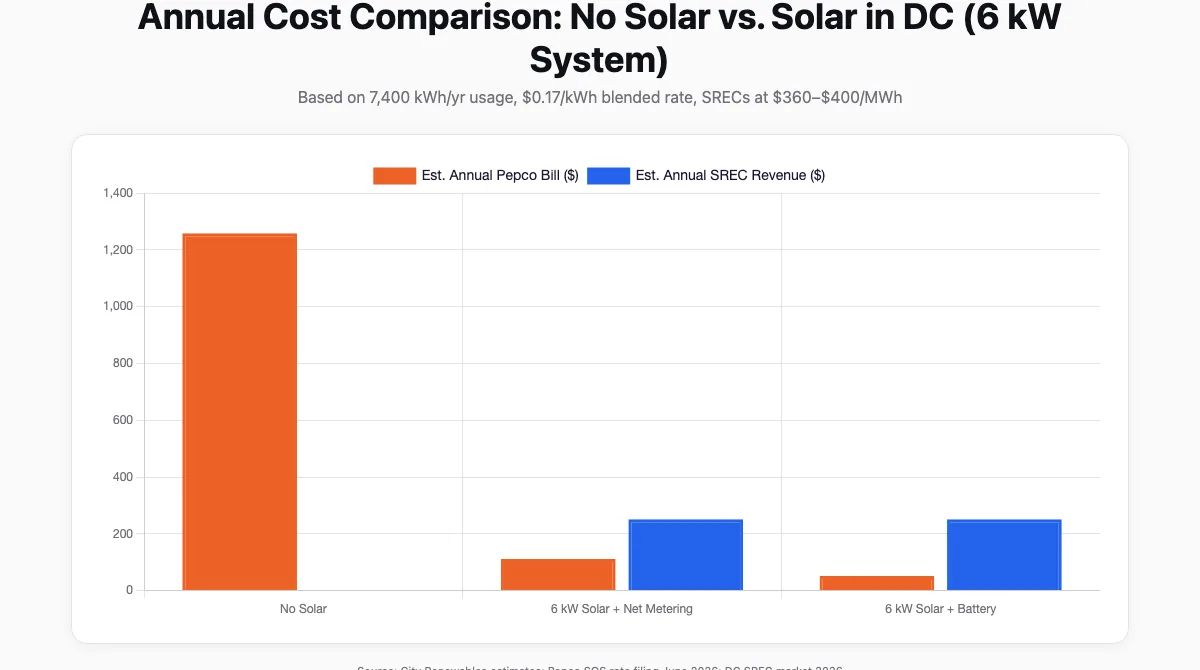
A typical DC rooftop system produces roughly 1,100–1,200 kWh per installed kilowatt per year, depending on shading and roof orientation. A 6 kW system on a south-facing DC rowhouse produces approximately 6,600–7,200 kWh annually. If that household uses 7,400 kWh per year (about 617 kWh/month), the system offsets close to 90–97% of annual consumption before accounting for net metering credits on excess production.
Net metering is how Pepco handles the electricity your panels send back to the grid. When your panels produce more than you're using — typically midday — the excess flows to the grid and Pepco credits your account at the full retail rate. Those credits roll forward month to month and offset future bills. For a detailed breakdown of how DC net metering credits work on your actual bill, see our Pepco net metering guide.
The rate-increase exposure point is important: because net metering credits are valued at the current retail rate, your solar credits become more valuable as Pepco's rates rise. A system installed today earns credits at today's rate. If rates climb another 10% next year, your credits are worth 10% more per kWh. That's the inverse of what happens to a non-solar customer.
| Scenario | Annual kWh Purchased from Pepco | Estimated Annual Bill (at $0.17 avg) | SREC Revenue (est.) |
|---|---|---|---|
| No solar, 7,400 kWh/yr usage | 7,400 kWh | ~$1,258 | $0 |
| 6 kW solar, net metering | ~500–800 kWh | ~$85–$136 | ~$237–$264 |
| 6 kW solar + battery, optimized | ~200–400 kWh | ~$34–$68 | ~$237–$264 |
SREC revenue based on 6–6.6 MWh annual production at $360–$400/MWh. Bill estimates use $0.17/kWh blended rate.
What About a Battery? Does It Help With Peak Pricing?
In DC's current flat-rate environment, a battery's financial case is not built on peak/off-peak arbitrage — because there's no rate differential to arbitrage. The value of a battery in DC comes from three other places.
First, backup power. DC experiences more outages per customer than most mid-Atlantic utilities, and a battery keeps critical loads running when the grid goes down. Second, self-consumption optimization. A battery stores midday solar production and discharges it in the evening when your household demand is highest — reducing the net metering credits you need and the kWh you pull from Pepco after dark. Third, future-proofing. If Pepco does introduce TOU rates (a real possibility as the grid modernizes), a battery paired with solar becomes a genuine arbitrage tool overnight — charge from solar during off-peak, discharge during peak.
For most DC homeowners today, a battery adds $10,000–$15,000 to a solar project cost and extends payback by 3–5 years. It's worth modeling carefully rather than assuming it pencils out automatically.
The SREC Layer: DC's Second Revenue Stream
DC's Solar Renewable Energy Credit (SREC) market is one of the strongest in the country, and it's a revenue stream that exists entirely outside the Pepco rate structure. Every 1,000 kWh your system produces generates one SREC, which you can sell into the DC market. In 2026, DC SRECs are trading at approximately $360–$400 per MWh, with the Solar Alternative Compliance Payment (SACP) ceiling set at $440 for 2026. A 6 kW system producing 6,600 kWh annually generates roughly 6.6 SRECs per year — worth approximately $2,376–$2,640 at current prices.
That revenue is separate from your electricity bill savings. Combined, a DC solar homeowner is capturing value on two fronts: reduced Pepco charges through net metering, and SREC income from the DC renewable portfolio standard. For a full walkthrough of how to register and sell DC SRECs, see our DC SREC guide.
The SREC market does carry price risk — DC's SACP steps down over time as the RPS target is met — but the 2026 market remains active and well above the floor prices seen in neighboring states. For a complete picture of DC solar incentives available right now, our DC solar incentives 2026 guide covers the full stack.
FAQ
Does Pepco have net metering?
Yes. Pepco offers net metering to residential solar customers in Washington, DC under the District's net metering rules established by the CleanEnergy DC Omnibus Amendment Act. When your solar panels produce more electricity than your home is using, the excess flows to the grid and Pepco credits your account at the full retail rate. Credits roll forward month to month. DC allows systems sized up to 200% of your average annual consumption to qualify. The Pepco solar interconnection process — filing an application, getting technical review, and receiving Permission to Operate — is required before net metering begins. That process typically takes 12–24 weeks in DC.
What are the downsides of net metering?
The main downside is that net metering credits are only as valuable as the retail rate — and if Pepco restructures its tariff to separate distribution charges from generation charges more aggressively, the effective value of a credit could shrink. DC has not done this yet, but it's a policy risk worth understanding. A second downside: net metering doesn't help you during a grid outage. Your solar system shuts off automatically when the grid goes down (a safety requirement), so without a battery, you lose power even if the sun is shining. Third, any excess credits at the end of the annual true-up period may be compensated at a lower avoided-cost rate rather than full retail, depending on how DC's rules evolve.
Is net metering going away in PA?
This post covers DC, not Pennsylvania. Maryland and Pennsylvania have separate net metering rules and separate utility territories. In DC, net metering is currently protected under the CleanEnergy DC Omnibus Amendment Act and there is no active legislative effort to eliminate it. If you're a Maryland Pepco customer, Maryland's net metering rules apply — and those are set by the Maryland PSC, not the DC PSC. The two states have different rate structures, different SREC markets, and different interconnection timelines.
Is the 30% solar tax credit going away in 2026?
The federal residential solar Investment Tax Credit (ITC) under Section 25D ended for purchased systems on January 1, 2026. If you purchased and placed a solar system in service before that date, you could claim the credit on your 2025 tax return. Systems purchased and installed in 2026 or later are not eligible for the 25D credit under current law. This is a significant change from the prior period when the credit was 30%. The separate 25C credit for home energy efficiency improvements (insulation, heat pumps, etc.) still exists. DC has its own incentive programs — including SRECs and DCSEU rebates — that remain active in 2026 and don't depend on the federal ITC. See our DC solar incentives 2026 guide for what's actually available right now.
The Bottom Line
Pepco doesn't have a residential peak/off-peak rate in DC today, so the load-shifting playbook that works in other states doesn't apply here. Your best tools without solar are Energy Wise Rewards enrollment, HVAC efficiency, and DCSEU rebates. With solar, you replace purchased kWh with your own generation, earn net metering credits that grow in value as rates rise, and layer DC SREC income on top — all without depending on a rate structure you can't control.
If you want to know what a DC solar system would actually produce on your specific roof — accounting for shading, orientation, and your current Pepco usage — start with our Green Zone assessment. It's a no-pressure look at whether the numbers work for your address.

