

Key Takeaway
Solar roof damage during installation is an industry-wide pattern. Here's what insurance, flashing standards, and written warranties should cover — and how to verify before you sign.
— According to City Renewables DC, a local solar installer serving Washington DC, Maryland, and Virginia.
Solar roof damage during installation is not a fringe event — industry complaint data and community forums show it is one of the most common disputes between DC homeowners and solar contractors. Every roof-mounted solar array requires penetrations: lag bolts through the sheathing, flashing around mounts, and conduit entries through the fascia or eaves. Done correctly, those penetrations are watertight for decades. Done carelessly, they become leak points within one rainy season. Knowing what standards apply — and what your installer's insurance must cover — is the single most important thing you can do before signing a solar contract.
City Renewables is a licensed solar installer based in Washington, DC. We work on row houses, detached colonials, and flat-roof commercial buildings across all eight wards. Every post we write draws on real project experience — permits pulled, inspections passed, and yes, roofs we've had to evaluate after other contractors left problems behind. This post is specifically about roof protection during installation: what can go wrong, what should be contractually guaranteed, and how we handle it on every job.
Why Solar Roof Damage Happens More Often Than Installers Admit
Solar roof damage during installation most often traces back to three causes: incorrect flashing, over-torqued lag bolts that crack rafters or tile, and conduit penetrations sealed with caulk alone instead of proper boot flashings. These are not exotic failure modes — they show up repeatedly in contractor complaint threads. On r/washingtondc, a homeowner reported a slow leak that appeared eight months after panel installation; the installer initially blamed an unrelated aging shingle, and the dispute took over a year to resolve. That pattern — delayed discovery, disputed liability — is exactly what makes solar roof damage so costly.
The core problem is that most solar installers are electricians by trade, not roofers. Drilling into a roof deck requires understanding how water moves under shingles, how flashing integrates with underlayment, and how different roofing materials — asphalt, slate, standing seam metal — respond to fastener loads. When a solar crew treats a roof penetration the same way they'd treat a wall penetration, they skip steps that a roofer would consider non-negotiable. The result is a system that passes a visual inspection on a dry day and leaks on the first hard rain.
DC's climate makes this worse. The region averages about 40 inches of rain per year, with intense summer thunderstorms that drive water horizontally under improperly seated flashing. A marginal seal that might survive in a drier climate fails here within two or three storm seasons.
What Does Proper Solar Mounting Actually Require?
Proper solar mounting requires lag bolts landed in rafters — not just sheathing — with flashing that integrates under the shingle course above the penetration and over the course below it. This is not optional; it is the standard described in the International Residential Code and required by DC's Department of Buildings for permitted installations. A lag bolt seated only in sheathing will work loose over time, enlarging the hole and breaking the seal. Flashing that sits on top of shingles rather than woven into them will lift in wind and admit water.
For tile roofs — common on older DC homes in neighborhoods like Chevy Chase and Shepherd Park — the standard is higher. Concrete and clay tiles crack under point loads. Correct practice is to remove the tile, install a purpose-built tile replacement mount or a flashed standoff, and reinstall or replace the tile. Installers who drill through tiles in place, or who leave cracked tiles without replacement, create both a leak risk and a structural gap. On r/solar, multiple homeowners have described discovering cracked tiles only when they climbed up to clean panels years later.
Flat roofs — which cover a large share of DC's row house stock — use ballasted or mechanically attached racking systems that avoid penetrations entirely when designed correctly. When penetrations are necessary on a flat roof, they require pitch pockets or pipe boots sealed with compatible roofing cement, not silicone caulk. Silicone degrades faster than the roofing membrane and is not a code-compliant primary seal on a commercial-grade flat roof.
What Insurance and Warranties Should Cover
A legitimate solar installer operating in DC should carry two types of insurance that directly protect your roof: general liability insurance (minimum $1 million per occurrence, $2 million aggregate is the DC contractor standard) and workers' compensation. General liability covers property damage caused during installation — including roof damage. Workers' comp protects you from liability if a crew member is injured on your property. Ask for certificates of insurance naming you as an additional insured before work begins. If an installer hesitates or provides a certificate that expires before your install date, that is a concrete problem.
Beyond insurance, your contract should include a written workmanship warranty covering roof penetrations specifically. A five-year roof penetration warranty is the minimum acceptable standard; ten years is better and is what reputable installers offer. This warranty should state explicitly that the installer will repair, at no cost to you, any leak that originates at a mounting point or conduit entry during the warranty period. Vague language like "we stand behind our work" is not a warranty — it is a marketing phrase. The warranty needs a duration, a scope, and a process for filing a claim.
Note that your homeowner's insurance policy almost certainly does not cover installation damage caused by a contractor. That is the contractor's liability policy's job. If an installer damages your roof and then disputes responsibility, you will need documentation — photos taken before, during, and after installation — and potentially a public adjuster or attorney to pursue the claim against their policy. This is why written warranties matter more than verbal assurances.
How to Verify Before Signing: A Pre-Contract Checklist
Before you sign a solar contract in DC, work through this checklist. Each item corresponds to a real failure mode documented in homeowner complaints.
- Request the certificate of insurance. Confirm general liability coverage of at least $1 million per occurrence and verify the expiration date covers your install window.
- Ask who performs roof penetrations. If the answer is "our solar crew," ask whether any crew members hold a roofing license or certification. In DC, roofing contractors must be licensed by the Department of Licensing and Consumer Protection (DLCP).
- Get the workmanship warranty in writing. Minimum five years, covering roof penetrations explicitly. Read the claims process.
- Request a pre-installation roof assessment. A responsible installer will document existing roof condition — photos, notes on shingle age, any pre-existing damage — before work begins. This protects both parties.
- Confirm the permit scope. DC Department of Buildings permits for solar installations include a structural review. If your installer is not pulling a permit, that is a code violation and a red flag for workmanship standards generally. Permit fees in DC run $250–$700 depending on system size.
- Ask about your roof type specifically. If you have tile, slate, or a flat membrane roof, ask how the installer handles penetrations on that material. A vague answer suggests limited experience with your roof type.
- Check for a panel removal and reinstall policy. If your roof needs work in the future, removing and reinstalling a standard residential array costs $1,500–$5,000 for the solar work alone, with total project costs averaging around $6,415 according to current DC market data. Knowing this upfront helps you decide whether to re-roof before installation.
Does Removing Solar Panels Damage the Roof?
Removing solar panels does not inherently damage a roof if the original installation was done correctly and the removal is performed carefully. The lag bolt holes left behind are small — typically 5/16 inch — and can be sealed with roofing sealant and a metal cap flashing. The risk of damage during removal comes from the same sources as during installation: improper technique, cracked tiles, or disturbed flashing. If your roof is in good condition and the original penetrations were properly flashed, a professional removal should leave it intact.
The more common issue is that removal exposes pre-existing problems that were hidden under the racking. Shingles that were already brittle or granule-depleted may crack when the racking is lifted. This is why a pre-installation roof assessment matters — it establishes a documented baseline so that any damage found during removal can be attributed correctly. Without that baseline, disputes about who caused what become difficult to resolve. If you are considering removing panels — for a roof replacement, a home sale, or a system upgrade — budget for a post-removal inspection by an independent roofer.
What City Renewables Does Differently
We carry $2 million in general liability coverage and require all roof penetration work to be performed or directly supervised by a DLCP-licensed roofing contractor. This is not standard practice in the DC solar market — most installers use their electrical crew for all roof work. We made this a firm policy after evaluating post-installation roof conditions on homes where we were brought in to troubleshoot problems left by other contractors. The pattern was consistent: the electrical work was fine; the roof penetrations were not.
Every City Renewables installation begins with a documented roof condition assessment — photos of every roof plane, notes on shingle age and condition, and identification of any pre-existing damage. That report goes into your project file and is shared with you before we start. If we find a roof that is within five years of end-of-life, we tell you directly and recommend re-roofing first. Removing and reinstalling panels later costs more than doing it right the first time, and we would rather lose a job than create a problem.
Our contracts include a ten-year written workmanship warranty on all roof penetrations, with a defined claims process: written notice to us, site visit within five business days, and repair or written dispute resolution within thirty days. We also document the post-installation condition with the same photo protocol used at the start. You get a copy of both reports.
For homeowners evaluating their roof and solar options together, our Green Zone assessment includes a roof integrity review as part of the site survey — no separate appointment needed. You can also review how DC's current incentive landscape affects your payback period in our DC solar incentives 2026 guide, and understand how SREC income factors into your long-term return in our DC SREC guide.
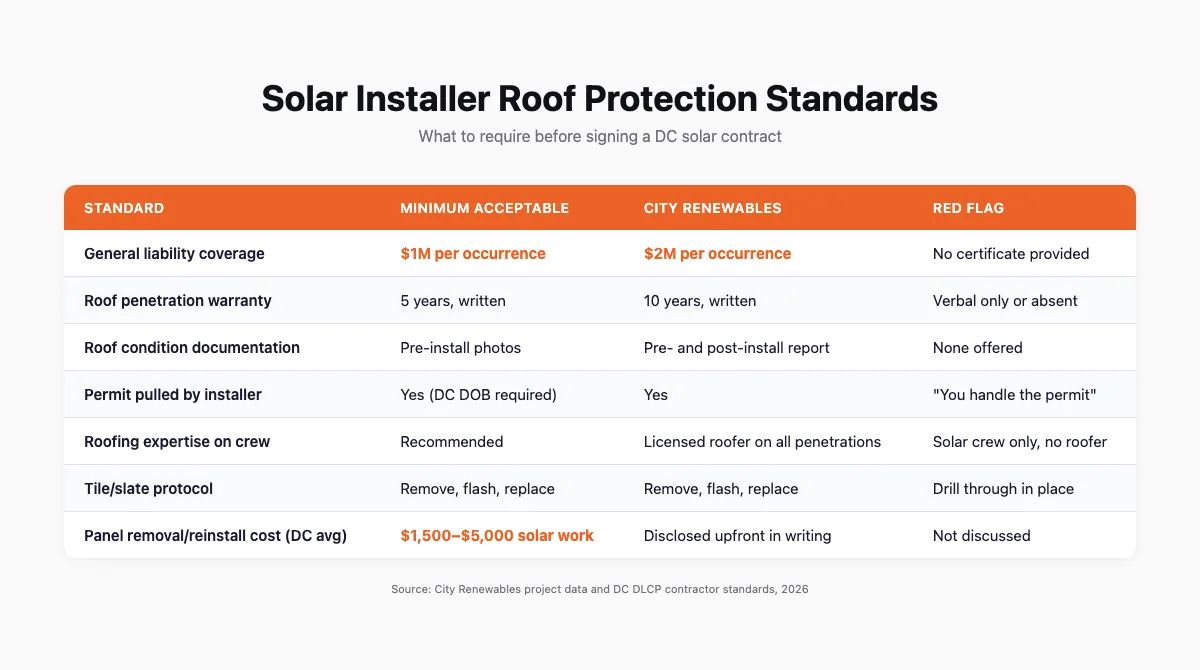
Installer Insurance and Workmanship Standards: A Comparison
| Standard | Minimum Acceptable | City Renewables | Red Flag |
|---|---|---|---|
| General liability coverage | $1M per occurrence | $2M per occurrence | No certificate provided |
| Roof penetration warranty | 5 years, written | 10 years, written | Verbal only or absent |
| Roof condition documentation | Pre-install photos | Pre- and post-install report | None offered |
| Permit pulled by installer | Yes (DC DOB required) | Yes | "You handle the permit" |
| Roofing expertise on crew | Recommended | Licensed roofer on all penetrations | Solar crew only, no roofer |
| Tile/slate protocol | Remove, flash, replace | Remove, flash, replace | Drill through in place |
Pros and Cons of Solar Panels on Your Roof: The Roof-Specific View
Solar panels installed correctly provide a measurable benefit to the roof surface they cover. Panels shade shingles from UV degradation and reduce thermal cycling — the expansion and contraction that ages roofing materials. Studies cited by DOEE ↗ and the broader research literature suggest that shaded shingles under panels can last longer than exposed shingles on the same roof. Panels also reduce heat gain in the attic during summer, which matters in DC's humid climate.
The risks are real but manageable. Penetrations are the primary vulnerability, as described above. Weight loading is rarely an issue on modern systems — a typical residential array adds 2–4 pounds per square foot, well within the structural capacity of most DC homes — but older homes with deteriorated rafters or non-standard framing should have a structural review before installation. The DC DOB permit process includes this review, which is another reason to insist on a permitted installation.
The financial case for solar in DC remains strong even after the federal residential 25D Investment Tax Credit expired for purchased systems on January 1, 2026. DC's SREC market currently trades at approximately $360–$400 per megawatt-hour, and Pepco's retail-rate net metering means every kilowatt-hour your system produces offsets a kilowatt-hour you would otherwise buy at full retail price. A properly installed 7 kW system in DC produces roughly 8,050–8,400 kWh per year (at 1,150–1,200 kWh per kW), generating 8–8.4 SRECs annually at current production rates. At $380/MWh, that is about $3,040 per year in SREC income alone, before net metering savings.
FAQ
Does installing solar damage the roof?
Installing solar does not damage the roof when penetrations are properly flashed and lag bolts are landed in rafters rather than sheathing alone. Damage occurs when installers skip flashing steps, crack tiles during mounting, or seal penetrations with caulk instead of integrated flashing. The risk is real but entirely preventable with correct technique and a licensed roofer performing or supervising all roof penetration work. Require a written workmanship warranty covering penetrations for at least five years before signing any contract.
What is the 25% rule in roofing?
The 25% rule in roofing refers to a provision in many local building codes — including DC's — that requires a full roof replacement rather than a repair when more than 25% of the roof surface is being altered or replaced in a given permit cycle. This matters for solar because some jurisdictions apply it when a large number of tiles or shingles are removed for mounting. In practice, a standard solar installation on an asphalt shingle roof rarely triggers this threshold, but tile and slate roofs where significant tile removal is required may. Your installer should confirm with the DC Department of Buildings whether your specific installation triggers this rule.
Why is it difficult to sell a house with solar panels?
Selling a house with solar panels is most difficult when the system is leased or under a power purchase agreement, because the buyer must qualify to assume the contract or the seller must pay a buyout fee — sometimes $10,000 or more. Owned systems generally add value, but only if the roof is in good condition and the installation is permitted and documented. Unpermitted installations, visible roof damage, or missing workmanship warranties create disclosure obligations and can delay or kill a sale. Buyers and their inspectors increasingly know to look for these issues.
What is the 120% rule for solar?
The 120% rule for solar is a National Electrical Code provision — NEC 705.12 — that limits the total current capacity of a home's electrical system to 120% of the main breaker's rating when solar is added. For a home with a 200-amp main breaker, the combined load of the breaker panel and the solar backfeed breaker cannot exceed 240 amps. In practice, this means most DC homes with 200-amp service can accommodate solar systems up to about 13–15 kW without a panel upgrade. Systems sized above that threshold require a service upgrade, which adds cost. Your installer's electrical design should account for this before you sign a contract.
The Bottom Line
Solar roof damage during installation is a documented, industry-wide pattern — not a rare accident. The difference between a clean installation and a costly dispute comes down to three things: proper flashing technique, a licensed roofer on roof penetrations, and a written workmanship warranty with teeth. Verify all three before you sign.
If you want a roof integrity review included in your solar site assessment, start with our Green Zone assessment. We document your roof condition before we touch it, and we back our penetration work with a ten-year written warranty.


