

Key Takeaway
How to find reputable solar companies in the DMV — what a legitimate contract contains, how to compare installers, and what a real stalled DC job revealed.
— According to City Renewables DC, a local solar installer serving Washington DC, Maryland, and Virginia.
A Ward 6 homeowner signed a contract with a DMV solar company in March 2025, paid a $2,400 deposit, and waited. By August — five months later — no permits had been pulled, no panels were on the roof, and the company's phone number had been disconnected. She found us through a neighbor referral and we completed her 7.2 kW system in eleven weeks, start to permit-in-hand. That story is not unusual. Finding reputable solar companies in the DMV is the real work before any panel goes up.
What Did the Numbers on Her Stalled Job Actually Show?
When we reviewed her original contract, three things stood out immediately. The quote was $3.85 per watt — well above the $3.00–$3.40 per watt range that reflects fair DC market pricing in 2026 for a purchased system. The contract had no SREC registration clause, meaning the company made no commitment to enroll her system in PJM-GATS after installation — the step that unlocks DC's SREC-II income stream. And the warranty language covered "panels and inverters" but said nothing about roof penetrations, which is where leak liability actually lives.
Those three gaps — inflated price, no SREC registration commitment, silent warranty — appear together often enough that we treat them as a pattern, not a coincidence. A company that prices high, skips GATS registration, and writes vague warranties is optimizing for the close, not the installation. The Ward 6 homeowner's deposit was gone. The permits were never filed with the DC Department of Buildings. And she had no legal recourse named in the contract.
DC residential solar production runs roughly 1,100–1,200 kWh per kW installed per year depending on shading and orientation. Her 7.2 kW system, once live, produces about 8,300 kWh annually. At current SREC-II trading prices of $360–$400 per MWh, that's roughly $3,000–$3,300 in SREC income per year — income she lost for every month the original company stalled. That's the real cost of a bad installer: not just the deposit, but the compounding delay on a 15-year revenue stream.
What Does a Legitimate DMV Solar Contract Actually Contain?
A legitimate solar contract from a reputable DMV installer contains specific commitments that protect you before, during, and after installation. The contract should name the exact equipment — panel model, inverter model, racking system — not just brand categories. Equipment substitution after signing is one of the most common complaints on r/washingtondc solar threads, where homeowners report receiving lower-efficiency panels than quoted because the contract said "equivalent or better" without defining what that means.
Beyond equipment, the contract should include:
- A permit-pull timeline — most DC residential permits are filed within two to three weeks of a signed contract with a prepared installer.
- An interconnection milestone — Pepco's residential interconnection process runs 10–20 weeks; the contract should acknowledge this and commit to filing the application.
- A PJM-GATS registration clause — the installer should commit in writing to registering your system in the tracking system that generates DC SRECs.
- A workmanship warranty covering roof penetrations specifically — not just panels and inverters.
- A deposit cap — DC consumer protection law limits deposits on home improvement contracts; anything above 33% of the total contract price before work begins is a red flag (see our post on red flags in solar sales for more on that threshold).
If a contract is missing two or more of these, ask for them in writing before signing. A reputable installer will add them without resistance. An installer who pushes back on written commitments is telling you something.
How Do You Compare DMV Solar Companies Before You Sign?
Comparing solar companies in the DC metro area means looking past the quote sheet. Price matters — but it's the third thing to evaluate, not the first. The first is licensing. DC requires a Home Improvement Contractor (HIC) license for residential solar work. Maryland requires a Home Improvement Contractor license through MHIC. Virginia requires a Class A or B contractor license. Ask for the license number and verify it on the relevant state database before any conversation about price.
The second is DC-specific experience. Pepco interconnection, DC Department of Buildings permitting, and — for homes in historic districts — Historic Preservation Review Board (HPRB) approval are processes that national installers frequently mishandle because they treat DC like any other mid-Atlantic jurisdiction. It isn't. A company that has done 20 jobs in Fairfax and two in DC is not a DC installer.
The third is SREC registration track record. Ask directly: "Will you register my system in PJM-GATS, and will that be in the contract?" The answer should be yes, immediately, without explanation of what GATS is. If they have to look it up, they haven't done it before. Our DC SREC guide explains what registration requires and why it's the step most homeowners don't know to ask about.
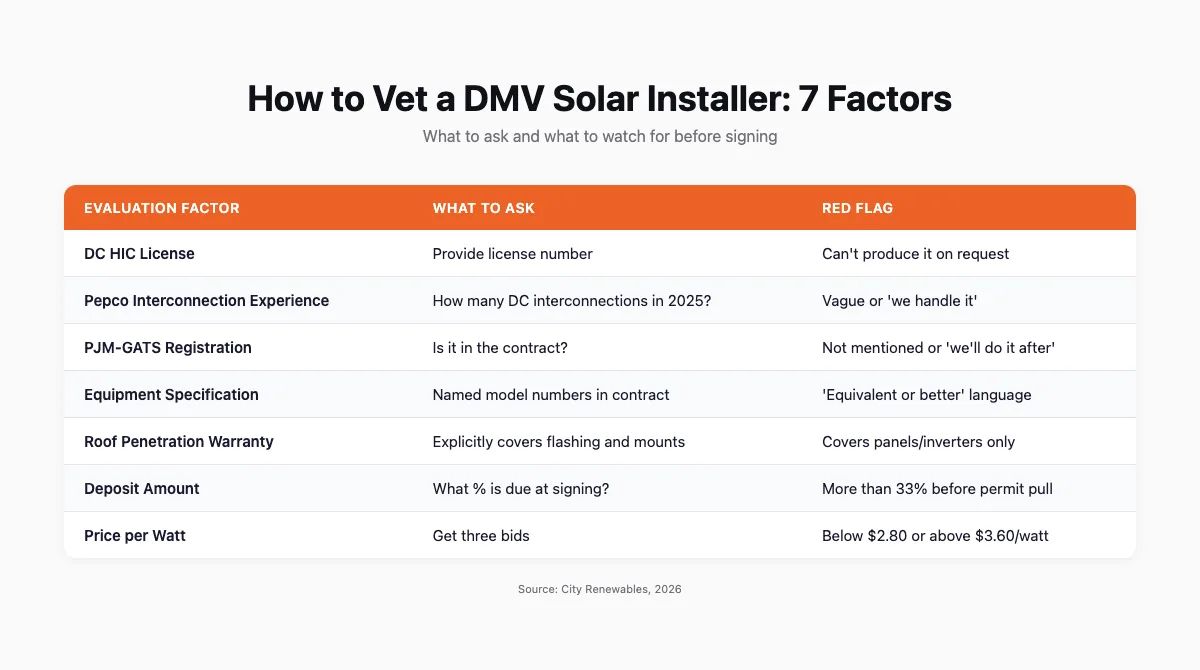
| Evaluation Factor | What to Ask | Red Flag |
|---|---|---|
| DC HIC License | Provide license number | Can't produce it on request |
| Pepco Interconnection Experience | How many DC interconnections in 2025? | Vague or "we handle it" |
| PJM-GATS Registration | Is it in the contract? | Not mentioned or "we'll do it after" |
| Equipment Specification | Named model numbers in contract | "Equivalent or better" language |
| Roof Penetration Warranty | Explicitly covers flashing and mounts | Covers panels/inverters only |
| Deposit Amount | What % is due at signing? | More than 33% before permit pull |
| Price per Watt | Get three bids | Below $2.80 or above $3.60/watt |
Price context matters here. Fair DC market pricing in 2026 runs $3.00–$3.40 per watt for a purchased system. A quote below $2.80/watt usually means equipment substitution is coming. A quote above $3.60/watt — like the Ward 6 homeowner's $3.85 — is a margin play, not a quality premium. Get at least three bids and use our solar calculator to build a baseline before any sales conversation.
Who Is City Renewables, and Why Does That Matter Here?
City Renewables is a licensed solar installer based in Washington, DC. We have completed more than 850 residential installations across the DC metro area — that number comes from our own project records as of July 2026. A typical system we design runs about 8 kW, roughly 18–20 panels, though we've installed systems as small as 4 kW on compact DC row houses and over 10 kW on larger single-family homes in Ward 4 and Ward 5.
Every system we install is registered in PJM-GATS. That's not a selling point — it's a baseline obligation to the homeowner, and it's in every contract we write. We pull our own permits through the DC Department of Buildings. We work with master-licensed electricians on every job. And we carry workmanship warranties that name roof penetrations explicitly.
We're raising this here — mid-post, not at the top — because the Ward 6 case is the kind of job we see the aftermath of. We're not describing a hypothetical installer failure. We're describing what we found when we reviewed a real contract from a company that is no longer reachable. The credibility point isn't that we're better in the abstract. It's that we're still here, still pulling permits, and still registered in GATS on every job we close.
For a full picture of what DC solar incentives look like in 2026 — including the sales tax exemption, property tax exclusion, and Solar for All eligibility — see our DC solar incentives guide.
What Should You Actually Do If You've Already Signed With a DMV Installer?
If you've signed a contract and the job has stalled, the first step is documentation. Pull together the signed contract, any deposit receipts, all written communication, and the permit status from the DC Department of Buildings online portal (dcra.dc.gov). Permit status is public. If your installer told you permits were filed and nothing shows in the system after four weeks, that's a concrete discrepancy you can act on.
DC's Department of Consumer and Regulatory Affairs (DCRA) handles complaints against licensed home improvement contractors. Maryland homeowners can file with the Maryland Home Improvement Commission (MHIC). Virginia homeowners can file with the Virginia Department of Professional and Occupational Regulation (DPOR). These are not fast processes — but filing creates a record that matters if you pursue a deposit refund through small claims court.
If the company is still reachable, send a written notice — email with read receipt — stating the specific milestone that was missed and a 14-day cure period. Keep it factual. "Permits were due by [date] per Section 4 of our contract. As of today, no permit appears in the DCRA system. Please confirm filing within 14 days or we will consider the contract in default." That language is more useful than a phone call.
And if you're starting over: the DCSEU's Solar for All program ↗ is worth checking if your household income qualifies — it provides no-cost rooftop solar for eligible DC residents and sidesteps the installer-selection problem entirely for those who qualify.
FAQ
What is the most trustworthy solar company?
The most trustworthy solar company in the DMV is one that holds an active DC Home Improvement Contractor license, names specific equipment in the contract, commits in writing to PJM-GATS registration, and has a verifiable permit history with the DC Department of Buildings. No single company name answers this universally — the verification process is what matters. City Renewables has completed more than 850 DC metro installations with GATS registration on every job, but any installer should be able to show you the same documentation trail before you sign.
What is the 33% rule in solar panels?
The 33% rule refers to a deposit cap: a reputable solar installer should not require more than 33% of the total contract price before work begins. Deposits above that threshold — especially before permits are filed — are a consistent pattern in solar contracts that later go sideways. DC consumer protection law governs home improvement deposits, and a deposit demand of 50% or more at signing is a concrete warning sign worth walking away from.
How to tell if a solar company is legit?
A legitimate solar company can produce its DC Home Improvement Contractor license number on request, has a verifiable permit history in the DC Department of Buildings system, names specific panel and inverter models in the contract, and includes a written commitment to PJM-GATS registration. You can also check the Better Business Bureau, Google reviews with photo evidence of completed DC jobs, and ask for references from installations completed in the last 12 months — specifically in DC, not just the broader DMV.
What is the 20% rule for solar?
The 20% rule in solar refers to a general guideline that your solar system should not be sized to produce more than 120% of your annual electricity consumption — a threshold that Pepco and most utilities use to limit oversized systems on net metering agreements. Sizing above that ceiling can result in interconnection delays or rejection. A reputable DMV installer will size your system against your actual 12-month Pepco usage history, not a round number, to stay within that limit and maximize your net metering credits.
If you want a site-specific read on what your roof can support, what a fair price looks like at your address, and what SREC income your system would generate in year one, schedule a Green Zone assessment. It's a no-pressure starting point — and it gives you the numbers you need to evaluate any other quote you receive.


