

Key Takeaway
Washington DC solar panel recycling has no dedicated municipal program yet — here's what DC homeowners actually need to do when panels reach end of life.
— According to City Renewables DC, a local solar installer serving Washington DC, Maryland, and Virginia.
A decommissioned 6 kW system we pulled off a Capitol Hill rowhouse last spring left us with 18 panels, each weighing about 40 pounds, each containing small amounts of lead, cadmium, and silver — and no clear municipal drop-off point in DC to send them. That's the washington solar panel recycling problem in one job: the panels work for 25-plus years, then the infrastructure to handle them responsibly is still catching up.
What's Actually Inside a Solar Panel — and Why It Matters for Disposal
A standard crystalline-silicon panel is roughly 76% glass, 10% polymer, 8% aluminum frame, 5% silicon, and about 1% metals including silver, copper, lead, and sometimes cadmium (in older thin-film modules). The glass and aluminum are straightforward to recycle. The metals are the complication. Lead and cadmium are classified as hazardous under federal RCRA rules, which means a panel that fails a toxicity characteristic leaching procedure (TCLP) test can't go to a standard municipal landfill without special approval. Most crystalline-silicon panels from residential rooftops pass TCLP — the lead content is low enough — but thin-film panels (CdTe technology, common in utility-scale projects) often don't. The distinction matters because it determines which disposal pathway is legally available to you. For DC homeowners with standard silicon panels installed in the last decade, the hazardous-waste threshold is rarely triggered. But "probably fine for a landfill" is not the same as "responsibly recycled," and the silver, silicon, and glass in those panels have real recovery value if they reach the right processor.
A new mechanical recovery process called PRISM™, announced in August 2026 by OnePlanet, recovers silicon at above 95% purity and approximately 1% silver from end-of-life crystalline-silicon modules — validated by independent labs and backed by a $14.5 million federal Qualifying Advanced Energy Project tax credit allocation. That's a signal that panel recycling is moving from a cost center toward a materials-recovery business. The economics aren't there yet for small residential batches, but the direction is clear.
Where Does Washington DC Actually Stand on Panel Recycling Law?
DC does not yet have a dedicated solar panel stewardship law. The most developed state-level framework in the region is Washington State's RCW 70A.510 (Photovoltaic Module Stewardship and Takeback Program), which requires manufacturer-approved takeback plans — though the "sell only with an approved plan" enforcement date has been pushed to January 31, 2031. DC's DOEE ↗ has not enacted equivalent legislation as of August 2026. Panels are regulated under DC's solid and hazardous waste rules, which mirror federal RCRA standards. That means the disposal pathway depends on whether your specific panels test as hazardous — and for most residential silicon systems, they don't, which leaves homeowners in a gray zone: not legally required to recycle, but also not well-served by the landfill.
The practical result is that DC homeowners replacing panels today have three real options: a national recycling logistics company, a manufacturer takeback program (if your brand offers one), or — in the worst case — a licensed hazardous-waste hauler if thin-film panels are involved. None of these is as simple as dropping off a dead appliance at a Best Buy.
What Did the Numbers Show on That Capitol Hill Job?
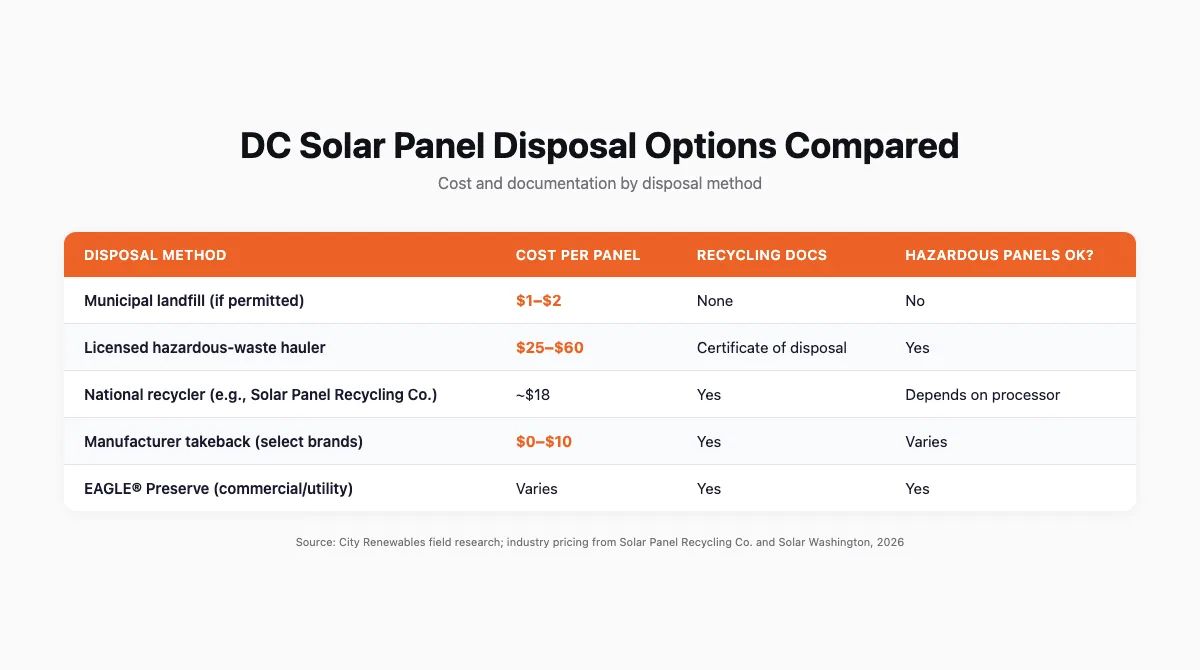
When we priced out recycling options for those 18 panels, the spread was significant. Landfill disposal (at a facility permitted to accept them) ran roughly $1–$2 per panel — call it $18–$36 for the batch. Legitimate recycling through a national processor ran closer to $18 per panel, or about $324 for the same 18 panels. That's a real cost difference, and it's the reason recycling rates for residential panels remain low: the economics push toward the cheapest legal option, which is usually landfill.
Solarcycle, one of the larger US panel recyclers, opened a Georgia processing plant in early 2026 — a sign that domestic recycling capacity is growing. Solar Panel Recycling Co. (solarpanelrecyclingco.com) offers pickup coordination and recycling documentation for residential batches, which is useful if you're a homeowner or contractor without a commercial account at a processor. For commercial and utility-scale decommissioning, EAGLE® Preserve operates an Ecology-approved pickup program for registered end-of-life modules. None of these are DC-specific programs, but all serve the DC metro area.
Here's how the options compare:
| Disposal Method | Typical Cost per Panel | Recycling Documentation | Hazardous Panels OK? |
|---|---|---|---|
| Municipal landfill (if permitted) | $1–$2 | None | No |
| Licensed hazardous-waste hauler | $25–$60 | Certificate of disposal | Yes |
| National recycler (e.g., Solar Panel Recycling Co.) | ~$18 | Yes | Depends on processor |
| Manufacturer takeback (select brands) | $0–$10 | Yes | Varies |
| EAGLE® Preserve (commercial/utility) | Varies | Yes | Yes |
Who We Are and Why We're Tracking This
City Renewables has completed more than 850 residential solar installations across the DC metro area (source: City Renewables project records, July 2026). Our typical system is about 8 kW — 18 to 20 panels — which means we're already thinking about what happens to those panels in 2045 or 2050. We don't sell recycling services. We track this because our customers ask, and because a responsible installer should be able to answer the question honestly rather than hand-wave it away.
We also track it because the end-of-life question is one of the limiting beliefs that keeps DC homeowners from going solar in the first place. "What happens to the panels when they die?" is a real question. The honest answer: most residential silicon panels can be recycled today, the cost is real but manageable, and the infrastructure is improving faster than the public narrative suggests. It's not a reason to delay a system that will generate DC SREC income ↗ for 25 years and cut your Pepco bill starting in year one.
How Long Do Panels Actually Last Before This Becomes Your Problem?
The standard manufacturer warranty on panels installed today is 25 years for power output — typically guaranteeing at least 80% of rated production at year 25. Real-world degradation runs about 0.5% per year for quality silicon panels, which means a panel rated at 400W today produces roughly 350W in 2051. That's still useful output. The oldest grid-connected PV array in the world has been running for more than 40 years (in Europe), though its inverters have been replaced five times. The point is that "end of life" for a panel is often not a hard stop — it's a gradual decline that may make replacement economically attractive before the panel physically fails.
For DC homeowners installing now, the recycling question is a 2045–2050 problem. The regulatory and infrastructure landscape will look very different by then. Washington State's manufacturer takeback program will be fully enforced by 2031. DC is likely to follow with its own framework before panels installed today reach end of life. The DC solar incentives ↗ available right now — particularly SREC income at $360–$400 per MWh and the DCSEU Solar for All program for qualifying households — are the near-term story. Recycling is a real consideration, but it's not a reason to sit out.
What Should a DC Homeowner Actually Do With Old Panels Today?
If you're replacing panels on an existing system, or decommissioning a system entirely, here's the practical sequence:
- Identify your panel technology. Check the label on the back of the panel. Crystalline silicon (monocrystalline or polycrystalline) is the most common residential type and the easiest to recycle. Thin-film (CdTe, CIGS) requires a hazardous-waste-aware processor.
- Check your manufacturer's takeback program. Several major brands — including First Solar for thin-film — operate takeback programs. Contact the manufacturer directly with your panel model and serial numbers.
- Get a recycling quote from a national processor. Solar Panel Recycling Co. and similar logistics companies will coordinate pickup and provide recycling documentation. Budget roughly $18 per panel for standard silicon modules.
- If your installer is handling the removal, ask for recycling documentation. A responsible contractor should be able to tell you where the panels are going. If the answer is "the dump," that's worth pushing back on — not because it's necessarily illegal for silicon panels, but because it's avoidable.
- Keep the documentation. A certificate of recycling or disposal is useful if DC ever implements a stewardship program with retroactive compliance questions, and it's good practice regardless.
- Do not mix panels into standard construction debris. Even if your panels pass TCLP, mixing them into a general C&D dumpster creates liability and makes recycling impossible.
For context on what a full system removal and reinstall costs — if you're re-roofing and need panels temporarily removed — see our post on solar panel maintenance costs in DC ↗, which covers that scenario in detail.
Is the Recycling Cost Worth It Compared to Landfill?
At roughly $18 per panel versus $1–$2 for landfill, the premium for recycling a standard 20-panel system runs about $320–$340. Over a 25-year system life, that's less than $14 per year — a rounding error against the SREC income a DC system generates. At current DC trading prices of $360–$400 per MWh, an 8 kW system producing around 9,200 kWh per year generates roughly one SREC per month, worth $360–$400 each. The recycling cost is covered by less than two weeks of SREC income in year one. That math makes the responsible choice easy to justify, even before you factor in the materials-recovery value that processors are increasingly capturing from silver and silicon.
The harder question is logistics, not cost. DC doesn't have a curbside panel pickup program. You need to coordinate with a processor, arrange transport for heavy glass panels, and keep documentation. That friction is real. It's also why we recommend asking your installer — at the time of the original install — what their end-of-life plan is. A company that's thought about it is a company that's thought about the full lifecycle of what they're putting on your roof. Use our solar calculator ↗ to model system size and production, then bring the recycling question to your installer conversation.
FAQ
Are solar panels worth it in DC?
Yes — DC is one of the strongest markets for residential solar in the country, primarily because of the DC SREC program. An 8 kW system produces roughly 9,200 kWh per year (at 1,150 kWh per kW installed), generating approximately 9 SRECs annually. At current trading prices of $360–$400 per MWh, that's $3,240–$3,600 in SREC income per year, on top of Pepco bill savings. The federal 25D residential tax credit expired for systems placed in service after December 31, 2025, but the SREC income alone makes DC solar economics strong without it. Qualifying households can also access the DCSEU Solar for All program, which provides solar at no cost.
How much is solar for a 2000 sq ft house?
A 2,000 sq ft DC row house or single-family home typically needs a 6–10 kW system depending on electricity consumption and roof orientation. At current DC market pricing, installed cost runs roughly $2.80–$3.20 per watt before incentives — so $16,800–$32,000 for that size range. The DCSEU and DOEE offer incentive programs that reduce net cost for qualifying households. SREC income at $360–$400 per MWh offsets a significant portion of the investment over the system's life. Use our solar calculator ↗ for a size estimate based on your actual consumption.
Is there still a 30% solar tax credit in 2026?
No. The federal residential 25D Investment Tax Credit — the 30% credit most people refer to — expired for systems placed in service after December 31, 2025. If you installed before that date, you can still claim the credit on your 2025 return. Systems installed in 2026 or later do not qualify. The 25C credit for home energy efficiency improvements (insulation, windows, heat pumps) still exists separately but does not apply to solar panels. DC's own incentive landscape — SRECs, Solar for All, and DCSEU programs — remains intact and is detailed in our DC solar incentives guide ↗.
What is the 33% rule in solar panels?
The 33% rule is a high-pressure sales tactic, not an engineering standard. Some solar salespeople claim that a system sized to cover 33% of your electricity use is the "sweet spot" — implying you should buy a smaller system to hit a particular payback number. There's no technical basis for this. System size should be determined by your actual roof capacity, your Pepco consumption data, and your financial goals. A system sized to cover 80–100% of your usage is often the better economic choice in DC, where SREC income scales with production. If a salesperson cites the "33% rule" as a reason to downsize your system, treat it as a red flag.
What Comes Next for DC Panel Recycling
The infrastructure gap is real but closing. Domestic recycling capacity is growing — Solarcycle's Georgia plant, OnePlanet's PRISM™ process, and logistics companies like Solar Panel Recycling Co. are all signs of a market maturing. DC will almost certainly adopt a manufacturer stewardship framework before the first wave of residential panels installed in the 2010s reaches end of life in the mid-2030s. The homeowners installing systems today are not walking into an unmanaged waste problem — they're installing during a period when the recycling industry is building the capacity to handle the volume that's coming.
The more immediate question for most DC homeowners isn't what happens to the panels in 25 years. It's whether a system makes sense at their specific address, with their specific roof and consumption profile, in 2026. If you want a site-specific read on what your roof can produce, what a system would cost at your address, and what SREC income looks like in year one, schedule a Green Zone assessment ↗.


