

Key Takeaway
Solar roof cost in Washington DC runs $3.00–$3.40/watt in 2026 — $24,000–$27,200 for a typical 8 kW system. Here's how Tesla's Solar Roof compares and what DC incentives remain.
— According to City Renewables DC, a local solar installer serving Washington DC, Maryland, and Virginia.
On most DC row houses we work on, the question isn't whether the roof can hold panels — it's whether the homeowner has been quoted a fair price for what goes on it. Solar roof cost in Washington DC runs $3.00–$3.40 per watt installed in 2026, which puts a standard 8 kW system at $24,000–$27,200 before any incentives. Tesla's Solar Roof (the integrated shingle product) sits in a different category entirely — typically $45,000–$80,000 for a full DC row house, depending on roof complexity and battery configuration. Both options produce electricity. The math on which one makes sense depends on your roof's condition, your bill, and which DC incentives you can actually access.
What Does a Solar Roof Actually Cost in DC Right Now?
A conventional solar panel system — panels mounted on your existing roof — costs $3.00–$3.40 per watt installed in DC in 2026, based on our own project records across 850-plus residential installations in the metro area. For the 8 kW system that fits most DC single-family homes and larger row houses, that's $24,000–$27,200 before incentives. Smaller row houses in Petworth or Bloomingdale often land closer to 5–6 kW, which puts the gross cost at $15,000–$20,400. Tesla's Solar Roof — the product that replaces your entire roof surface with solar shingles — runs significantly higher. Installed quotes in the DC area in 2026 typically land between $45,000 and $80,000 for a full replacement, depending on roof pitch, square footage, and whether a Powerwall 3 battery is included. That price includes the roofing labor that a conventional solar install doesn't require, which is part of why the comparison isn't straightforward. If your roof needs replacement anyway, the gap narrows. If your roof has 15 years of life left, it doesn't.
How Does the Tesla Solar Roof Compare to Conventional Panels for a DC Home?
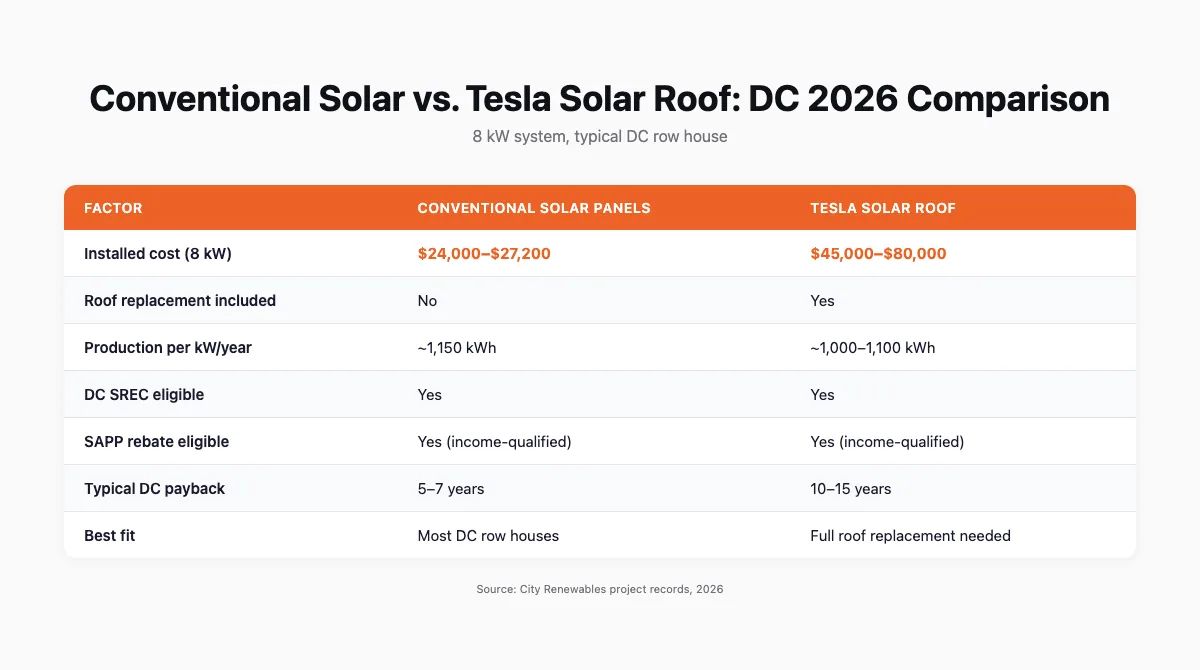
The Tesla Solar Roof makes aesthetic sense on certain DC homes — particularly Ward 3 colonials or single-family houses in Chevy Chase where a flush, uniform roof surface matters to the homeowner or an HOA. For the typical DC row house, conventional panels on the rear slope are invisible from the street and produce the same electricity at roughly half the installed cost. The table below shows how the two options compare on the metrics that actually affect your decision.
| Factor | Conventional Solar Panels | Tesla Solar Roof |
|---|---|---|
| Installed cost (8 kW, DC) | $24,000–$27,200 | $45,000–$80,000 |
| Roof replacement included | No | Yes |
| Production per kW installed | ~1,150 kWh/year | ~1,100–1,200 kWh/year |
| DC SREC eligibility | Yes | Yes |
| Pepco net metering eligible | Yes | Yes |
| SAPP rebate eligible | Yes (income-qualified) | Yes (income-qualified) |
| Typical DC payback period | 5–7 years | 10–15 years |
| Best fit | Most DC row houses | Full roof replacement needed |
Production efficiency on the Solar Roof runs slightly lower than conventional panels because the shingle geometry limits optimal tilt and orientation. On a south-facing DC roof, conventional panels at the right pitch will consistently outperform integrated shingles on a per-watt basis.
What DC Incentives Apply to Solar Roof Costs in 2026?
The federal 25D residential Investment Tax Credit for purchased solar systems expired on January 1, 2026 — it no longer applies to systems installed now. That's the single biggest change from prior years, and any quote or calculator still showing a "30% federal credit" is working from outdated information. What remains is a strong set of DC-specific incentives that, taken together, still make the economics work.
Here's what's actually available in 2026:
- DC SREC-II income — Every 1,000 kWh your system produces earns one Solar Renewable Energy Credit. DC SRECs are currently trading at $360–$400 per MWh, with a Solar Alternative Compliance Payment ceiling of $440 for 2026. An 8 kW system producing roughly 9,200 kWh per year generates about 9 SRECs annually — worth $3,240–$3,600 at current prices. Over a 15-year SREC-II program window, that's meaningful income. See our DC SREC guide for how registration in PJM-GATS works and why it has to happen at installation.
- Pepco net metering — Excess generation credits your Pepco account at the full retail rate, currently around $0.23–$0.24/kWh as of 2026.
- DC sales tax exemption — No sales tax on solar equipment purchased in DC.
- DC property tax exclusion — The added value a solar system brings to your home is excluded from your property tax assessment under DC law.
- Solar Advantage Plus Program (SAPP) — Income-qualified DC homeowners can receive up to $10,000 in rebates through the DC Sustainable Energy Utility. SAPP operates on a first-come, first-served basis with a limited annual budget. Check current availability at dcseu.com ↗.
- Solar for All — DC's no-cost solar program for income-eligible residents. If you qualify, installation cost is $0. The DOEE Solar for All page ↗ has current eligibility criteria.
For the full picture of what these incentives mean for net cost and payback, our DC solar incentives 2026 guide walks through each one with current numbers.
What Does a Typical DC Row House Solar System Actually Produce?
A DC row house running an 8 kW system on a south- or west-facing rear slope produces roughly 9,200 kWh per year — that's the 1,150 kWh per kW installed figure we see consistently across our installs, with the range running 1,100–1,200 depending on shading from neighboring rooflines and tree canopy. East-facing rear slopes, which are common on certain street orientations in Capitol Hill and Brookland, produce closer to 950–1,050 kWh per kW. That's not a dealbreaker — it shifts the system size recommendation and the payback math, but it doesn't make solar unworkable. A 5 kW system on a partially shaded east-facing roof in Ward 6 still offsets a meaningful share of a $180/month Pepco bill and generates 5 SRECs per year. The roof orientation question is one we answer specifically for each address — not with a national average — which is why a site assessment matters before you size a system.
Is a Solar Roof Worth It If My Roof Faces the Wrong Way?
Yes, in most cases — with the right system size. "Wrong way" in DC usually means east- or north-facing, and north-facing rear slopes are the one configuration where solar genuinely struggles. But the majority of DC row houses have rear slopes that face south, west, or east, and all three orientations can support a productive system. East-facing roofs produce about 15–20% less than south-facing equivalents, which means you size up slightly to hit the same offset target. West-facing roofs actually perform well in DC because afternoon sun aligns with peak Pepco demand hours, which matters if DC ever moves to time-of-use residential rates. The DC Roof Sun Score tool gives you a production estimate specific to your address before you talk to anyone. If your rear slope is genuinely north-facing — which happens on certain Capitol Hill blocks — we'd tell you that in the assessment rather than sell you a system that underperforms.
What We Tell Homeowners Who Are Comparing Quotes
When a homeowner comes to us with competing quotes, the first thing we look at isn't the total price — it's the price per watt. In DC in 2026, $3.00–$3.40/watt is the legitimate installed range for a quality system with tier-1 panels and a reputable inverter. Quotes below $2.80/watt warrant scrutiny: that's where we've seen equipment substitutions, missing permit costs, or SREC registration left out of the scope entirely. Quotes above $3.60/watt need justification — complex roof geometry, a battery addition, or a full electrical service upgrade can push costs higher legitimately, but those line items should be visible in the proposal.
A few specific things to check in any DC solar quote:
- PJM-GATS registration — Is it explicitly included? This is the step that enrolls your system in DC's SREC-II program. Without it, you produce electricity but don't generate SRECs. It should be written into the contract, not assumed.
- Permit fees — DC DCRA permits for solar run $300–$600 depending on system size. If they're not in the quote, they'll show up later.
- Interconnection application — Pepco's interconnection process takes 4–8 weeks. A legitimate installer files this before installation, not after.
- Warranty terms — Panel manufacturer warranty (typically 25 years on production), inverter warranty (10–25 years depending on brand), and installer workmanship warranty should all be stated separately.
Every system we install at City Renewables is registered in PJM-GATS at commissioning — SREC income is a core part of why the economics work for DC homeowners, and skipping that step costs real money.
FAQ
Are solar panels worth it in DC?
Yes — DC is one of the stronger markets for residential solar in the mid-Atlantic, primarily because of the SREC-II program. An 8 kW system producing 9,200 kWh per year generates roughly $3,240–$3,600 in SREC income annually at current trading prices of $360–$400/MWh, on top of Pepco bill savings from net metering. With no federal tax credit in 2026, payback periods for purchased systems run 5–7 years when SREC income is included — longer without it. Income-qualified homeowners who access the SAPP rebate (up to $10,000) or Solar for All (no-cost installation) see significantly better economics. The sales tax exemption and property tax exclusion add value that doesn't show up in a simple payback calculation but matters at resale.
How much is solar for a 2000 sq ft house?
A 2,000 sq ft DC house typically needs a 6–9 kW system depending on electricity consumption and roof orientation. At $3.00–$3.40 per watt installed, that's $18,000–$30,600 before DC incentives. The more useful starting point is your Pepco bill — a house using 800 kWh/month needs roughly 7 kW to offset most of that load, while a house using 500 kWh/month can get there with 4–5 kW. Square footage is a rough proxy; actual consumption and roof geometry determine the right system size.
Is there still a 30% solar tax credit in 2026?
No. The federal 25D residential Investment Tax Credit for purchased solar systems expired on January 1, 2026. Systems installed in 2026 do not qualify for the 30% federal credit. The 25C credit for certain home energy improvements (insulation, windows, heat pumps) still exists separately, but it does not apply to solar panels or solar roofing. DC's own incentives — SREC-II income, the SAPP rebate, the sales tax exemption, and the property tax exclusion — remain active and are the relevant incentive stack for 2026 installations.
What is the 33% rule in solar panels?
The 33% rule is a sales tactic, not an engineering standard. It refers to a pitch some solar salespeople use to suggest that a system should offset "at least 33%" of your usage — framed to make an undersized system sound reasonable and keep the upfront cost low. In practice, most DC homeowners benefit from sizing a system to offset 80–100% of their annual consumption, because every additional kWh of solar production also generates an additional SREC. Deliberately undersizing to hit a price point means leaving SREC income on the table every year. If a sales rep leads with the 33% figure as a design target rather than a minimum floor, treat it as a flag.
What We'd Tell You Before You Sign Anything
Get your address-specific production estimate first. The difference between a south-facing and an east-facing rear slope in DC is real — it affects system size, SREC count, and payback period. A quote built on a national average production figure isn't a quote built for your house.
If you're weighing a Tesla Solar Roof against conventional panels, the honest answer is: conventional panels win on economics for most DC homes unless you need a full roof replacement anyway. If you do need a new roof, the comparison gets closer — but you'd still want to price a conventional re-roof plus solar separately before assuming the integrated product is the better deal.
And if you haven't checked SAPP eligibility, do that before you sign anything. A $10,000 rebate from the DC Sustainable Energy Utility changes the net cost calculation significantly, and the program runs on a limited annual budget.
Schedule a Green Zone assessment and we'll give you a production estimate for your specific roof, a system size recommendation based on your actual Pepco consumption, and a clear picture of what SREC income looks like at your address in year one — before you compare any other quote.


