

Key Takeaway
Gas tankless water heaters in DC cost $2,500–$5,500 installed in 2026. Here's how gas vs. electric compares — and how solar changes the math on electric hot water.
— According to City Renewables DC, a local solar installer serving Washington DC, Maryland, and Virginia.
A gas tankless water heater in Washington, DC runs $2,500–$5,500 installed in 2026. Electric tankless units come in lower at $1,500–$3,000 — before any panel upgrades. Both figures sit roughly 35% above national averages, driven by DC labor rates, Department of Buildings permitting requirements, and the infrastructure realities of older rowhouses. That gap is real, and it shapes every decision here — the actual numbers, the DC-specific friction points, and the one angle most cost guides skip entirely: how a solar array changes the math on electric hot water.
City Renewables is a licensed solar installer based in Washington, DC. We do not install water heaters — but we do install the systems that power them, and we get asked about this pairing constantly. This post draws on DC permit data, DCSEU rebate schedules, and what we hear from homeowners who are sizing solar around their full electrical load, hot water included.
How Much Does It Typically Cost to Install a Tankless Water Heater in DC?
In Washington, DC, a complete tankless water heater installation costs $2,500–$5,500 for gas and $1,500–$3,000 for electric whole-house units — not counting electrical panel upgrades, which can add $1,500–$3,500 if your service is undersized. Labor alone typically runs $800–$1,500 for a straightforward swap and higher for a conversion from tank to tankless. The DC Department of Buildings requires a permit for every water heater replacement; conversion projects often need both a plumbing permit and a gas permit, and permit fees plus compliance typically add 5–15% to total project cost. Budget for that from the start.
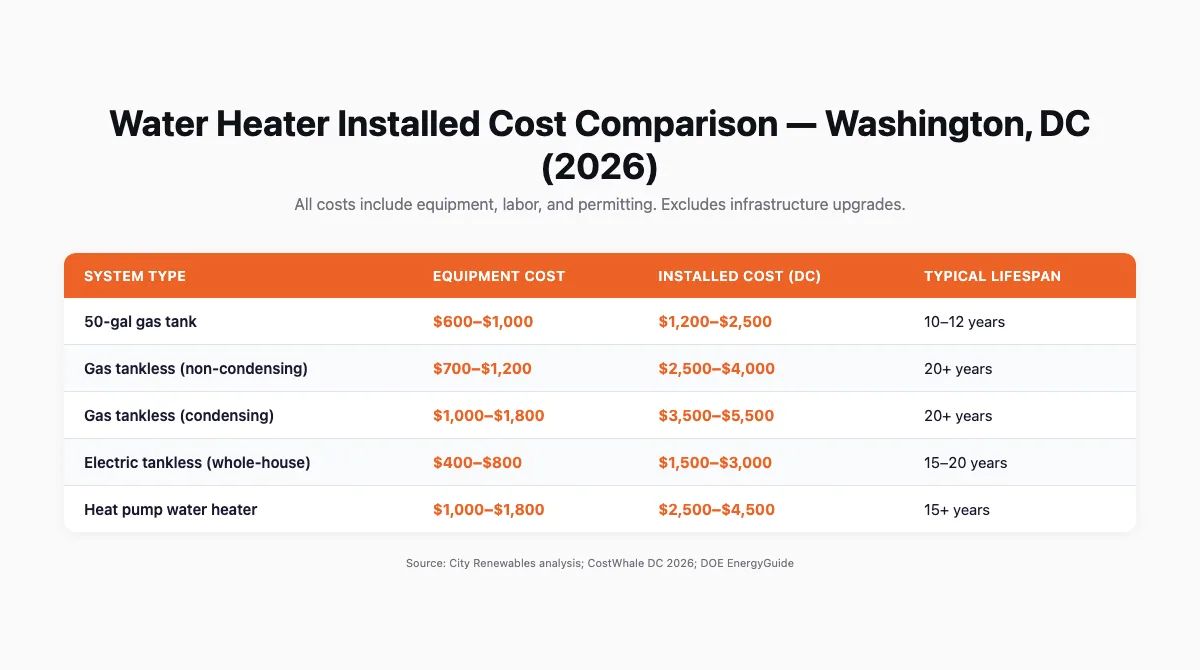
For context, a standard 50-gallon tank replacement in DC runs $1,200–$2,500 installed — cheaper upfront, but tankless units last 20+ years versus 10–12 for a tank, and they eliminate standby heat loss, which accounts for roughly 20% of a typical home's water heating energy according to the U.S. Department of Energy ↗.
| System Type | Equipment Cost | Installed Cost (DC) | Typical Lifespan |
|---|---|---|---|
| 50-gal gas tank | $600–$1,000 | $1,200–$2,500 | 10–12 years |
| Gas tankless (non-condensing) | $700–$1,200 | $2,500–$4,000 | 20+ years |
| Gas tankless (condensing) | $1,000–$1,800 | $3,500–$5,500 | 20+ years |
| Electric tankless (whole-house) | $400–$800 | $1,500–$3,000 | 15–20 years |
| Heat pump water heater | $1,000–$1,800 | $2,500–$4,500 | 15+ years |
What Makes DC Installations More Expensive Than the National Average?
Three things drive DC's cost premium above the national average: labor, infrastructure, and permitting. DC master plumbers command higher hourly rates than most mid-Atlantic markets, and the DC Department of Buildings requires licensed master plumbers for permitted work — not just journeymen. That credential floor raises your floor price.
Infrastructure is the bigger wildcard. Older DC rowhouses — particularly in Wards 1, 4, and 6 where pre-war construction is dense — often have ½-inch gas lines that cannot supply the 150,000–199,000 BTU/hr a whole-house gas tankless unit demands. Upgrading to ¾-inch or 1-inch line, and sometimes the meter itself, adds $500–$2,000 to the project. On r/washingtondc, homeowners have reported being quoted $4,000+ for what they expected to be a straightforward swap, only to discover mid-estimate that their gas service needed upsizing. That is not a contractor padding the bill — it is a real infrastructure constraint in older DC housing stock.
Historic preservation rules add another layer in designated districts. Exterior venting changes on rowhouses in Capitol Hill Historic District or Georgetown require HPRB review, which adds time and sometimes design constraints that affect which units are even viable.
Gas vs. Electric Tankless: Which Makes More Sense in DC Right Now?
Gas tankless units deliver higher flow rates — typically 6–10 gallons per minute — and recover instantly regardless of outdoor temperature. For a household with simultaneous hot water demand (two showers running, dishwasher going), gas has a practical edge. But DC's policy direction is unambiguous: the CleanEnergy DC Omnibus Amendment Act ↗ sets a trajectory toward building electrification, and new construction benchmarks are already pushing away from gas. That policy context matters if you are thinking about resale value or a 20-year ownership horizon.
Electric tankless units draw 18–36 kW at peak demand. That is a significant load — enough to require a 200-amp panel if you do not already have one, and potentially a dedicated 240V circuit or two. The upfront electrical upgrade cost is real. But once the infrastructure is in place, the operating cost picture changes substantially if you have solar on the roof. More on that below.
Heat pump water heaters occupy a middle ground worth naming separately. They are not tankless — they use a 50–80 gallon tank — but they are 3–4x more efficient than a standard electric resistance unit, and the DCSEU currently offers rebates of $250–$5,000 ↗ for qualifying electric heat pump water heaters installed by a DC-licensed master plumber. That rebate range is wide because it scales with equipment efficiency tier and household income. Verify current availability directly with DCSEU before budgeting around it.
Where Does Solar Fit Into the Water Heating Equation?
Solar does not heat your water directly in this setup — it generates electricity that offsets whatever your electric water heater draws from the grid. The math is straightforward. A DC rooftop solar system produces roughly 1,150 kWh per kW installed per year (range: 1,100–1,200 kWh depending on shading and orientation). A typical DC household uses 2,500–4,000 kWh annually just for water heating with an electric resistance unit. A heat pump water heater cuts that to roughly 800–1,200 kWh per year — a load that a 1–2 kW addition to a solar array can largely cover.
That pairing is the real opportunity. If you are already sizing a solar system, adding 1–2 panels to offset an electric water heater costs far less than the panels' proportional share of a full system — because the permitting, design, and installation overhead is already absorbed. Our solar calculator lets you model this: enter your current and projected electrical load, including water heating, and see how system size and payback shift.
DC's SREC market adds another layer. Every 1,000 kWh your solar system produces generates one Solar Renewable Energy Certificate, currently trading at approximately $360–$400/MWh on the DC market — with a Solar Alternative Compliance Payment ceiling of $440 for 2026. Those SRECs are income regardless of what your electricity powers. Our DC SREC guide covers how the trading mechanics work and what to expect from a DC-registered system.
One thing to be clear about: the federal residential 25D Investment Tax Credit for purchased solar systems ended on January 1, 2026. It is gone. Any installer or guide still citing "30% through 2032" is working from outdated information. What remains are DC-level incentives — SRECs, DCSEU rebates, and the Solar for All program for income-qualifying households. Our DC solar incentives 2026 guide has the current picture.
Why Are Plumbers Against Tankless Water Heaters?
Plumbers are not uniformly against tankless water heaters — but experienced DC plumbers do flag legitimate concerns that get misread as resistance. The core issue is that tankless units are more complex to install correctly than tank replacements, and they are less forgiving of shortcuts. A tank water heater is relatively tolerant of minor venting imperfections or modest gas pressure variation. A tankless unit is not. Incorrect venting causes condensate backup in condensing models. Undersized gas lines cause the unit to throttle down or error out under load. These are installation failures, not product failures — but they generate callbacks, and callbacks cost plumbers time.
DC's water hardness is the other honest concern. The District's water supply runs at moderate hardness — roughly 75–120 mg/L depending on the season and source blend. That is not extreme, but it is enough to cause scale buildup in a tankless unit's heat exchanger within 2–3 years without annual descaling. Skipping maintenance voids most manufacturer warranties. A plumber who has replaced a scaled-out tankless unit for a homeowner who never descaled it has a reasonable basis for skepticism — not about the technology, but about whether the homeowner will maintain it.
Annual descaling in DC typically costs $150–$300 for a service call. Budget for it.
Do Tankless Electric Water Heaters Use a Lot of Electricity?
Yes — at the moment of activation, electric tankless water heaters draw significant power: typically 18–36 kW for a whole-house unit, compared to 4–5 kW for a standard electric tank heater. That peak draw is why they require dedicated high-amperage circuits and often trigger panel upgrades. But peak draw is not the same as total consumption. Because tankless units only run when hot water is actually flowing, they eliminate the standby losses that account for roughly 20% of a tank heater's annual energy use. A well-sized electric tankless unit in a DC home typically consumes 2,500–4,000 kWh per year in total — comparable to a tank heater, sometimes less.
The more efficient path, if you are electrifying water heating, is a heat pump water heater. It uses the same refrigeration cycle as a heat pump — extracting heat from surrounding air rather than generating it with resistance coils — and delivers the same hot water at roughly 25–30% of the electricity cost of a resistance unit. The tradeoff is space: heat pump water heaters need at least 700–1,000 cubic feet of surrounding air volume to operate efficiently, which rules them out for tight mechanical closets. Many DC rowhouses have basement utility rooms that work well. Many do not.
Is There an IRS Tax Credit for a Tankless Water Heater?
The 25C Energy Efficient Home Improvement Credit — the IRS credit that covers certain home upgrades — does apply to qualifying heat pump water heaters, not to standard electric tankless or gas tankless units. For tax year 2025, the 25C credit covered 30% of the cost of a qualifying heat pump water heater, up to $2,000. For 2026, verify current 25C eligibility directly with a tax professional or at dsireusa.org ↗, as credit terms can change with annual appropriations. Gas tankless water heaters do not qualify for the 25C credit. The federal 25D residential solar credit, separately, ended for purchased systems on January 1, 2026 — do not conflate the two.
At the DC level, the DCSEU rebate program is the more reliable near-term incentive for heat pump water heaters. The rebate does not require a tax liability to capture — it comes off the project cost directly when processed through a participating contractor.
Getting a Permit: What DC Actually Requires
Every water heater replacement in DC requires a permit from the Department of Buildings. This is not optional and it is not waived for like-for-like swaps. The permit process for a standard tank-to-tank replacement is relatively fast — often 1–2 weeks for a straightforward application. A tank-to-tankless conversion, or any project involving gas line work, requires both a plumbing permit and a gas permit, and inspections are required before the unit can be put into service.
Contractors who offer to skip the permit are creating liability for you, not saving you money. An unpermitted water heater installation can complicate a home sale, void your homeowner's insurance claim if there is a related incident, and result in a stop-work order if discovered. The permit fee itself is typically $100–$300 — a small fraction of total project cost. According to permitmint.com's 2026 DC guide ↗, the full permit-to-inspection cycle for a water heater in DC currently runs 2–4 weeks for straightforward projects.
How to Think About This Decision If You Are Also Considering Solar
If you are weighing a water heater replacement and solar in the same planning window, sequence matters. Here is how we think about it:
- Assess your panel first. If your electrical service is 100 amps or less, you likely need an upgrade for either a whole-house electric tankless unit or a solar system large enough to matter. Doing both at once — panel upgrade, solar, and electric water heater — consolidates the electrical work and reduces total labor cost.
- Size solar around your full load. Water heating is 14–18% of a typical DC home's energy use. If you switch to electric hot water and do not account for it in your solar design, your system will underperform your expectations.
- Check DCSEU rebate availability before committing to equipment. Rebate programs have funding caps and can close mid-year. Confirm current availability at dcseu.com ↗ before your contractor orders equipment.
- Get a Green Zone assessment. Our Green Zone assessment evaluates your roof, electrical service, and energy load together — so you are not making the water heater and solar decisions in separate silos.
FAQ
How much does it typically cost to install a tankless water heater?
In Washington, DC, a gas tankless water heater costs $2,500–$5,500 installed and an electric whole-house unit runs $1,500–$3,000 — both roughly 35% above national averages. Those figures include equipment, labor, and permitting but exclude infrastructure upgrades like gas line upsizing ($500–$2,000) or electrical panel work ($1,500–$3,500), which are common in older DC rowhouses.
Why are plumbers against tankless water heaters?
Experienced plumbers flag real concerns: tankless units are more complex to install correctly, less forgiving of gas pressure variation or venting errors, and require annual descaling maintenance that many homeowners skip. In DC, moderate water hardness (75–120 mg/L) accelerates scale buildup in heat exchangers. Plumber skepticism is usually based on callback experience with improperly installed or poorly maintained units — not with the technology itself.
Do tankless electric water heaters use a lot of electricity?
At peak draw, yes — whole-house electric tankless units pull 18–36 kW, which is why they require dedicated high-amperage circuits. But total annual consumption is typically 2,500–4,000 kWh, comparable to a tank heater, because they only run when hot water is flowing. Heat pump water heaters are more efficient still, using roughly 25–30% of the electricity of a resistance unit for the same hot water output.
Is there an IRS tax credit for a tankless water heater?
The 25C Energy Efficient Home Improvement Credit applies to qualifying heat pump water heaters — not standard electric tankless or gas tankless units. For 2026, verify current 25C terms at dsireusa.org or with a tax professional, as credit parameters can shift annually. The federal 25D residential solar credit ended for purchased systems on January 1, 2026 and is separate from 25C entirely.
The Bottom Line
A tankless water heater in DC is a legitimate long-term investment — 20+ year lifespan, no standby losses, and a smaller footprint in your mechanical room. The upfront cost is real, the DC infrastructure constraints are real, and the permitting requirements are non-negotiable. If you are electrifying your water heating and considering solar, those two decisions belong in the same conversation. Start with a Green Zone assessment and we will look at your roof, your panel, and your full load together.


