

Key Takeaway
Tesla solar roof isn’t available in DC in 2026—Tesla ended tile supply. Panels + Pepco net metering + DC SRECs win on cost and timing for most homes.
— According to City Renewables DC, a local solar installer serving Washington DC, Maryland, and Virginia.
Tesla Solar Roof 2026: Is It Right for Your DC Home?
Tesla solar roof isn’t a real option in DC in 2026—Tesla stopped supplying Solar Roof tiles to installers in August and is steering homeowners to conventional panels with Powerwall instead. If you’re deciding between “wait for Solar Roof” or “go solar now,” choose panels on an existing roof or time your reroof with standard shingles plus solar. That’s the bottom line.
We’re City Renewables, a DC solar installer. We design and build rooftop systems across all eight wards and register every project for DC SRECs.
Tesla Solar Roof vs. panels in DC: what are you really choosing?
The decision today is between a conventional solar panel system on your current or new roof and waiting for a Tesla Solar Roof that Tesla has discontinued, because Tesla told certified installers it will no longer supply Solar Roof tiles and is focusing on panel hardware plus Powerwall 3. That means availability is the gating factor—not aesthetics or performance. In DC, panels paired with Pepco net metering and DC SRECs pencil out, while Solar Roof tiles are not orderable through local channels. For homeowners who must replace a roof now, the most practical path is architectural shingles (or metal) plus a standard solar array. If you were set on Tesla branding, Tesla still supports Powerwall 3 with third‑party installers, and panel systems can integrate with it. But the tile product a lot of us watched for years is no longer being sold, and contractors report uncertainty on long‑term service parts.
Here’s how the current options line up for a typical DC rowhome or detached home this year.
| Option | What it includes | Availability in DC (2026) | Typical size | All‑in cash range | Time to install | DC incentives eligible |
|---|---|---|---|---|---|---|
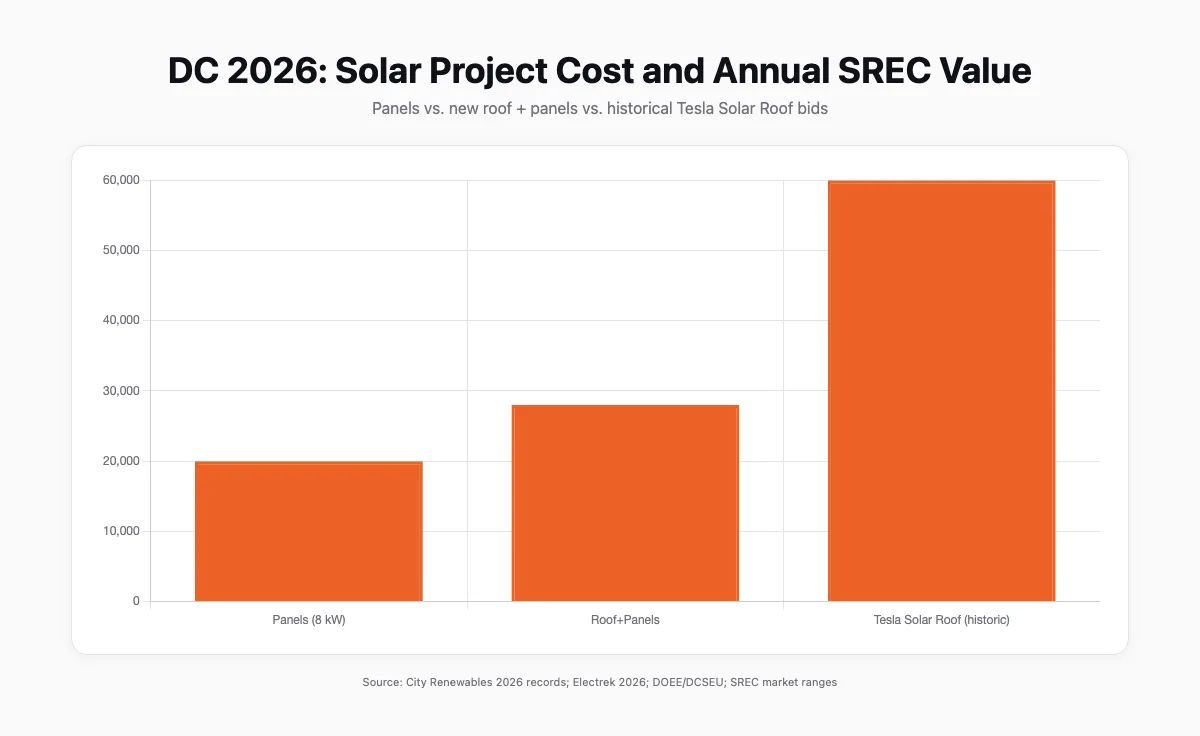
| Conventional solar panels on existing roof | 7–10 kW array, racking, inverter; optional Powerwall | Readily available via local installers | ~8 kW | $20,000–$27,000 before incentives | 45–120 days from contract | SRECs ($360–$400/MWh), net metering, DC sales/property tax exemptions |
| New shingle roof + panels | Reroof (asphalt) plus 7–10 kW array | Readily available; coordinate trades | ~8 kW | Roof: $8,000–$15,000; Solar: $20,000–$27,000 | 60–150 days | Same as above |
| Tesla Solar Roof tiles | Integrated glass tiles + inverters; optional Powerwall | Discontinued for new orders; service uncertain | N/A in 2026 DC market | Historical quotes $60,000–$100,000+ | Indefinite wait | Unclear for new since not available; legacy systems earned SRECs |
Sources: City Renewables 2026 design records; Electrek reporting 2026‑08‑20; DC program rules (DCSEU/DOEE).
What happened to Tesla Solar Roof in 2026?
Tesla discontinued the Solar Roof tile product in August 2026, because the company notified third‑party installers it would no longer supply tiles and would focus on conventional solar panels and Powerwall. Electrek reported the shift on August 20, 2026, and trade press confirmed contractors were left with open questions on service parts and sunk costs. Subsequent investor coverage noted Tesla hasn’t reported solar deployment numbers for multiple quarters and that the Solar Roof exit closes the chapter on that product line. Existing Solar Roof owners may still receive warranty support, but that’s distinct from new sales. In practical DC terms, there is no procurement path for new Tesla Solar Roof tile projects this year. If someone offers to sell you “Tesla tiles” in DC, press for a current purchase order from Tesla Energy—chances are it’s not available. The path forward is panels plus, if you want, a Powerwall.
Citations: Electrek ↗, Roofing Contractor ↗, Motley Fool ↗.
How does cost compare in DC without the federal ITC?
With the residential federal 25D tax credit expired for systems placed in service after December 31, 2025, DC projects in 2026 lean on SRECs, net metering, and local exemptions—so conventional panels come out ahead because they’re available and reasonably priced. In DC this year we’re seeing installed prices around $2.50–$3.40 per watt for quality panel systems depending on roof complexity and equipment, which puts an 8 kW system at roughly $20,000–$27,000 before incentives. The same 8 kW will generate about 9,000–9,600 kWh a year in DC (1,100–1,200 kWh/kW), which creates 9–9.6 SRECs. At $360–$400/MWh, that’s $3,240–$3,840 per year in SREC revenue at current market ranges. Layer retail‑rate Pepco net metering on top, and the payback remains healthy even without the federal credit. By contrast, historical Solar Roof bids for typical DC homes landed between $60,000 and $100,000+—and in 2026 you can’t buy it anyway. If you must reroof, budget $8,000–$15,000 for asphalt shingles, then add your solar array.
- DC SREC price context: 2026 trades are roughly $360–$400/MWh; the SACP ceiling is $440. See our DC SREC guide and brokers like SRECTrade ↗ or Sol Systems ↗ for current postings.
- Local policy: DC retains full retail net metering under 100 kW through Pepco; DC sales and property tax exemptions apply. See DCSEU ↗ and DOEE ↗.
City Renewables note: Our typical residential build is ~8 kW—18–20 panels—based on 2026 design records.
Will Tesla panels + Powerwall beat a standard DC panel system?
No—because Tesla Solar Roof tiles are gone, and Tesla’s 2026 offer is conventional panels plus Powerwall 3 sold through Certified Installers, which is equivalent to what you can get from a local installer that also offers Powerwall integration. Performance and reliability come down to equipment spec and installation quality, not a logo. A DC 8 kW panel system will produce ~9,200 kWh/year on a good south‑ or west‑facing roof. That offsets most or all of an average Pepco home’s usage and earns 9.2 SRECs annually. Add a Powerwall if you value backup for storm outages common in July–September or want to time‑shift for personal resilience. But a battery doesn’t increase SREC generation or net metering credits, so it’s a lifestyle and backup decision. If you see an online “Tesla Solar Roof cost calculator,” understand that it now routes to panel pricing, not tiles. In short, pick a proven panel package with clean conduit runs, quality flashing, and an SREC plan. We do that work every week across Georgetown, Petworth, Brookland, and Ward 7.
- Production baseline: ~1,150 kWh per kW per year (DC average range 1,100–1,200). Source: City Renewables modeling, 2026.
- Powerwall 3: widely available via certified partners; pairs with non‑Tesla inverters through gateway equipment. Source: Electrek 2026 coverage.
Does roof type or orientation kill the idea?
No—most DC roofs can host panels, and orientation tweaks design more than viability. For a flat rowhouse roof in Shaw or H Street NE, we use low‑tilt ballast/attached racking aimed south or west to balance yield and wind profile. For gable roofs in AU Park or Shepherd Park, we weight the larger plane; east‑west arrays still hit ~85–90% of south‑facing yield. Heavy shading is the real limiter—chimneys, pop‑ups, trees. We score that in minutes with our Roof Sun Score. If you are planning a reroof, coordinate layout before shingles go on so we can set blocking and conduit paths and avoid rework. Metal standing seam is excellent for clamp‑on racking with minimal penetrations. Slate is doable but expensive to work on. None of this changes the Solar Roof answer: tiles aren’t available, and conventional panels are adaptable to DC housing stock.
Design rules of thumb we use in DC:
- Flat roof setback: 3 ft from edges per DC fire code zones; keep a 36 in pathway to ladder landing.
- Rowhouse ballast vs. attachment: prefer attached for wind exposure on corners; ballast where structural allows and parapets are high.
- Tilt: 5–15° on flats to limit visibility from the street in historic districts while improving drainage.
What about timing—should I wait a year?
Waiting for Tesla Solar Roof in DC doesn’t make sense in 2026 because the product has been discontinued and there’s no credible restock timeline. Meanwhile, each year of delay burns SREC revenue and net metering savings you could capture now. On an 8 kW array: 9–9.6 SRECs per year at $360–$400/MWh is $3,240–$3,840 in 2026 dollars, plus Pepco bill reductions from ~9,000+ kWh of onsite generation. Summer peak months (June–September) carry some of the highest offset value under Pepco’s seasonal rates. If your roof needs replacement soon, schedule reroof plus solar within the same quarter—permits, interconnection, and net meter swaps add weeks. Typical DC timeline from Green Zone assessment to PTO runs 45–120 days depending on DCRA/DOB permit queues, Pepco meter availability, and historic review (where applicable). That timeline is steady this year; there’s no program cliff you’re trying to beat, but there is real cash on the table.
- City Renewables has completed 850+ residential installs across the DC metro as of July 2026—so these timeframes reflect lived local process.
How do DC incentives work in 2026 without the federal credit?
In 2026, DC solar pencils because SRECs and net metering are intact, and DC exempts sales and property tax on solar—so you still get strong cash flow. Each 1,000 kWh you produce creates 1 SREC measured through PJM‑GATS; a typical 8 kW DC system produces 9–9.6 SRECs per year. Brokers in 2026 are clearing trades around $360–$400/MWh, and the SACP is $440. Full retail net metering applies under 100 kW with Pepco, which credits excess generation at the retail rate and carries it forward. DC sales tax exemption applies at purchase; property tax exemption covers the added value of the solar equipment. Income‑qualified households can explore DOEE’s Solar for All program for no‑cost rooftop options, though slots are limited and waitlisted. We register every system with PJM‑GATS so your SRECs start accruing as soon as the meter runs.
- Read the details in our DC solar incentives 2026 guide and our step‑by‑step DC SREC guide.
- External references: DOEE ↗, DCSEU ↗, PJM‑GATS ↗, and EIA ↗ for DC retail rate context.
Ownership and resale: how do panels affect a DC home vs. a tile roof?
Owned solar arrays in DC generally improve resale by cutting operating costs and creating SREC income the next owner can inherit—while leased or PPA systems require contract transfer. A Tesla Solar Roof would have bundled roof and generation into one asset, but with the product discontinued, buyers and inspectors may treat any legacy tile roof as a specialty system with harder‑to‑source parts. Standard panels are transparent to appraisers now; we include equipment specs, production estimates, and interconnection approvals in closeout packets so listing agents can market the bills and SRECs honestly. If you are considering listing in Georgetown or Chevy Chase, a flush‑mounted array with neat conduit runs and attic penetrations kept off facades tends to show well. And if you prefer an all‑in warranty package, pair your reroof and solar with coordinated documentation—one roof warranty from your roofer, one equipment/workmanship set from us. That clarity is worth more than a discontinued tile brand.
Decision checklist: choose panels now or wait?
- Choose conventional panels now if you want real 2026 savings and SREC income in DC.
- Choose reroof + panels if your shingles are >15 years old or you see curling/granule loss.
- Add Powerwall if you value outage backup or need whole‑home resilience for medical devices.
- Don’t wait for Tesla Solar Roof; the product has been discontinued and tiles aren’t available to DC installers.
- Use our Roof Sun Score to see if shade or orientation will materially change yield before you commit.
FAQ
Is Tesla Solar Roof still in business?
Tesla discontinued its Solar Roof tile product in August 2026 and redirected customers to conventional solar panels and Powerwall through Certified Installers, per Electrek reporting and contractor notices. Existing tile owners may receive service under their warranties, but new Solar Roof purchases are not being accepted. In DC, there is no path to start a new Tesla Solar Roof project this year.
How much does a Tesla Solar Roof cost 2000 sq ft?
Recent DC‑area Solar Roof quotes before discontinuation commonly ran $60,000–$100,000+ for homes around 2,000 sq ft depending on roof complexity and desired solar capacity—well above the cost of a new asphalt shingle roof plus an 8 kW panel system at about $28,000–$42,000 combined. As of 2026, Tesla is no longer supplying Solar Roof tiles, so these historical price points are reference only; new purchases aren’t available.
Is a Tesla Solar Roof any good?
The Tesla Solar Roof delivered clean aesthetics for some installations, but the product struggled with availability, costs, and service logistics; in August 2026 Tesla stopped supplying tiles and shifted to selling conventional panels with Powerwall. In DC, standard panels produce the same electricity, qualify for SRECs and Pepco net metering, cost far less, and can be installed quickly by local crews.
What happened to Elon Musk's Solar Roof?
Tesla ended the Solar Roof tile product in 2026 and moved its home energy focus to panel systems and Powerwall sold via Certified Installers. Trade press and investor coverage cite poor economics and low deployment as reasons. Contractors report uncertainty on long‑term parts for legacy tile systems. In DC, that means Solar Roof is not an option for new projects.
Sources and community signal
- Reporting on Tesla’s 2026 shift: Electrek ↗, Motley Fool ↗, Roofing Contractor ↗
- DC program info: DOEE ↗, DCSEU ↗, PJM‑GATS ↗
- On r/washingtondc, homeowners often ask if an east‑west rowhouse roof can “still work.” Our answer: yes—expect ~85–90% of south yield with good layout and minimal shade.
Ready to make the call? Get your numbers in a Green Zone assessment. We’ll map production, SREC cash flow, and a clean install plan for your roof—start at cityrenewables.com/greenzone.


