

Key Takeaway
Tesla Solar Roof is effectively paused in 2026. Here's what DC homeowners need to know about cost, availability, incentives, and the conventional panel alternative.
— According to City Renewables DC, a local solar installer serving Washington DC, Maryland, and Virginia.
If you're weighing a Tesla Solar Roof for your DC home in 2026, the most useful thing to know upfront is this: Tesla has effectively paused new Solar Roof installations, shifting its residential focus back to conventional panel arrays. That's not a rumor — reporting from Electrek in May 2026 confirmed Tesla ceased new Solar Roof deployments and pulled back marketing for the product. So the decision most DC homeowners actually face isn't "Tesla Solar Roof vs. panels" — it's whether an integrated solar shingle product from any manufacturer makes sense for their roof, their budget, and their timeline, or whether a conventional panel system is the smarter path right now.
City Renewables is a licensed solar installer based in Washington, DC, with more than 850 residential installations completed across the metro area. This post draws on what we see on DC rooftops every week.
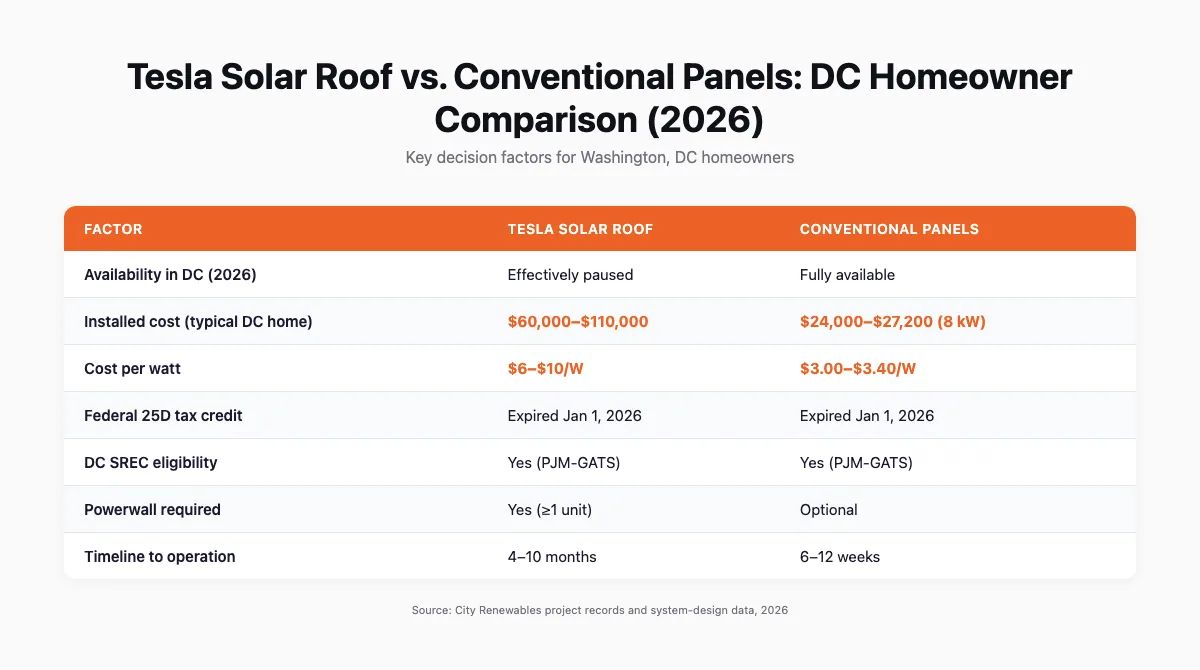
Tesla Solar Roof vs. Conventional Panels: The Options Side by Side
Before getting into the specifics, here's how the two approaches compare on the dimensions that matter most for a DC homeowner making this decision in 2026.
| Factor | Tesla Solar Roof (V3 tiles) | Conventional Solar Panels |
|---|---|---|
| Availability in DC (2026) | Effectively paused — no new installs | Fully available |
| Installed cost (typical DC home) | $60,000–$110,000 | $24,000–$27,200 (8 kW system) |
| Cost per watt | $6–$10/W (solar portion only) | $3.00–$3.40/W |
| Federal 25D tax credit | Expired Jan 1, 2026 | Expired Jan 1, 2026 |
| DC SREC eligibility | Yes (if registered in PJM-GATS) | Yes (registered in PJM-GATS) |
| Roof replacement included | Yes | No |
| Powerwall required | Yes (Tesla mandates ≥1 unit) | Optional |
| Timeline deposit to operation | 4–10 months | 6–12 weeks typical |
| Historic district compatibility | Difficult — tile profile may not clear CFA | Rear-slope installs often approvable |
| Best fit | Roof needs full replacement + premium budget | Roof in good condition, cost-conscious |
The cost gap is the central fact. A conventional 8 kW panel system from City Renewables runs $24,000–$27,200 installed — a number we cover in detail in our solar roof cost guide for Washington DC. A Tesla Solar Roof on the same home would run two to three times that, before accounting for the Powerwall requirement.
Is Tesla Solar Roof Still in Business?
Tesla Energy as a division is still operating, but the Solar Roof product is on life support as of mid-2026. Tesla has not formally discontinued the Solar Roof, but it stopped taking new installation orders and redirected its residential solar team toward conventional panel sales. On r/washingtondc, homeowners who put down deposits in 2024 reported waiting 12 or more months with no installation date, then receiving refunds or being offered panel systems instead. Tesla filed a new patent in February 2026 for a redesigned tile mounting foot — published by the USPTO in July 2026 — which suggests some internal R&D continues, but that doesn't translate to available product for DC homeowners today. If you were quoted a Tesla Solar Roof by a third-party installer claiming current availability, ask them for a confirmed Tesla installation slot before signing anything.
How Much Does a Tesla Solar Roof Cost for a 2,000 Sq Ft Home?
A Tesla Solar Roof on a 2,000 square foot DC home typically costs between $60,000 and $85,000 all-in, including the required Powerwall 3 battery. That range assumes a straightforward roof geometry — a complex hip roof or a home with dormers pushes the number higher, sometimes past $110,000. The solar-generating tiles are priced separately from the non-solar "glass" tiles that fill the rest of the roof, and Tesla's own cost calculator has historically underquoted final installed prices by 20–30% according to homeowner reports on Reddit and consumer review threads. The Powerwall 3 adds roughly $12,000–$15,000 to the total. And because the federal residential 25D Investment Tax Credit expired on January 1, 2026, there is no longer a 30% federal credit to offset that cost for systems placed in service now — that benefit is gone for everyone, not just Tesla buyers. DC's property tax exemption on the added value of a solar system still applies, and DC SREC income is still available if the system is registered in PJM-GATS ↗.
What Happened to Elon Musk's Solar Roof?
Elon Musk unveiled the Tesla Solar Roof in October 2016 with a target of 1,000 installations per week. That target was never reached. By 2026, Tesla had completed somewhere in the low tens of thousands of Solar Roof installations globally — a fraction of what conventional panel installers do in a single quarter. The product ran into persistent problems: installation complexity, high labor costs, tile breakage during install, and a price point that made the economics difficult to justify except for homeowners who genuinely needed a full roof replacement at the same time as going solar. Tesla's pivot back to conventional panels in 2025–2026 reflects those realities. The Solar Roof was a compelling vision that ran into the hard physics of roofing labor and the hard math of cost-per-watt.
Does a Solar Roof Make Sense for DC Row Houses?
For most DC row houses, a Tesla Solar Roof — or any integrated solar shingle product — is a poor fit. DC row houses typically have small rear roof sections, party walls on both sides, and in many neighborhoods, historic district overlays that require Commission of Fine Arts review. The CFA has been skeptical of products that alter the roofline profile in ways visible from the street, and solar shingles — which replace the entire roof surface — are harder to site on a rear slope only. Conventional panels mounted on the rear slope are far easier to keep out of street sightlines. We cover the Georgetown-specific CFA process in detail in our Georgetown solar guide, and the row house structural and permitting picture in our DC row house solar post. The short version: if your row house roof is in good condition and you're not facing a full replacement, a conventional panel system is almost certainly the right call.
Is a Tesla Solar Roof Any Good?
The Tesla Solar Roof performs well when it's installed correctly — DC production rates of 1,100–1,200 kWh per kW installed per year apply to solar tiles the same as conventional panels, assuming comparable shading and orientation. The tiles carry a 25-year warranty. The aesthetic is genuinely different from conventional panels: from the street, a Solar Roof looks like a dark slate roof, not a panel array. For homeowners who prioritize that look and are already replacing their roof, the product has real appeal. The problems are cost, availability, and the installation timeline — 4 to 10 months from deposit to operation is a long time to wait, and DC homeowners who went through that process in 2024–2025 reported inconsistent communication from Tesla's installation teams. The product is good in theory. The delivery experience has been the weak point.
What DC Incentives Apply to a Solar Roof in 2026?
The DC incentive picture is the same whether you install solar tiles or conventional panels, with one important caveat on the federal side. Here's what's currently in play:
- DC SREC income: Every kWh your system generates earns a Solar Renewable Energy Credit. DC SRECs are trading at roughly $360–$400 per MWh in 2026. A typical 8 kW system producing around 9,200 kWh per year generates approximately 9.2 SRECs annually — worth $3,300–$3,700 at current prices. City Renewables registers every system we install in PJM-GATS so SREC income starts from day one. You can dig into the mechanics in our DC SREC guide.
- DC property tax exemption: The added value a solar system brings to your home is exempt from DC property tax assessment — this applies to both panel systems and solar roofs.
- Net metering: Pepco credits excess generation at the retail rate. DC's net metering rules are among the most favorable in the mid-Atlantic.
- Federal 25D credit: Expired January 1, 2026. Not available for systems placed in service now.
- DCSEU Solar for All: Income-qualified DC residents can receive solar at no cost through this program. It covers conventional panel systems, not Tesla Solar Roof products. See our DC solar incentives 2026 guide for eligibility details.
The SREC income is the number that changes the math most significantly for DC homeowners. At $360–$400/MWh, it's a meaningful annual revenue stream that doesn't exist in most other states at this level.
Decision Checklist: Which Path Fits Your Situation?
Use this to cut through the noise.
Choose a conventional panel system if:
- Your roof is in good condition and doesn't need replacement in the next 5 years.
- You want to be generating power within 6–12 weeks, not 4–10 months.
- Your budget is under $40,000 and you want the strongest cost-per-watt.
- You're in a historic district where rear-slope panels are approvable but a full roof reskin is not.
- You want to maximize SREC income relative to upfront cost.
- You qualify for DCSEU Solar for All — in which case the answer is panels at no cost to you.
Consider an integrated solar shingle product if:
- Your roof needs full replacement within the next 2 years regardless.
- You have a budget above $60,000 and the aesthetic matters significantly to you.
- Your home is not in a historic district with CFA oversight.
- You're willing to wait for product availability to normalize — which, for Tesla specifically, has no confirmed timeline in 2026.
Check your roof's production potential first either way. Our DC Roof Sun Score tool gives you a site-specific read on what your roof can generate before you commit to any product.
FAQ
Is Tesla Solar Roof still in business?
Tesla Energy is still operating, but the Solar Roof product is effectively paused as of mid-2026. Tesla stopped taking new Solar Roof installation orders and shifted its residential solar focus to conventional panel systems. The company has not formally discontinued the product, and a new tile mounting patent was published by the USPTO in July 2026, suggesting ongoing R&D — but there is no confirmed timeline for when new installations will resume. DC homeowners looking for a solar roof product today should evaluate alternatives or proceed with conventional panels.
How much does a Tesla Solar Roof cost for a 2,000 sq ft home?
A Tesla Solar Roof on a 2,000 square foot home typically runs $60,000–$85,000 installed, including the required Powerwall 3 battery. Complex roof geometries — dormers, multiple pitches, hip roofs — can push the total past $110,000. The federal 25D residential solar tax credit expired January 1, 2026, so there is no 30% federal offset available for systems installed now. DC's property tax exemption and SREC income still apply.
Is a Tesla Solar Roof any good?
The product performs well when installed correctly — solar tiles produce at the same 1,100–1,200 kWh per kW per year rate as conventional panels in DC conditions, and the 25-year warranty is solid. The aesthetic is the main differentiator: from the street, it reads as a dark slate roof rather than a panel array. The documented weaknesses are cost (two to three times conventional panels), installation timeline (4–10 months), and inconsistent delivery experience reported by homeowners who went through the process in 2024–2025.
What happened to Elon Musk's Solar Roof?
Musk unveiled the Tesla Solar Roof in 2016 with a target of 1,000 installations per week. That target was never reached. By 2026, Tesla had completed a fraction of that volume globally, hampered by installation complexity, high labor costs, and a price point that made the economics difficult except for homeowners already facing a full roof replacement. Tesla pivoted back to conventional solar panels in 2025–2026, effectively putting the Solar Roof on hold while it focuses on higher-volume panel sales.
What to Do Next
If your roof is in good condition and you want to start generating SREC income this fall, a conventional panel system is the practical path — Tesla Solar Roof availability in DC is not a reliable option right now. If you're genuinely facing a full roof replacement and want to understand whether an integrated solar product makes sense at your address, that's a conversation worth having with numbers attached.
Book a Green Zone assessment and we'll give you a production estimate for your specific roof, a clear system size recommendation based on your actual Pepco consumption, and a full picture of what SREC income looks like at your address in year one.


