

Key Takeaway
DC's home electrification and appliance rebates are active in 2026 — but most homeowners don't know which program applies to them or how solar makes the math work.
— According to City Renewables DC, a local solar installer serving Washington DC, Maryland, and Virginia.
DC homeowners have access to two distinct home electrification and appliance rebate paths in 2026 — and most people conflate them, miss one, or assume the money dried up when the federal tax credit ended. It didn't. The DCSEU's residential electrification rebates are active through September 30, 2026, covering heat pumps, panel upgrades, and circuit work. Income-qualified households can also access the Affordable Home Electrification Program (AHEP), which draws on federal HEAR funding and can cover up to 100% of electrification costs. The catch: AHEP is currently waitlisted. Knowing which program applies to you — and in what order — is the difference between capturing thousands of dollars and leaving them on the table.
City Renewables installs solar in Washington, DC. We work with homeowners across all eight wards, and we see the same pattern repeatedly: someone replaces their gas furnace with a heat pump, collects a DCSEU rebate, and then realizes their Pepco bill jumped because they're now running electric heat without any offset. Solar is what closes that loop. This post covers the electrification rebate programs available right now, what they pay, and why pairing them with solar is the move that actually makes the math work.
What Is the HEAR Rebate Program — and Is It Available in DC?
The HEAR program — Home Electrification and Appliance Rebates, originally called HEEHRA — is a $4.5 billion federal initiative funded through the Inflation Reduction Act. It pays direct rebates (not tax credits) for switching to efficient electric appliances. In DC, HEAR funding flows through the Affordable Home Electrification Program (AHEP), administered by the DCSEU. You cannot apply for HEAR rebates directly through a federal portal or a retail store — in DC, AHEP is the program. AHEP is income-qualified, targeting households at or below 80% of Area Median Income, and it can cover up to 100% of electrification upgrade costs for eligible participants. As of mid-2026, AHEP is accepting waitlist applications at dcseu.com/ahep-sfa-apply ↗. If you've been searching for the "HEAR program application" or "Home Energy Rebates portal" and landing on out-of-state pages, that's why — DC routes this money through DCSEU, not a standalone federal portal.
What Does the DCSEU Electrification Rebate Cover?
For DC homeowners who don't qualify for AHEP — or who are on the waitlist and want to act now — the DCSEU's standard residential electrification rebates are the primary path. These are available regardless of income. The DCSEU residential electrification rebate program ↗ covers gas-to-electric conversions and the electrical infrastructure work that makes them possible. Rebates require installation by a licensed contractor, a DC Department of Buildings permit, and submission by September 30, 2026. Applications go through rebates.dcseu.com ↗.
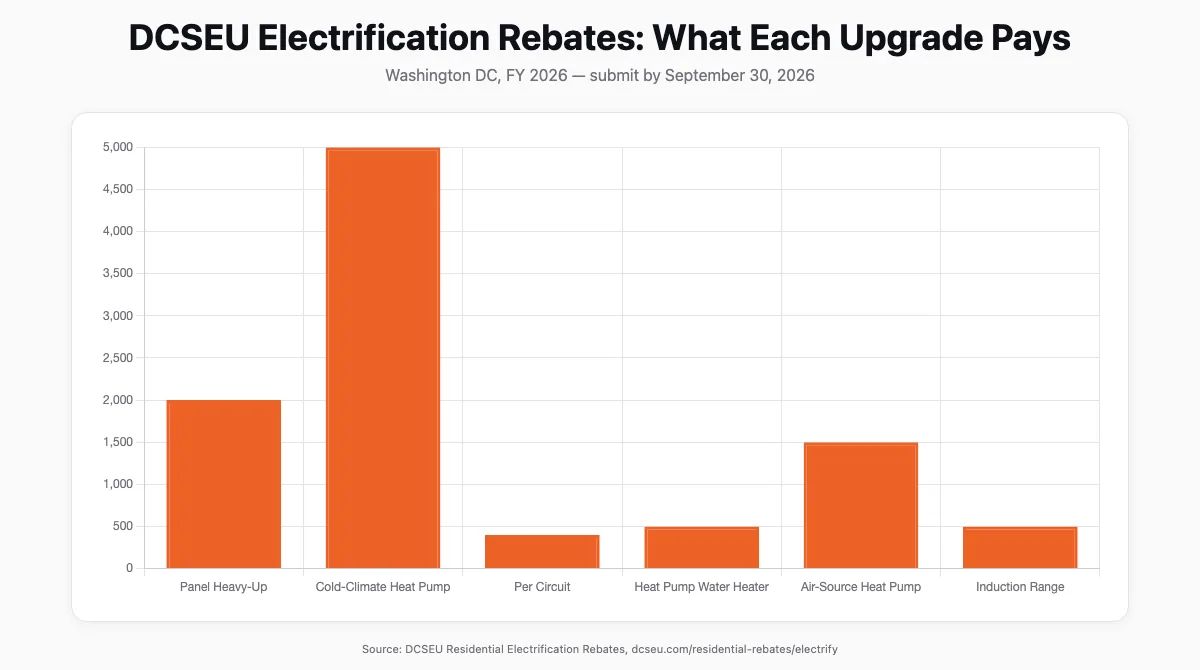
Here's what the current rebate schedule covers:
| Upgrade | DCSEU Rebate Amount |
|---|---|
| Electrical panel upgrade (heavy-up) | Up to $2,000 |
| New circuit installation | $400 per circuit |
| Heat pump (air-source) | $250–$1,500 |
| Heat pump water heater | Up to $500 |
| Cold-climate heat pump | Up to $5,000 |
| Induction range/cooktop | $200–$500 |
These rebates are stackable with each other. A homeowner doing a full gas-to-electric conversion — panel heavy-up, new circuits, cold-climate heat pump, and heat pump water heater — could realistically collect $7,000–$8,000 in DCSEU rebates before touching any other incentive. That's real money, and it's sitting there unclaimed by most DC homeowners who haven't heard of the program.
How Does the AHEP Differ From Standard DCSEU Rebates?
AHEP and the standard DCSEU electrification rebates share the same administrator but serve different populations. Standard DCSEU rebates are open to all DC homeowners and renters (with landlord approval), pay a fixed rebate per item, and require you to pay upfront and apply for reimbursement. AHEP, by contrast, is income-qualified (at or below 80% AMI), can cover 100% of project costs for households below 80% AMI, and is structured more like a direct-install program than a rebate — meaning you may not need to front any money. The tradeoff is the waitlist. On r/washingtondc, homeowners have reported waiting several months for AHEP intake appointments, which tracks with what we hear from clients. If you're income-qualified, get on the waitlist now. If you're not, the standard DCSEU rebates are your lane — and they close September 30, 2026.
When Will HEEHRA Rebates Be Available — and What Happened to the Name?
HEEHRA (High-Efficiency Electric Home Rebate Act) was the legislative name for what is now commonly called the HEAR program. The rebates are already available in DC — they just aren't branded as "HEEHRA" at the point of application. If you've been searching "when will HEEHRA rebates be available" and finding conflicting answers, the short version is: in DC, they're available now through AHEP for income-qualified households. The program launched in 2024 and is actively disbursing funds. The confusion stems from the fact that each state and jurisdiction implements HEAR funding differently — some states built standalone portals, DC routed the money through DCSEU's existing infrastructure. There is no separate "Home Energy Rebates portal" for DC residents to use. DCSEU is the portal.
Why Electrification Without Solar Often Backfires
Here's the part most rebate guides skip. When you replace a gas furnace with a heat pump, your home's electricity consumption increases — often by 3,000–5,000 kWh per year for a typical DC row house. Pepco's residential rate in 2026 sits around $0.14–$0.16 per kWh after delivery charges. That's $420–$800 in additional annual electricity cost, every year, before any rate increases. DC electricity prices have risen roughly 85% since 2020 — we covered the full picture in our post on high Pepco bills and what DC homeowners are doing about it.
Solar changes the math entirely. A 5 kW system on a DC rooftop produces roughly 5,750–6,000 kWh per year (using DC's production rate of 1,150–1,200 kWh per kW installed). That output covers the new load from a heat pump and heat pump water heater with room to spare. Instead of paying Pepco for the electricity your heat pump consumes, you're generating it. The electrification rebates reduce your upfront equipment cost. Solar eliminates the ongoing operating cost. Neither one is as powerful without the other.
For a full breakdown of what solar incentives are still on the table in DC — including SRECs, net metering, and the Solar Advantage Plus Program — see our DC solar incentives 2026 guide.
How to Stack Electrification Rebates With Solar in DC
Stacking works because the programs don't conflict. Here's the sequence that maximizes value for a DC homeowner doing a full electrification + solar project:
- Get a Green Zone assessment first. Confirm your roof's solar production potential before sizing anything. A shaded roof changes the calculus on system size and payback.
- Apply for AHEP if income-qualified. Get on the waitlist immediately — processing takes time, and the waitlist is real.
- Collect DCSEU electrification rebates for equipment. Panel heavy-up, circuits, heat pump, heat pump water heater. Submit by September 30, 2026.
- Install solar. Size the system to cover your new electrified load, not just your historical usage. Your installer should model post-electrification consumption.
- Register for DC SRECs through GATS. Every megawatt-hour your solar system produces generates a Solar Renewable Energy Certificate worth approximately $360–$400 in DC's 2026 market. Our DC SREC guide walks through registration and trading.
- Enroll in Pepco net metering. Excess solar production credits your bill at the retail rate.
A homeowner who runs this sequence — DCSEU rebates, solar, SRECs, net metering — can realistically offset the full cost of electrification over 7–10 years, with ongoing SREC income after that.
Does Renting or Having a North-Facing Roof Rule You Out?
No on both counts, though the path is different. Renters can access DCSEU electrification rebates for appliances like heat pump water heaters and induction ranges with landlord approval — the rebate goes to whoever pays for the equipment. Solar for renters is more limited, but DC's Solar for All program (also administered by DCSEU) provides community solar subscriptions to income-qualified renters, delivering bill credits without rooftop installation.
For homeowners with north-facing roofs or significant shading: a north-facing roof in DC still produces roughly 70–80% of what a south-facing roof produces, depending on pitch and obstructions. That's often enough to make solar worthwhile, especially when you're offsetting the higher electricity load from a heat pump. We assess this directly in the Green Zone evaluation — it's not a sales call, it's a production estimate based on your actual roof geometry.
Frequently Asked Questions
What is the HEAR rebate program?
The HEAR program (Home Electrification and Appliance Rebates) is a federal rebate initiative funded by the Inflation Reduction Act with $4.5 billion allocated nationally. It provides direct rebates — not tax credits — for switching to efficient electric appliances including heat pumps, heat pump water heaters, and induction ranges. In Washington DC, HEAR funding is administered through the DCSEU's Affordable Home Electrification Program (AHEP), which is income-qualified and currently accepting waitlist applications.
When will HEEHRA rebates be available?
In DC, HEEHRA rebates are already available — they launched in 2024 under the AHEP program name. HEEHRA was the legislative name for the program; HEAR is the common name; AHEP is what DC calls it at the point of application. If you're income-qualified (at or below 80% AMI), you can join the AHEP waitlist now at dcseu.com/ahep-sfa-apply. Standard DCSEU electrification rebates — open to all income levels — are also active through September 30, 2026.
How do I apply for the HEAR program in DC?
DC does not have a standalone HEAR application portal. Applications go through the DCSEU. Income-qualified households apply for AHEP at dcseu.com/ahep-sfa-apply. All other homeowners apply for standard electrification rebates at rebates.dcseu.com. Both require installation by a licensed contractor and a DC Department of Buildings permit.
Can I get electrification rebates and solar incentives at the same time?
Yes. DCSEU electrification rebates and DC solar incentives — including SRECs and net metering — are separate programs and do not conflict. You can collect rebates for a heat pump and panel upgrade, then install solar and register for SREC trading through GATS. The programs are designed to be used together, and stacking them produces the strongest financial outcome.
Do electrification rebates apply to renters in DC?
Some do. DCSEU rebates for appliances like heat pump water heaters and induction ranges are available to renters with landlord approval. Whole-home electrification programs like AHEP are generally structured for homeowners. DC's Solar for All program provides community solar bill credits to income-qualified renters who can't install rooftop solar.
Is the 25C federal tax credit still available for heat pumps in 2026?
The 25C Energy Efficient Home Improvement Credit — which covers heat pumps, heat pump water heaters, and insulation — is a separate credit from the 25D residential solar credit. The 25D solar credit ended January 1, 2026. The 25C credit for envelope improvements and efficient HVAC equipment has its own legislative status; consult a tax professional for your specific situation, as congressional activity in 2025–2026 has created uncertainty around its continuation.
What to Do Next
The DCSEU electrification rebates close September 30, 2026. AHEP is waitlisted but worth joining now. And the solar incentives that make electrification financially durable — SRECs, net metering, the Solar Advantage Plus Program — are all still active.
The first step is knowing what your roof can actually produce. A Green Zone assessment gives you a production estimate, a system size recommendation, and a clear picture of how solar fits alongside the electrification work you're already planning. No pressure, no commitment — just the numbers you need to make a real decision.


