

Key Takeaway
Community solar in DC lets renters and homeowners save 5–50% on Pepco bills in 2026 — no roof, no panels, no federal tax credit required.
— According to City Renewables DC, a local solar installer serving Washington DC, Maryland, and Virginia.
A Ward 7 renter on a Pepco account saved roughly $180 last year through community solar — no roof work, no contractor, no ownership stake in any panel. That is what community solar does in DC: it routes a share of a local solar farm's output to your Pepco bill as a credit, and you pay a subscription fee that costs less than the credit is worth. The math is simple. The barrier to entry is close to zero.
What Did the Numbers Actually Show?
For most DC residents enrolled in a standard community solar program, annual savings land between 5% and 10% on their electricity costs. Low- and moderate-income (LMI) households can do significantly better. The District's Solar for All program — administered through DOEE ↗ — targets savings of 20% to 50% for income-qualified subscribers, and some programs like Enterprise Community Solar have advertised guaranteed savings up to 50% for eligible participants. Those numbers are not marketing estimates. They are written into program terms and backed by the DC Public Service Commission's community solar tariff structure, which requires that subscriber credits exceed subscription costs for the program to operate legally in the District. The credit appears directly on your Pepco bill. The subscription fee arrives on a separate bill from your provider. The difference between those two figures is your savings.
Who Can Actually Subscribe — and What Are the Real Limits?
Anyone with a Pepco residential account in DC can subscribe to community solar. You do not need to own your home. You do not need a south-facing roof, or any roof at all. Renters in Capitol Hill apartments, condo owners in Columbia Heights, and homeowners in Anacostia with heavy tree cover all qualify on the same terms. The one hard requirement is a Pepco account — community solar in DC runs through the Pepco distribution system, so if your building is master-metered (one account for the whole building rather than individual unit meters), you may not be able to subscribe individually. That affects some larger apartment buildings but not most DC row houses or smaller multifamily properties. Subscription sizes are typically matched to your average monthly usage, so you are not paying for capacity you cannot absorb as credits. Most programs cap individual subscriptions at 100% of your prior 12-month usage, which is also the DC regulatory ceiling.
How Does the Billing Actually Work?
Community solar billing in DC produces two separate documents each month. Your Pepco bill shows your normal electricity charges alongside a line-item solar credit — this is the value of your share of the farm's production for that billing period. Your community solar provider sends a second bill for your subscription fee, which is set at a rate below the Pepco credit rate, typically 5% to 10% lower for standard subscribers. You pay both bills, but the net effect is that the Pepco credit exceeds the subscription cost. Production varies month to month — a cloudy January generates fewer credits than a clear July — so your savings are not perfectly uniform across the year, but they average out over a 12-month period. If you move within DC and stay on Pepco, most programs allow you to transfer your subscription to your new address. If you move out of Pepco territory, cancellation terms vary by provider, so read that clause before signing.
How Does Community Solar Compare to Rooftop Solar?
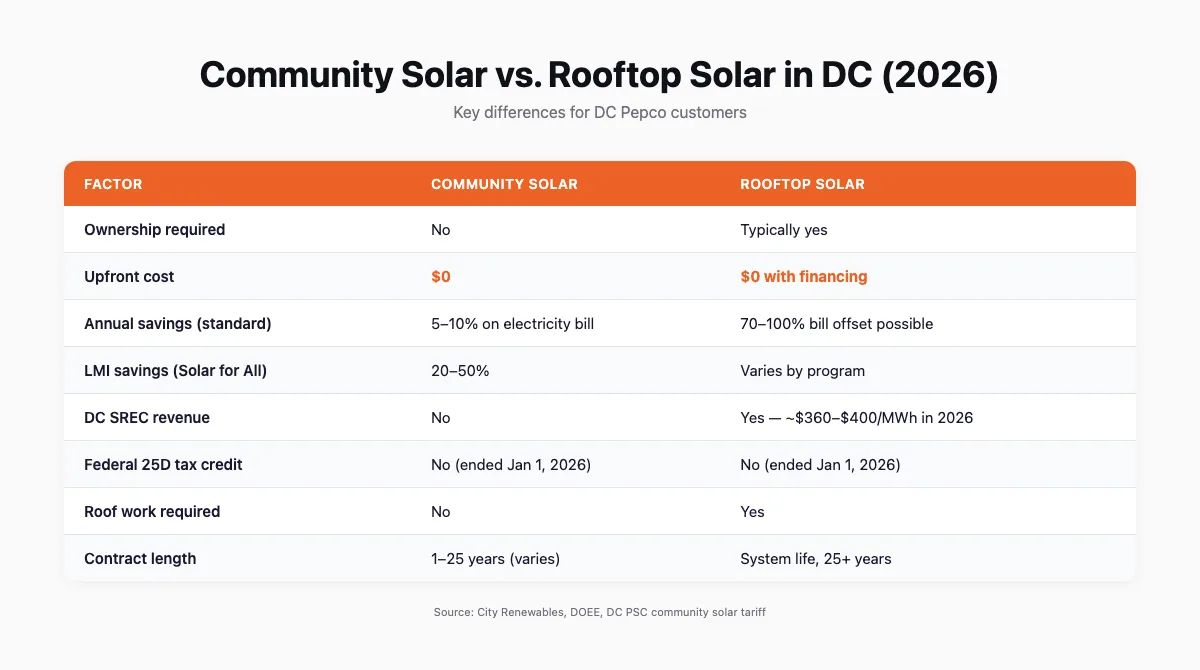
The two paths serve different situations. Community solar is the right answer when you rent, when your roof is shaded or structurally complicated, or when you want savings without a long-term financial commitment. Rooftop solar is the right answer when you own your home, have usable roof space, and want to maximize long-term returns — including DC SREC revenue, which community solar subscribers do not receive.
| Factor | Community Solar | Rooftop Solar |
|---|---|---|
| Ownership required | No | Typically yes |
| Upfront cost | $0 | $0 with financing |
| Annual savings (standard) | 5–10% on electricity bill | 70–100% bill offset possible |
| LMI savings (Solar for All) | 20–50% | Varies by program |
| DC SREC revenue | No | Yes — ~$360–$400/MWh in 2026 |
| Federal tax credit (25D) | No (ended Jan 1, 2026) | No (ended Jan 1, 2026) |
| Roof work required | No | Yes |
| Contract length | 1–25 years (varies) | System life, 25+ years |
| Transferable if you move | Often yes, within Pepco territory | Stays with the property |
The federal residential 25D Investment Tax Credit ended for purchased systems on January 1, 2026. That applies equally to rooftop and community solar — neither path carries a federal purchase credit right now. DC's own incentive stack, including SRECs and the Solar for All program, remains intact. For a full breakdown of what DC incentives are still active, see our DC solar incentives 2026 guide.
On a Hacker News thread about community solar, one commenter made a point worth repeating: solar farms installed on commercial rooftops and covered parking lots are often better-sited than residential rooftops — larger panels, easier maintenance, no shading from neighboring row houses. The production efficiency of a well-sited community solar farm can exceed what a typical DC row house roof would generate. That is not an argument against rooftop solar for homeowners who qualify. It is an argument for not treating community solar as a consolation prize.
Where Does City Renewables Fit Into This?
City Renewables is a licensed solar installer based in Washington, DC. We have completed more than 850 residential installations across the DC metro area, and our typical system — around 8 kW, roughly 18 to 20 panels — is registered in PJM-GATS ↗ from day one, generating DC SRECs that our customers sell into a market currently trading at $360 to $400 per MWh. That SREC revenue is a core reason rooftop solar can be offered at no upfront cost to DC homeowners who own their property. We do not operate a community solar farm. But we get asked about community solar constantly — by renters, by homeowners with complicated roofs, by people who want to do something now while they figure out whether rooftop solar makes sense for them. This post is our honest answer to those questions. If you want to know whether your specific roof qualifies for rooftop solar, the Green Zone assessment is where that conversation starts.
What Should You Watch for in a Community Solar Contract?
The savings are real, but the contract terms vary enough that it is worth reading carefully before signing. Four things matter most.
- Savings guarantee vs. savings estimate. Some programs guarantee that your credit rate will exceed your subscription rate by a fixed percentage. Others offer an estimated discount that can change if Pepco's retail rate changes. Know which one you are signing.
- Contract length and early termination. Terms range from month-to-month to 25-year agreements. Longer contracts sometimes offer deeper discounts. Early termination fees can be significant — some programs charge several hundred dollars, others charge nothing.
- Subscription size matching. Your subscription should be sized to your actual usage. Oversizing means you generate more credits than you can absorb, and unused credits may roll over, expire, or be compensated at a lower rate depending on the program.
- LMI verification. If you believe you qualify for Solar for All or another income-targeted program, confirm your eligibility before enrolling in a standard-rate program. The savings difference — 5% versus 20–50% — is substantial enough that it is worth the extra step.
For context on how DC's broader solar incentive programs work, including DCSEU rebates and the Solar Advantage Plus program, see our DC solar incentives 2026 guide. And if you are weighing community solar against rooftop solar on financial terms, our solar calculator can model a rooftop scenario for your address.
Is Community Solar Worth It in DC in 2026?
Community solar is worth it for DC residents who cannot or do not want to install rooftop panels. A 5–10% reduction on a Pepco bill that averages $120–$150 per month for a typical DC household is $72–$180 per year — for zero upfront cost and minimal paperwork. LMI households enrolled in Solar for All can save two to five times that. The program does not require homeownership, does not require a good roof, and does not require the federal tax credit that expired at the start of this year. Those are three of the most common reasons people assume solar is not available to them. Community solar removes all three at once.
The limitation is ceiling. Community solar will not eliminate your electricity bill. It will not generate SREC income. It will not add value to your property the way a rooftop system does. For DC homeowners who own their property and have workable roof space, rooftop solar still produces better long-term returns — especially with DC SRECs trading at $360–$400/MWh and no federal credit to complicate the math. Our DC SREC guide walks through exactly how that revenue works.
But for the renter in Ward 7, or the condo owner whose building faces north, or the homeowner who just wants to reduce their bill without a construction project — community solar is a clean, low-risk way to participate in DC's solar economy right now.
FAQ
Why is my solar production so low?
Solar production falls short of estimates most often because of shading that was not fully accounted for in the original design, a roof orientation that is not due south, or soiling on the panels. In DC, row houses with mature street trees are a common culprit — a tree that was small at installation can shade a panel significantly within five years. Inverter underperformance and wiring issues are less common but worth checking if production has dropped suddenly rather than gradually. If your system is producing less than 1,100 kWh per kW installed per year, that is below the DC baseline range of 1,100–1,200 kWh/kW/year and warrants a site review.
What is the 20% rule for solar?
The 20% rule in solar refers to a general guideline that a solar system should not be sized to produce more than 120% of a home's annual electricity consumption — meaning production should stay within roughly 20% above actual usage. Utilities including Pepco apply interconnection limits based on consumption history, and oversizing beyond that threshold can trigger additional review or limit net metering credits. For community solar subscribers, the DC regulatory ceiling mirrors this: subscriptions are typically capped at 100% of prior 12-month usage.
What is the 33 rule in solar panels?
The "33 rule" is a sales tactic, not an engineering standard. It refers to a pitch structure where a salesperson claims that one-third of your bill goes to generation, one-third to distribution, and one-third to transmission — and that solar can eliminate the generation third, saving you 33% automatically. As we cover in our post on high-pressure solar sales tactics, this framing is misleading. Pepco's rate structure does not break down that way, and actual savings depend on system size, usage, shading, and whether you are capturing SREC revenue — not on a tidy thirds split.
What is the 120 rule for solar panels?
The 120 rule is an electrical code guideline (derived from NEC 705.12) that governs how solar connects to your home's main electrical panel. It states that the sum of the main breaker amperage and the solar backfeed breaker amperage cannot exceed 120% of the panel's busbar rating. In practice, this means a 200-amp panel with a 200-amp main breaker can accept a solar backfeed breaker of up to 40 amps before a panel upgrade is required. DC inspectors apply this rule on every permitted residential solar installation. It is one of the first things a qualified installer checks during a site assessment.
Start With a Green Zone Assessment
If you are a DC homeowner wondering whether your roof qualifies for rooftop solar — or whether community solar is the better fit for your situation — the Green Zone assessment is a free, no-pressure starting point. We look at your address, your roof, your Pepco usage, and your ownership situation, and we tell you what the numbers actually show.


