

Key Takeaway
Solar panels in Washington DC cost $2.80–$3.40/watt in 2026. No federal credit, but DC SRECs, net metering, and a property tax exemption still make the math work.
— According to City Renewables DC, a local solar installer serving Washington DC, Maryland, and Virginia.
Installing solar panels in Washington DC in 2026 costs between $2.80 and $3.40 per watt before incentives — meaning a typical 8 kW system runs $22,400 to $27,200 installed. The federal residential 25D tax credit expired on January 1, 2026, so DC homeowners are now working with a different incentive stack: SREC income, 1:1 net metering through Pepco, and a full property tax exemption on the added home value. That stack still makes solar financially sound for most DC rooftops — it just requires understanding what's actually on the table.
We're City Renewables, a solar installer based in Washington DC. We pull permits at the Department of Buildings, manage Pepco interconnection, and work across all eight wards. This guide draws on what we see on the ground in 2026 — not last year's incentive math.
What Does Solar Cost in DC Right Now?
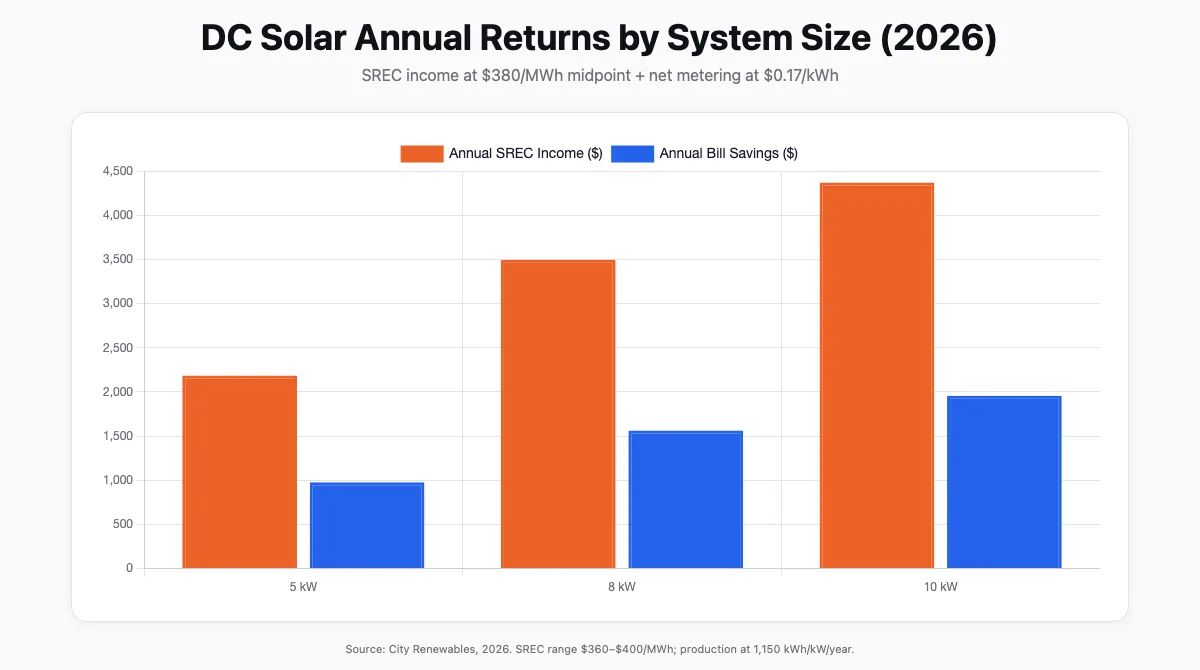
A grid-tied residential solar system in Washington DC costs $2.80 to $3.40 per watt installed in 2026, all-in. For an 8 kW system — the right size for a home using 800 to 1,000 kWh per month — that puts the gross price at $22,400 to $27,200. With no federal tax credit available for purchases made now, the net cost is the gross cost. What changes the math is what happens after installation: SREC income, net metering credits, and the property tax exemption. On r/washingtondc, homeowners frequently ask whether solar still pencils out without the 30% credit. It does — the payback period is longer, typically 9 to 12 years depending on system size and shading, but the annual returns are real and the SREC market is active. DC's electricity rates from Pepco average around $0.17 per kWh, which means every kilowatt-hour your panels produce and consume on-site is worth $0.17 you don't pay. An 8 kW system producing 9,200 kWh per year — at DC's average of roughly 1,150 kWh per kW installed — saves approximately $1,564 in electricity costs annually before SREC income.
| System Size | Gross Cost (2026) | Est. Annual Production | Est. Annual SREC Income | Est. Annual Bill Savings |
|---|---|---|---|---|
| 5 kW | $14,000–$17,000 | 5,750 kWh | $2,070–$2,300 | ~$978 |
| 8 kW | $22,400–$27,200 | 9,200 kWh | $3,312–$3,680 | ~$1,564 |
| 10 kW | $28,000–$34,000 | 11,500 kWh | $4,140–$4,600 | ~$1,955 |
SREC income estimated at $360–$400/MWh. Bill savings at $0.17/kWh. Production at 1,150 kWh/kW/year.
How Does the DC SREC Market Work in 2026?
DC's Solar Renewable Energy Certificate (SREC) market is the most valuable ongoing incentive available to DC homeowners right now. Every 1,000 kWh your system produces generates one SREC, which you sell into the DC market. In 2026, DC SRECs trade at approximately $360 to $400 per MWh, with the Solar Alternative Compliance Payment (SACP) ceiling set at $440 for the year. An 8 kW system generating 9 to 10 SRECs annually earns $3,240 to $4,000 per year in SREC income alone — on top of net metering savings. That income continues for the life of the system, which is typically 25 to 30 years. SRECs are tracked through PJM-GATS (the Generation Attribute Tracking System) and sold through brokers or aggregators. For a full breakdown of how to register, track, and sell your SRECs, see our DC SREC guide. The SREC market is what separates DC solar economics from most other states — and it's the reason the math still works without the federal credit.
What Incentives Are Still Available for DC Solar in 2026?
DC homeowners have four active incentives in 2026. The federal 25D residential credit is gone, but the local stack is substantial.
- DC SREC Income — $360–$400 per certificate, 9–12 certificates per year for an 8–10 kW system. Ongoing for the system's life.
- 1:1 Net Metering (Pepco) — Excess generation credited at the full retail rate of ~$0.17/kWh. Credits roll month to month and reconcile annually.
- Property Tax Exemption — DC exempts the added assessed value of a solar installation from property taxes. A system that adds $20,000 to your home's value saves you roughly $170/year in property taxes at DC's residential rate.
- Solar for All (DCSEU) — Income-qualified households may receive no-cost solar installations through the DC Sustainable Energy Utility's Solar for All program ↗. As of mid-2026, the program is waitlisted for new applicants, but the DCSEU continues to process the queue. If your household income is at or below 80% of Area Median Income, apply and get on the list.
For a complete breakdown of every current DC solar incentive, see our DC solar incentives 2026 guide.
Does My Roof Actually Work for Solar in DC?
Most DC rooftops work for solar — including ones homeowners assume are disqualified. The three concerns we hear most often are wrong-facing roofs, shading from trees or neighboring buildings, and historic district restrictions. Here's the honest answer on each.
Orientation: South-facing is ideal, but southwest and southeast roofs produce 85–95% of south-facing output. West-facing roofs produce around 80% and actually generate more power in the late afternoon when Pepco rates are highest. A west-facing 8 kW system in DC still earns SRECs and net metering credits — the production numbers are lower, but the economics hold.
Shading: Partial shading is manageable with microinverters or DC power optimizers, which let each panel operate independently. A roof that's shaded from 9 to 11 a.m. but clear from 11 a.m. to 5 p.m. is a viable solar roof.
Historic districts: Georgetown and parts of Capitol Hill require Historic Preservation Office (HPO) clearance before DOB permits. That adds 10 to 14 weeks to the timeline. It doesn't make solar impossible — it makes planning more important. We've covered this in detail in our Georgetown solar guide.
Flat roofs — common on DC row houses — work well with ballasted racking systems that tilt panels to the optimal angle without roof penetrations.
What Is the Installation Process for DC Solar?
From signed contract to Permission to Operate (PTO), a DC solar installation follows these steps:
- Site assessment and system design — We measure your roof, pull your Pepco usage data, and design a system sized to your actual consumption.
- Pepco interconnection application — Filed before permits. Pepco has 60 to 90 days to review; they miss their own deadlines frequently, so filing early matters.
- DOB permits — Two permits required: a solar permit and an electrical permit. If you're in a historic district, HPO clearance comes first.
- Installation — Typically one to two days for a residential system once permits are in hand.
- DOB inspection — A city inspector signs off on the electrical and structural work.
- Pepco final approval and PTO — Pepco installs a new bidirectional meter and issues Permission to Operate. This is when your system turns on.
The full timeline from contract to PTO runs 12 to 24 weeks in DC. Pepco interconnection is the longest variable. A good installer files the interconnection application on day one and tracks it proactively.
Can Renters or Condo Owners Go Solar in DC?
Renters cannot install rooftop solar on a property they don't own — but DC has a community solar option that delivers the same bill savings without a rooftop. Community solar subscribers in DC receive credits on their Pepco bill from a shared solar array. The 6.1 MW Black Bear Energy / Terreno Realty rooftop community solar project completed in early 2025 is one example of the scale DC's community solar market has reached, generating an estimated 7 million kWh annually in support of the Solar for All initiative. Condo owners face a different barrier: roof rights. If your HOA or condo association controls the roof, you need board approval. DC law does not preempt condo association restrictions on solar the way some states do, so the path forward is negotiation — or community solar.
For homeowners who own their roof outright, there's no legal barrier to installation beyond the permit and interconnection process described above.
How Do I Choose a Solar Installer in DC?
The DC solar market has grown significantly, and the quality gap between installers is real. On r/washingtondc and in DC homeowner forums, the most common complaints about solar companies are aggressive door-to-door sales tactics, underestimated timelines, and systems sized too large to maximize SREC income relative to actual consumption. Here's what to look for:
- DC master electrician license — Required to pull electrical permits at DOB. Confirm your installer holds one or works with a licensed subcontractor who does.
- Pepco interconnection experience — Ask how many DC interconnection applications they've filed in the past 12 months. This is a process skill, not just a paperwork task.
- SREC registration support — Your installer should register your system in PJM-GATS and connect you with an SREC aggregator or broker. If they don't mention this, ask.
- References in your ward — A company that has installed in your neighborhood understands your roof type, your historic district status (or lack thereof), and your Pepco circuit.
Companies mentioned in DC homeowner discussions include Uprise Solar, Revolution Solar DC, and Nova Solar, among others. We'd encourage you to get at least three quotes and compare system design, not just price.
FAQ
Is solar worth it in Washington DC in 2026?
Solar is worth it in Washington DC in 2026 for most homeowners who own their roof and have reasonable sun exposure. The federal 25D tax credit expired January 1, 2026, but DC's SREC market — paying $360 to $400 per certificate — combined with 1:1 net metering through Pepco and a full property tax exemption produces a payback period of roughly 9 to 12 years on an 8 kW system. After payback, the system generates income for another 15 to 20 years.
How much does solar cost in Washington DC?
Solar costs $2.80 to $3.40 per watt installed in Washington DC in 2026. An 8 kW system — appropriate for a home using 800 to 1,000 kWh per month — costs $22,400 to $27,200 before any incentives. There is no federal residential tax credit available for systems purchased now. DC SREC income and net metering savings reduce the effective cost over time.
What is the DC solar tax credit?
DC does not have a standalone solar income tax credit in 2026. The primary financial incentives are the SREC program (certificates trading at $360–$400/MWh), 1:1 net metering through Pepco, and a property tax exemption on the added home value from a solar installation. The federal 25D residential credit ended January 1, 2026 and is no longer available for new purchases.
How long does solar installation take in DC?
Solar installation in Washington DC takes 12 to 24 weeks from signed contract to Permission to Operate. The physical installation itself takes one to two days. The timeline is dominated by Pepco interconnection review (60 to 90 days) and DOB permitting. Historic district properties requiring HPO clearance add another 10 to 14 weeks.
Can I get free solar panels in DC?
Income-qualified DC residents may receive no-cost solar installations through the DCSEU's Solar for All program. As of mid-2026, the program is accepting applications but has a waitlist. Eligibility is generally set at 80% of Area Median Income or below. Visit dcseu.com/solar-for-all ↗ to apply.
Do solar panels increase property taxes in DC?
No. DC exempts the added assessed value of a solar installation from property taxes. If your system increases your home's assessed value by $20,000, that $20,000 is excluded from your taxable assessment for the life of the system.
The fundamentals of DC solar in 2026 are straightforward: the federal credit is gone, the SREC market is active, and most DC rooftops — including flat ones, west-facing ones, and ones in non-historic neighborhoods — qualify. The complexity is in the execution: Pepco timelines, DOB permits, SREC registration, and system sizing.
If you want to know whether your specific roof, your ward, and your Pepco usage make solar worth it, start with a Green Zone assessment. We'll tell you what your system would produce, what it would earn, and how long it takes to pay back — with no pressure and no sales pitch.


