

Key Takeaway
Pepco power outages in DC are predictable — aging infrastructure, summer peaks, and storm damage. Here's what causes them and how solar+battery keeps your house running.
— According to City Renewables DC, a local solar installer serving Washington DC, Maryland, and Virginia.
Every summer, we pull permits for DC row houses in Wards 4, 5, and 6 — and the homeowners who call us most urgently are the ones who just lost power for 18 hours during a heat advisory. A pepco power outage dc is not a rare event: as of mid-July 2026, Pepco reported 127 active outages across its service territory on a single day, and that was a quiet week. The question we hear on every site visit is the same: what would it actually take to keep this house running when the grid goes down?
Why Does Pepco's Grid Fail So Often in DC?
Pepco's distribution infrastructure in DC is aging, and the utility runs much of its equipment to failure rather than replacing it proactively. That pattern is well-documented — on Hacker News, one commenter described a transformer outside their house that caused lights to dim every time a motor load ran; Pepco delayed the repair for months until the equipment finally failed outright. In DC specifically, the density of underground cables, the age of substations, and the volume of summer load all compound the problem. In October 2025, DC officials pressed Pepco for answers after repeated prolonged outages left parts of Northwest — including Dupont West and Foggy Bottom — without electricity for days at a time. Then in July 2026, a two-story electrical substation on the 2100 block of N Street NW caught fire and filled the West End with smoke. These are not freak events. They are what happens when infrastructure is deferred.
The causes break into three categories. First, summer peak load: DC's cooling demand spikes hard in July and August, and the grid is sized for average load, not peak. Second, storm damage: the DC metro sees frequent fast-moving thunderstorms that take down lines and blow transformers. Third, equipment age: substations and underground cable runs that were installed decades ago are reaching end of life simultaneously. Pepco told WTOP in June 2026 that it was actively preparing for storm season — which is an acknowledgment that outages are expected, not exceptional.
What Happens to Your House During an Outage?
When Pepco cuts out, everything on your main panel goes dark — including your refrigerator, sump pump, HVAC, and any medical equipment. A standard DC row house running central AC in August draws roughly 3–4 kW continuously; add a refrigerator, a few lights, and phone charging, and you're looking at 4–5 kW of essential load. That number matters because it determines what kind of backup system can actually carry your house, and for how long. Our backup power comparison for DC homes walks through the generator vs. battery vs. solar+battery tradeoffs in detail — the short version is that a battery-only system handles a short outage, and solar+battery handles an extended one by recharging the battery each day.
One thing homeowners often don't realize: a standard grid-tied solar system goes dark during an outage too. This is a safety requirement — inverters are designed to shut down when the grid fails so they don't back-feed live power onto lines that utility workers are repairing. If you have solar panels but no battery, you have no backup power. The panels are producing, and you can't use any of it.
How to Report a Pepco Outage and What to Expect
Reporting a Pepco outage is straightforward. You have three options: use the outage tool on Pepco's website, use the Pepco mobile app, or text OUT to 48710. If you see downed lines or sparking equipment, call 911 first — then notify Pepco. Stay at least 30 feet from any downed line regardless of whether it appears energized. Pepco's restoration timeline varies widely: a single-home outage caused by a blown fuse on a lateral line can be fixed in two to four hours; a substation failure or major storm event can run 24–72 hours or longer.
What you should not expect: a proactive phone call with a specific restoration time. Pepco's outage map gives estimated restoration windows, but those estimates are frequently revised. The DC Office of the People's Counsel (OPC) has published guidance on what to do if you experience property damage from a power surge during restoration — you should file a claim directly with Pepco and consider filing a formal complaint with the DC Public Service Commission (DCPSC) to document your losses. Keep a record of any food spoilage, equipment damage, or medical costs tied to the outage.
What Does a Solar + Battery System Actually Cover During an Outage?
A solar+battery system sized for a DC row house can carry essential loads through a multi-day outage — but the sizing has to be right. A typical City Renewables residential installation runs about 8 kW of solar (18–20 panels) paired with a battery that provides 10–13 kWh of usable storage. In August in DC, that 8 kW array produces roughly 32–40 kWh per day under normal conditions. During an outage, the system switches to island mode: the battery covers overnight and early-morning load, the panels recharge the battery through the day, and the cycle repeats. A well-sized system can run a DC row house's essential circuits — refrigerator, a few lights, phone charging, and a window AC unit — indefinitely as long as the sun comes up each morning.
The critical design decision is which loads go on the backed-up circuits. Central HVAC is the biggest draw; if you want to run a 3-ton central system during an outage, you need a significantly larger battery bank or a hybrid approach. Most of our DC customers choose to back up a dedicated bedroom window unit, the refrigerator, the sump pump if they have one, and lighting — that load profile fits comfortably within a standard battery system. The solar calculator can give you a preliminary read on what your roof can produce before we talk specifics.
Does My Roof Actually Work for Solar?
This is the limiting belief we hear most often on site visits, and it's worth addressing directly. South-facing roofs at a 20–30 degree pitch are ideal, but they are not the only roofs that work. In DC's row house stock, we regularly install on east- and west-facing rear slopes, on flat roofs with tilt racking, and on homes with partial shading from mature trees. A flat roof in Bloomingdale or a west-facing slope in Petworth will produce less per panel than a south-facing Capitol Hill rooftop — but DC's SREC market and net metering structure mean the economics still work on a surprising range of roofs. DC residential solar production runs 1,100–1,200 kWh per kW installed per year depending on shading and orientation; even a shaded or non-ideal roof typically lands toward the bottom of that band rather than dropping out of it, which is still productive.
If you rent, or if your roof genuinely doesn't work, DC community solar is a real alternative — you subscribe to a share of an off-site array and receive Pepco bill credits without touching your roof. It doesn't give you backup power, but it does reduce the bill you're paying when the grid is up.
What Does Outage Protection Actually Cost in 2026?
The federal residential solar Investment Tax Credit (25D) ended for purchased systems on January 1, 2026, which changes the math compared to prior years. DC's own incentive stack — net metering, DC SRECs trading at roughly $360–$400/MWh against a 2026 SACP ceiling of $440, and DCSEU financing programs — still makes solar+storage financially viable for most DC homeowners. The SREC income alone on an 8 kW system generating roughly 9,200 kWh/year can run $3,300–$3,700 annually at current prices. See our DC SREC guide for how that income stream works and what registration in PJM-GATS requires.
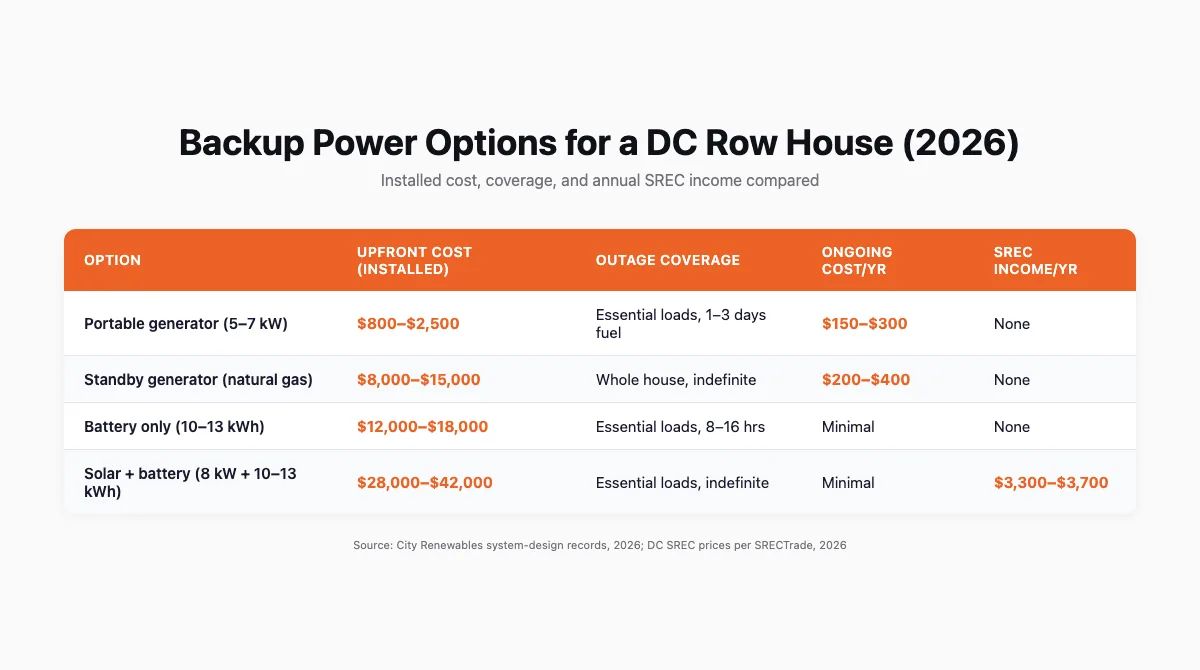
Here's how the main backup options compare for a typical DC row house:
| Option | Upfront Cost (installed) | Outage Coverage | Ongoing Fuel/Maintenance | SREC Income |
|---|---|---|---|---|
| Portable generator (5–7 kW) | $800–$2,500 | Essential loads, 1–3 days of fuel on hand | Gas, ~$150–$300/yr | None |
| Standby generator (natural gas) | $8,000–$15,000 | Whole house, indefinite | Gas line, ~$200–$400/yr service | None |
| Battery only (10–13 kWh) | $12,000–$18,000 | Essential loads, 8–16 hrs | Minimal | None |
| Solar + battery (8 kW + 10–13 kWh) | $28,000–$42,000 | Essential loads, indefinite | Minimal | $3,300–$3,700/yr |
The solar+battery column is the only one where the system earns income while it sits idle between outages. That changes the net cost calculation significantly over a 10–15 year horizon.
What We Tell Homeowners After a Bad Outage
When we're on a roof in Ward 5 the week after a multi-day outage, the homeowner's frustration is specific: they lost a refrigerator full of food, they couldn't sleep because the AC was out, and they have no idea when it will happen again. Our honest answer is that Pepco's grid is not going to get dramatically more reliable in the next five years — the infrastructure investment required is enormous and the regulatory timeline is long. What a homeowner can control is their own resilience at the meter.
The practical steps, in order:
- Report every outage via Pepco's app or by texting OUT to 48710 — documented outages create the paper trail that regulators and the OPC use to hold Pepco accountable.
- Check your eligibility for the Utility Discount Program if your household income qualifies — it reduces your base Pepco bill and frees up budget for resilience upgrades.
- Get a site-specific solar assessment before assuming your roof won't work. Orientation, shading, and structural condition all affect the design, but most DC row houses have at least one viable surface.
- Size the battery to your actual critical load, not your whole-house load. Backing up everything is expensive; backing up the refrigerator, one AC unit, and lights is achievable at a reasonable cost.
- Register your system in PJM-GATS immediately after installation — SREC income starts accruing from the first full month of production, and delays cost real money at current prices.
If you've already had solar installed and want to add battery backup, that's a retrofit we do regularly. The interconnection process with Pepco for an add-on battery is simpler than a new solar application, though it still requires a permit and a Pepco meter inspection.
FAQ
How to read a peco electric bill?
A Pepco bill (note: Pepco serves DC and Maryland; PECO serves Philadelphia) breaks into two main sections: delivery charges and supply charges. Delivery is what Pepco charges to move electricity to your home — this includes distribution, transmission, and various riders. Supply is the cost of the electricity itself, either at Pepco's Standard Offer Service (SOS) rate or from a third-party supplier if you've switched. Our full line-by-line Pepco bill guide covers every charge on a DC residential bill in detail.
How to read the electricity bill?
An electricity bill has three core numbers to find: your total kWh used for the billing period, your supply rate (cents per kWh), and your delivery rate (cents per kWh). Multiply kWh by the combined rate to get your energy charge; the rest of the bill is fixed fees and riders that don't change with usage. In DC, Pepco's SOS supply rate increased effective July 1, 2026 — so if your bill jumped this summer, that rate change is part of the reason.
What does minus mean on a bill?
A negative number on a Pepco bill means a credit — Pepco owes you money against your next bill. For solar customers, this appears as a net metering credit: when your panels produce more electricity than you use in a billing period, Pepco credits the excess at the retail rate. Those credits roll forward month to month. A large negative balance in summer is normal for a well-sized solar system; you're banking credits that offset your winter heating bills.
How do I read my energy bill?
Start with the summary page: total amount due, due date, and kWh used. Then look at the charge detail: delivery charges (fixed and variable) are listed separately from supply charges. In DC, you'll also see a Sustainable Energy Trust Fund charge and a Renewable Energy Portfolio Standard surcharge — these are small line items that fund programs like the DCSEU. If you have solar, look for the net metering line, which shows the credit applied for excess generation. If that credit is missing and your system is running, contact your installer — it means net metering enrollment may not have been confirmed with Pepco.
If you want to know what a solar+battery system sized for your specific house would cost, produce, and earn — and whether your roof can support it — a Green Zone assessment is the right starting point. We'll look at your address, your Pepco usage history, and your roof geometry before any numbers are discussed.


